Films · Developmental Neuroscience
Measured Against Fetal Cortex
Read the transcript of “Measured Against Fetal Cortex”
Film transcript: Measured Against Fetal Cortex
An organoid has no blood. Every bit of oxygen must diffuse in from its surface. What happens at the center? The cells use oxygen as it moves inward. So it runs out a short way in. Take a simple model, with assumed rates of oxygen use. In a large organoid, oxygen reaches only about 0.1 to 0.6 millimetres in. A large organoid is up to about 4 millimetres across. In this model, a third or more of it has no oxygen. That is why cells in the center of a large organoid often die. In adult cortex, capillaries sit only tens of micrometres apart. Faster spinning helps only partly. It keeps the surface supplied, but under these assumptions it cannot feed a deep core.
Shortening the path helps. Slice the organoid, or grow it where air meets liquid. Blood is surroundings. The rule flags this failure, and the estimate shows how large it is. Now a finer test, cell by cell. Do the organoid's cells match fetal cortex? Single-cell RNA sequencing counts the messenger RNAs in thousands of separate cells. Cells with similar profiles are grouped into clusters. Then each organoid cluster is compared with each fetal one. In 2020, Aparna Bhaduri and colleagues compared hundreds of thousands of cells this way. The broad classes matched: radial glia, intermediate progenitors and neurons. Those are program features, as the rule predicts.
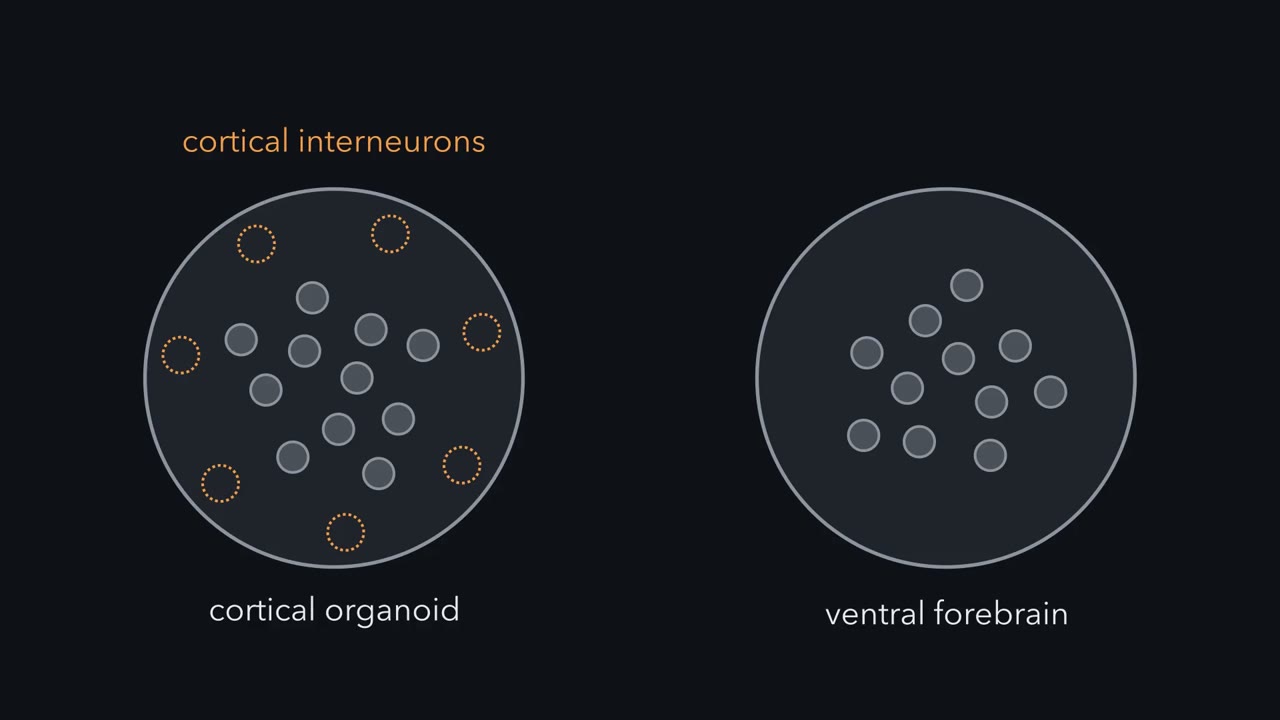
Finer subtypes blurred. An organoid cluster often resembled several fetal subtypes about equally. Markers of particular subtypes, such as SATB2 in upper-layer neurons, were much rarer. Here is the twist. Organoid cells expressed stress genes at higher levels. Transplanted into mouse cortex, those stress genes fell. Some cells came to resemble fetal subtypes more closely. So the dish itself seems to add problems. The rule says where to look first. It is not a verdict. Every feature still has to be measured.
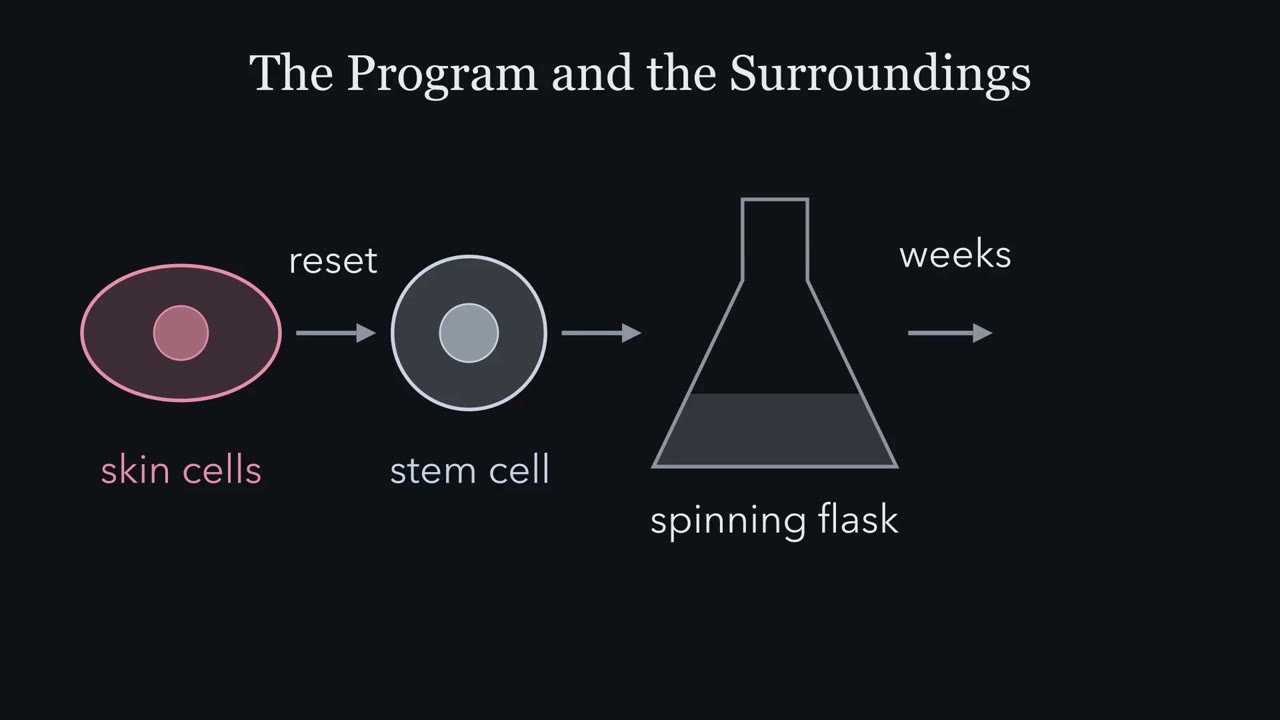
Can a person's skin cells, first reset to stem cells and then grown for weeks in a spinning flask, become a model of their early cortex?
Continue in the lesson: Brains in a Dish: Stem Cells and Organoids →
2:41 · Free, with captions and a transcript. The lesson has the full text, the questions and the sources.
More films from this lesson
How this film was made. Narration: an AI narrator voice (Kokoro, af_heart) reading narration written from this lesson's text. Animation: AI-generated in code (Manim) by Claude, a schematic with no drawn molecular structures. Captions come from the narration script. See something wrong? Report it.