Fewer Pores
Read the transcript of “Fewer Pores”
Film transcript: Fewer Pores
If you remove most of a barley leaf's pores, does the plant go hungry? Or can it save water and still fill its grain? On paper, a leaf with fewer pores can pay less water for its carbon. A real experiment tested what fewer pores do to a crop. Julie Gray's team, with Hughes as first author, worked in barley. They made plants overexpress a barley gene, HvEPF1. That means making extra of the gene's product. This gene limits leaf cells from entering stomatal development and moving through it. So extra product should mean fewer stomata. They compared these plants with empty-vector controls. Leaf surface impressions told the story. Two engineered lines kept only about a quarter and an eighth of the controls' stomata.
Why the controls, and why two lines? The procedure itself might change a leaf. And the inserted gene lands somewhere in the genome. Two independent lines make a landing-spot effect less likely. Next, a leaf was clamped in a small chamber that measures gas exchange. In well-watered plants, leaves with fewer stomata exchanged much less gas with the air. Gas exchange fell steeply. So what happened to the carbon taken in, and to the grain? Did they fall just as steeply?
In general, if fewer pores slow gas flow while photosynthesis continues, carbon dioxide inside the leaf falls. Its gap widens, and that props up carbon gain. So a leaf can save more water than it loses carbon. In this study, one efficiency measure rose in both lines under water restriction. The measures did not all agree. the grain? In a greenhouse trial, neither line showed a statistically significant drop in yield, well watered or water restricted. No drop was detected. But each group held only five plants. A small loss could still hide below what the trial could see. No drop detected is not proof of equal yield. So what kind of answer is this?
It shows how one gene limits stomata, and what fewer stomata do to gas, water and grain. It says nothing about why wild barley evolved its stomatal density. That second question is about lineages and their history, not one plant. Answering it needs different evidence, and it is where the lesson goes next.
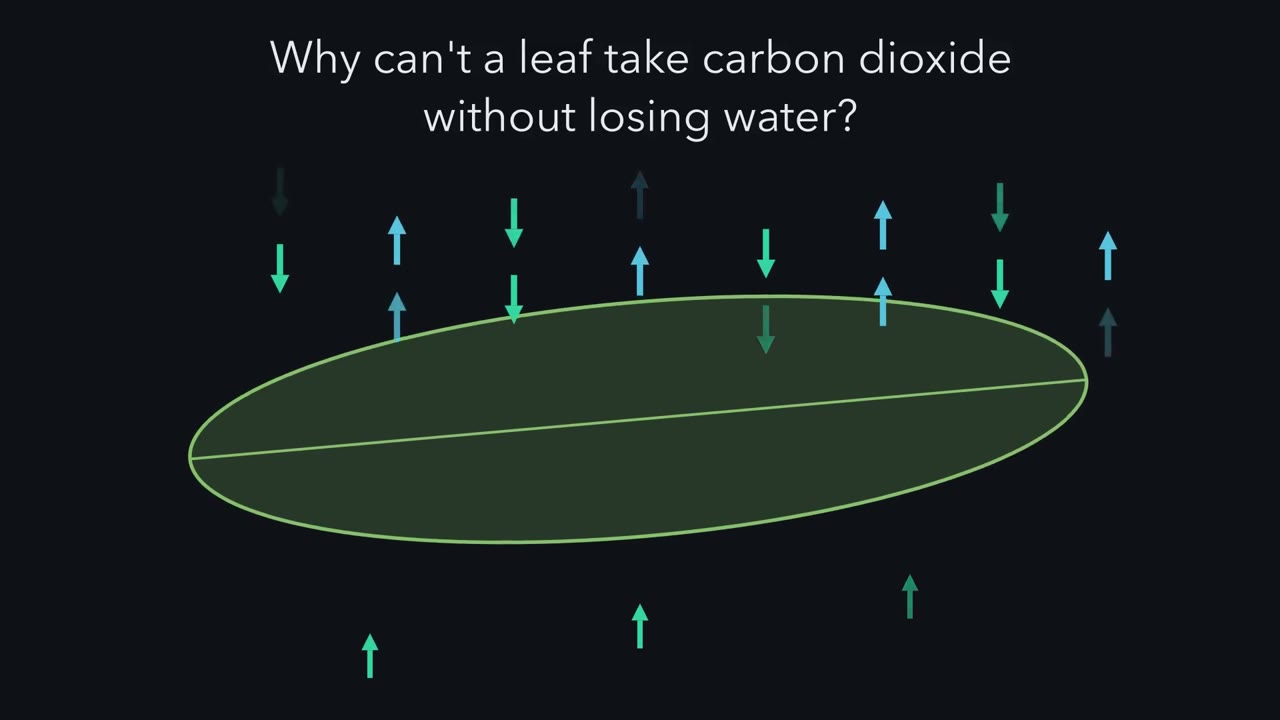
A barley leaf cannot take in carbon dioxide without letting water out of the same pores. How much water does each bite of carbon cost, and can a plant pay less?
Continue in the lesson: What an Organism Has to Do →
3:05 · Free, with captions and a transcript. The lesson has the full text, the questions and the sources.
More films from this lesson
How this film was made. Narration: an AI narrator voice (Kokoro, af_heart) reading narration written from this lesson's text. Animation: AI-generated in code (Manim) by Claude, a schematic with no drawn molecular structures. Captions come from the narration script. See something wrong? Report it.