The Price of a Breath
Read the transcript of “The Price of a Breath”
Film transcript: The Price of a Breath
Why can't a leaf take carbon dioxide from the air without losing water? Taking something in often carries a cost somewhere else. A leaf makes that cost easy to see. Every multicellular organism faces the same five problems. Get energy and materials. Exchange and move them, wastes included. Keep its inside relatively stable.
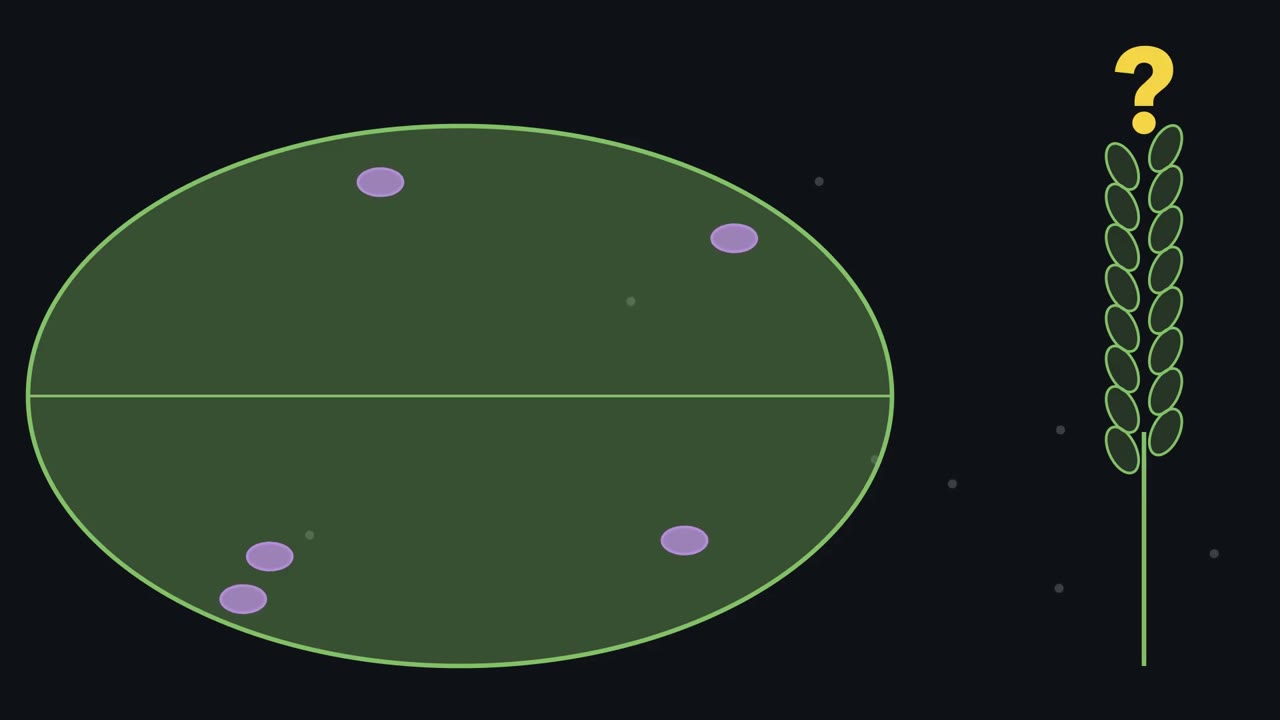
Resist damage and invasion. Leave descendants. Barley, honeybee or human, each body solves all five. Many solutions carry a cost, paid somewhere else. The exchange problem shows that cost most clearly. Zoom into a barley leaf. A waxy layer covers the surface, and water crosses it poorly. So gas moves mainly through pores called stomata. Two guard cells flank each pore and open or close the gap.
Inside the leaf, cell walls line air spaces, and those walls are wet. Carbon dioxide must dissolve in that water film to reach the cells. But a wet surface open to air loses water. So water vapour leaves through the same pore that lets carbon dioxide in. Both gases take one path. What, then, sets the price, the water lost for each carbon gained? Look at two gaps across the pore. First, the carbon dioxide gap. Carbon dioxide is a tiny share of air, and the leaf draws it down only part of the way. Now the water gap. Air inside a leaf is saturated with water vapour, while outside air is drier. That gap is far bigger. So the leaf pays hundreds of water molecules for each carbon dioxide.
Now let the guard cells narrow the pore, with both gaps held fixed. Both streams shrink together. The pores set how fast gas moves. The two gaps set the price. Your lung also moves a gas across a wet surface. It takes in oxygen. Will it pay more water for each molecule of gas, or less?
Far less. Oxygen is plentiful in air, so each breath can hand over a lot of it. The breath out carries away about as much water vapour. So the lung pays about one water molecule for each oxygen. But the lung cannot close the way a stoma can. It sits sheltered deep in the chest. In ordinary unsaturated air, narrowing or sheltering a path can cut the water cost. But while gas keeps flowing in, some water still leaves. Back to the checklist. For every row, ask what a solution costs, and where that cost is paid. Then ask how you would test it.
A barley leaf cannot take in carbon dioxide without letting water out of the same pores. How much water does each bite of carbon cost, and can a plant pay less?
Continue in the lesson: What an Organism Has to Do →
3:23 · Free, with captions and a transcript. The lesson has the full text, the questions and the sources.
More films from this lesson
How this film was made. Narration: written from this lesson's text and read by an AI narrator voice (Kokoro, af_heart). Animation: AI-generated in code (Manim) by Claude, a schematic with no drawn molecular structures. Captions come from the narration script. See something wrong? Report it.