Move It, Mutate It, Block It
Read the transcript of “Move It, Mutate It, Block It”
Film transcript: Move It, Mutate It, Block It
How did anyone find a nuclear address, or prove what it does? Chapter one showed receptors reading labels, with Ran controlling where cargo loads and unloads. Start with nucleoplasmin, a frog oocyte protein of five copies, each with a tail. In 1982, Dingwall, Sharnick and Laskey clipped the tails away.
Bare cores injected into the cytoplasm stayed out. A larger pentamer keeping one tail went in. One attached tail was sufficient for final accumulation. More tails changed the rate, not how much eventually reached the nucleus.
One more injection put bare cores straight into the nucleus. They remained there. Why that injection matters is a question the page asks you. Which route does cargo take? In 1984, Feldherr and colleagues injected gold grains coated with nucleoplasmin. The coated grains spanned about 5 to 20 nm. They entered the nucleus.
Electron microscopy located transport at the pores. Now predict. Coat the same gold with an inert polymer instead of nucleoplasmin. Where will most of the grains end up? Mostly outside the nucleus. Gold coated with nucleoplasmin lacking its transport part was also largely kept out. So the coat, not the gold, decided entry. Next, a label you could move.
Kalderon, Smith and colleagues traced the address of SV40 large T antigen to a short stretch. The normally cytoplasmic reporters were beta β-galactosidase and pyruvate kinase. Attached to either one, the stretch caused nuclear accumulation. Next, change it. Swapping lysine 128 for threonine abolished nuclear accumulation. Moving, mutating, and blocking are complementary tests. Each result supports only a limited claim. By 1995, importin α was shown to recognize the signal. Importin β was shown to dock at the pore. Leucine-rich export signals still had no known reader. In 1997, Fornerod, Mattaj and colleagues tested CRM1. Extra CRM1 stimulated export of Rev.
It also stimulated export of U snRNAs. Leptomycin B inhibited both export pathways. CRM1, RanGTP and an export signal formed a complex in vitro. All three results pointed at CRM1. Together, they made a stronger case than any one result alone. The same year, Izaurralde, Görlich and colleagues collapsed the Ran gradient in oocyte nuclei. They injected RanGAP1, RanBP1, or a defective Ran mutant. The mutant could not stably hold GTP. All three treatments depleted nuclear RanGTP. Major import and export pathways stopped.
Export was more readily inhibited than import. None of these results proved everything. Move it, mutate it, block its reader: each supports one claim. The page's drug puzzle stays unresolved.
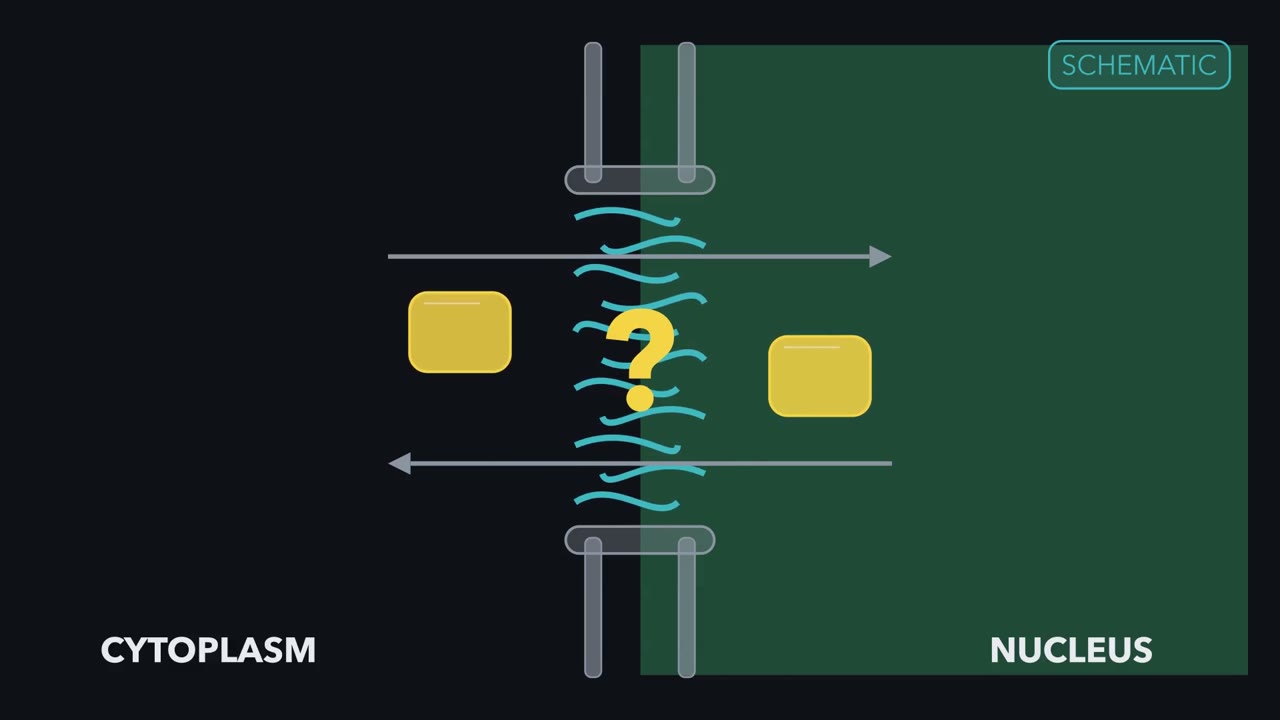
If one pore carries traffic both ways, what decides which way each protein goes?
Continue in the lesson: The Nuclear Envelope and Nuclear Transport →
3:58 · Free, with captions and a transcript. The lesson has the full text, the questions and the sources.
More films from this lesson
How this film was made. Narration: an AI narrator voice (Kokoro, af_heart) reading narration written from this lesson's text. Animation: AI-generated in code (Manim) by Claude, a schematic with no drawn molecular structures. Captions come from the narration script. See something wrong? Report it.