One Pore, Two Directions
Read the transcript of “One Pore, Two Directions”
Film transcript: One Pore, Two Directions
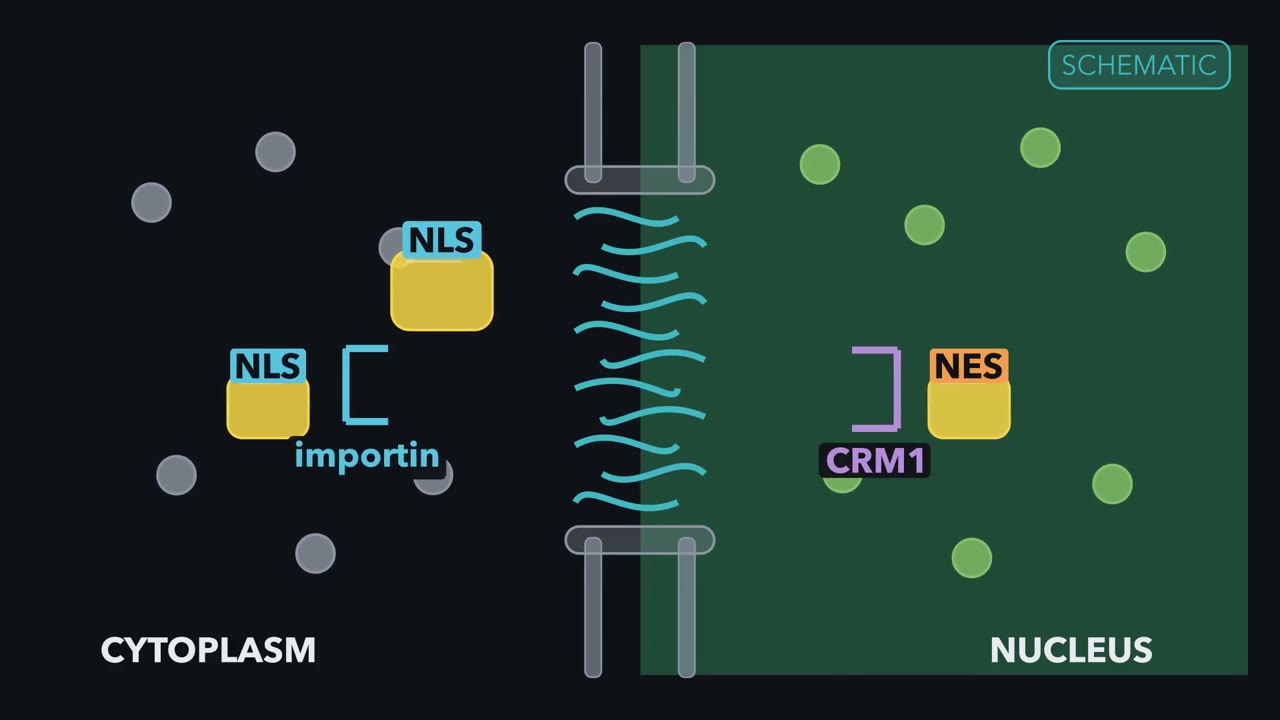
The nuclear pore is not a one-way door. So how can the same pore deliver one protein inward and another outward? Watch one pore between the cytoplasm and nucleus. Soluble cargo floats within either compartment instead of sitting in a membrane. Here is a first picture. For soluble protein cargo, the nuclear pore is a selective passage, not a one-way motor. Small grey particles slip between moving teal chains. Larger yellow cargo crosses slowly alone. Receptors engage the barrier for faster passage. Cargo carries labels that transport-receptor proteins can read. A blue NLS tag recruits blue importin α, which holds cargo.
Importin β joins it and engages the pore. An orange NES tag can recruit the purple export receptor CRM1. The difference between the two sides comes from Ran, a small switch protein. Ran is on with GTP and off with GDP. Green RanGTP is abundant in the nucleus.
Grey RanGDP dominates in the cytoplasm. This unequal distribution is the Ran gradient. In the simplest form, the import complex threads through the pore. It moves from cytoplasm to nucleus without a directional push. In the nucleus, green RanGTP binds importin β and separates it from importin α. Importin α then releases the blue-tagged cargo where RanGTP is high. All three receptor and cargo pieces are now distinct. Now predict. If RanGTP became equally common on both sides, could importin still unload only inside? Hold the two-sided picture in your mind.
No. Importin could still cross. But on either side, it might drop cargo or fail to pick it up. Net import would lose its one-sided rule. Restore the gradient, and cargo release again favors the nuclear side. Export reverses the same rule.
Nuclear green RanGTP helps purple CRM1 grip orange-tagged NES cargo. The complex crosses outward. In the cytoplasm, Ran-binding proteins first help the cargo come free. Hydrolysis then turns RanGTP into RanGDP. This frees CRM1 for another round. Nuclear RanGTP tells importins to unload and exportins to load. Blue importins carry NLS cargo in. Purple CRM1 carries many NES cargoes out. One asymmetry gives opposite receptors useful directions. In Ran-dependent protein transport, GTP hydrolysis maintains the gradient; it does not push cargo through the pore. In Ran-dependent transport, Ran mainly sets where cargo loads and unloads.
Pore proteins still help on each face, but the pore sets no direction of its own. Most messenger RNA export uses another receptor.
If one pore carries traffic both ways, what decides which way each protein goes?
Continue in the lesson: The Nuclear Envelope and Nuclear Transport →
3:48 · Free, with captions and a transcript. The lesson has the full text, the questions and the sources.
More films from this lesson
How this film was made. Narration: written from this lesson's text and read by an AI narrator voice (Kokoro, af_heart). Animation: AI-generated in code (Manim) by Claude, a schematic with no drawn molecular structures. Captions come from the narration script. See something wrong? Report it.