Planting Past the Edge
Read the transcript of “Planting Past the Edge”
Film transcript: Planting Past the Edge
A plant's range ends at a headland. Why does it stop there? Is it the cold, the neighbours, or seeds never getting there? The first film drew a niche as the conditions where lambda stays at or above one without immigrants. Now we test an edge directly. Each answer is a different kind of limit.
Conditions make an abiotic limit. Other species make a biotic limit. Never arriving makes a dispersal limit. The direct test is to plant the species beyond the edge and follow it for years. But plant the same way inside the range too.
Transplanting itself is a shock, and a bad year can kill plants anywhere. Then split every site in two. On randomly chosen plots, clear away the neighbouring plants. On the others, leave them. Count survival, growth and seed production across the whole life cycle. From those, estimate lambda for every plot. One season's survival is not enough. First possible result.
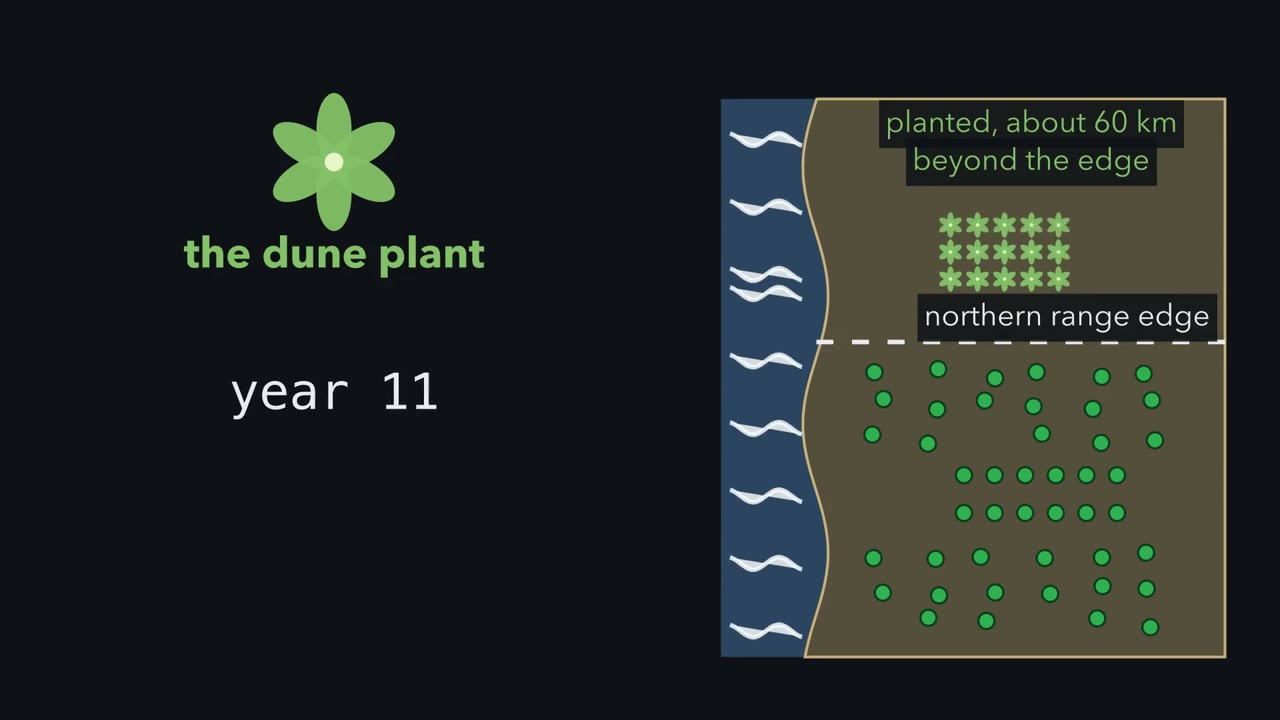
Lambda beyond the edge stays at or above one, with or without neighbours. The species can live there. Seeds have not arrived, or have not recolonised empty patches. The dune plant looks like this case, though its neighbours were never cleared. Planted beyond its northern edge, the population more than tripled in twelve to fourteen years. Second result. Beyond the edge, lambda falls below one only on plots where neighbours remain. Cleared plots do fine. Other species are setting the limit. Third result. The plots inside the range grow. Beyond the edge, plots shrink whether or not neighbours were cleared. What does that implicate?
The conditions beyond the edge. Climate is a strong candidate. But herbivores, pathogens or missing soil partners need their own tests first. One more result. Every plot fails, inside the range as well as beyond it. Then the test cannot single out the edge.
Handling, the seed or a bad year may be to blame. Check them, then repeat the study. So here is the reading rule. Compare lambda beyond the edge with lambda inside the range, on plots with and without neighbours. That comparison separates access, neighbours and conditions beyond the edge. A map of where the species grows cannot do it on its own. Plant beyond the edge, with the same planting inside, and measure lambda. Where it replaces itself beyond the edge, the range stops short of the niche.
A dune plant was planted 60 km past its own range edge, and the planted population more than tripled. So what was stopping it?
Continue in the lesson: Distributions, Niches and Tolerances →
3:17 · Free, with captions and a transcript. The lesson has the full text, the questions and the sources.
More films from this lesson
How this film was made. Narration: an AI narrator voice (Kokoro, af_heart) reading narration written from this lesson's text. Animation: AI-generated in code (Manim) by Claude, a schematic with no drawn molecular structures. Captions come from the narration script. See something wrong? Report it.