Where It Can Live, Where It Is
Read the transcript of “Where It Can Live, Where It Is”
Film transcript: Where It Can Live, Where It Is
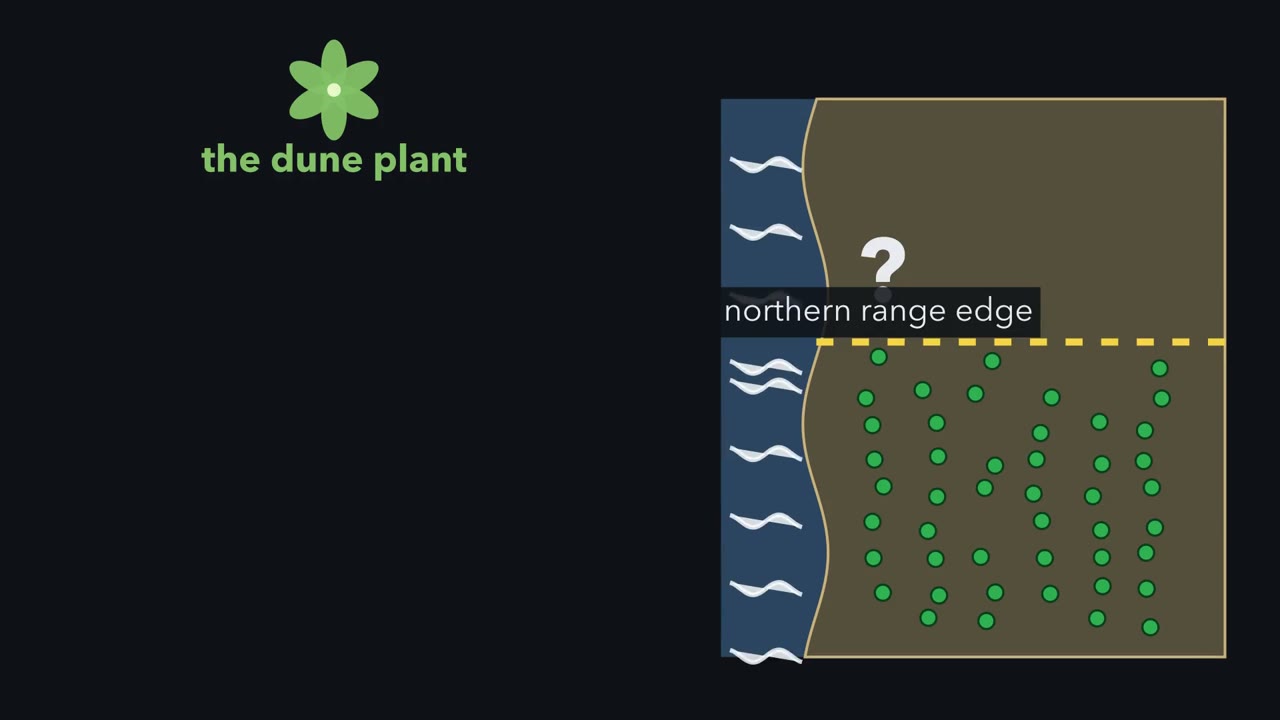
A dune plant was planted about sixty kilometres past the northern edge of its range. The planted population more than tripled. If it can live there, why was it never there? To answer, keep two things apart. One is the set of conditions a species can live in. The other is the map of where it is found. Draw the conditions first. Put temperature on one axis and soil moisture on the other. Each sampled spot becomes a point, and one place can give several. Now ask one question at each point. Count a local population once a year, with no newcomers. By what factor does it multiply that year? Ecologists call that factor lambda. Years differ, so lambda changes from year to year.
The test uses the long-run lambda, good and bad years together. One good summer does not count. Where long-run lambda is at least one, the population replaces itself without immigrants. That region of conditions is the niche, drawn as a teal box.
Now turn to the map. Shade every stretch of coast whose conditions fall inside the box. That teal shading is where the species could live. Then add the places where the species is actually found, as dark green dots. The dots and the shading do not match. Picture a teal stretch with no dots. Its conditions are inside the niche. Nothing has arrived to start a population. So absence alone does not mark the edge of a niche. A species can be missing from a good place because it never got there. Now the other mismatch. A plant turns up at one site in every survey, year after year. Is that site inside its niche?
Not necessarily. Here deaths outnumber births, so lambda is below one. Seeds arriving from a neighbouring site replace the dead every year. Cut off the arriving seeds, and the plants dwindle away. A population like this, kept going by immigrants, is called a sink. So presence alone does not mark the niche either. A map shows only where the species is found. Spotting sinks takes counts of births, deaths and immigrants. Other species change lambda too. A competitor or an enemy can push it down. A helper can push it up. Back to the dune plant. Its planted population grew past the edge. So, at least at that site, the edge is not where the plant fails.
A niche is where long-run lambda is at least one without immigrants. A map shows only where the species is found.
A dune plant was planted 60 km past its own range edge, and the planted population more than tripled. So what was stopping it?
Continue in the lesson: Distributions, Niches and Tolerances →
3:21 · Free, with captions and a transcript. The lesson has the full text, the questions and the sources.
More films from this lesson
How this film was made. Narration: written from this lesson's text and read by an AI narrator voice (Kokoro, af_heart). Animation: AI-generated in code (Manim) by Claude, a schematic with no drawn molecular structures. Captions come from the narration script. See something wrong? Report it.