Films · Developmental Neuroscience
Where in the Plate?
Read the transcript of “Where in the Plate?”
Film transcript: Where in the Plate?
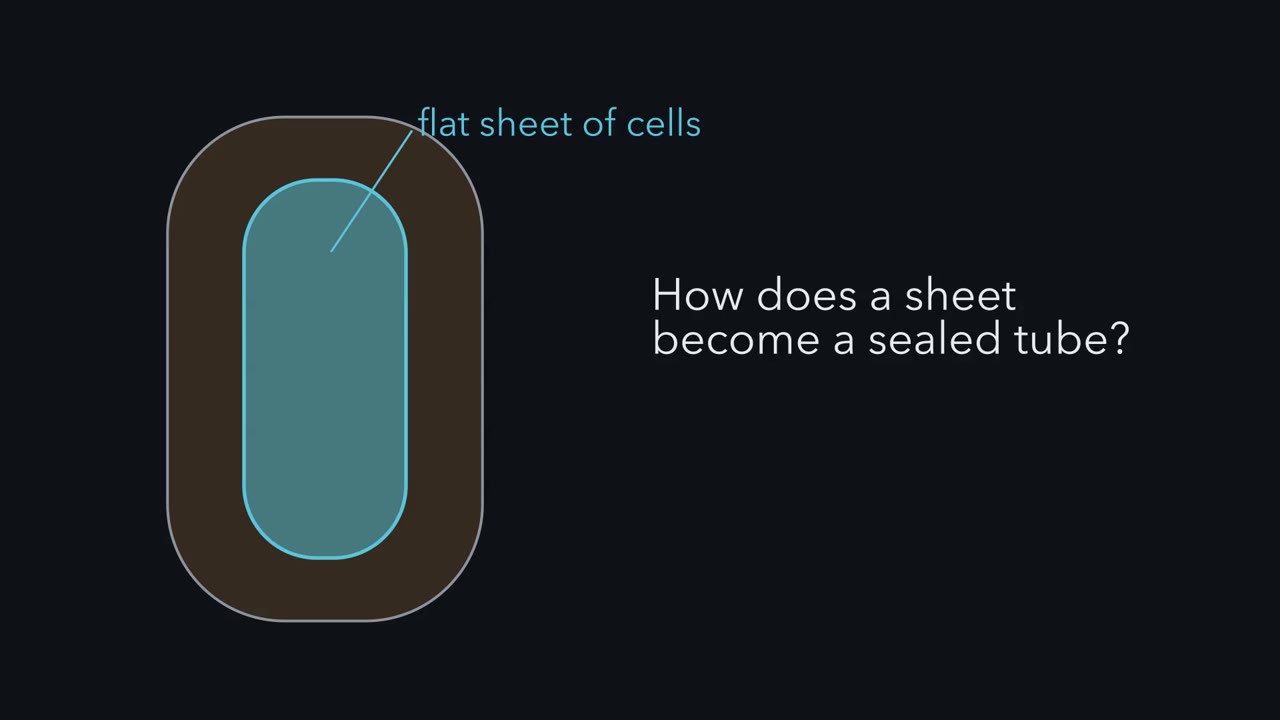
How does the width of the midline between the folds affect whether they can meet? A simple cartoon shows the idea. Put your hands flat, thumbs touching, and roll each up onto its thumb edge. The top edges meet, however broad your hands.
Now put a book between your thumbs. Upright, the hands stop apart by the book's width. Broader hands do not help unless you tip them past upright. The book is the midline. How does the midline narrow? Cells crawl in between their side neighbours. This is intercalation. Same cells, rearranged: narrower across, longer along. This is convergent extension.
But which way is across? On a fly's wing, every hair points toward the tip. In mutant flies, the hairs swirl. Frizzled and Dishevelled gather on one side of each cell. Van Gogh and Prickle gather on the other. This is planar cell polarity, a sense of direction within a sheet.
In 2002, John Wallingford and Richard Harland asked where in the frog plate it matters. Frog cell fates are mapped, so an injection can be aimed at one part of the plate. They injected a Dishevelled built to block planar polarity. In some embryos it reached the midline; in others, the sides.
Predict. Which embryos keep an open tube: those blocked at the midline, or those blocked at the sides? Blocked at the midline, the plate stayed wide. The folds rose and moved inward. But the tube stayed open. Blocked at the sides, where the folds form and fuse, closure was normal.
The hands rose with the book still between them. Dishevelled is needed at the midline. A mouse points the same way. The loop-tail mouse carries a mutation in Vangl2, a relative of Van Gogh. With two copies, the tube is open from the midbrain down the spine.
In 2007, Andrew Copp's laboratory labelled that midline. Before neurulation began, it had failed to extend. And Closure 1 never happened. Narrowing starts early and overlaps folding. The plate must still bend, and the fold tips must stick together.
Takeaway: the midline must be narrow enough for the folds to close the gap. Frog and mouse both tie closure to midline narrowing.
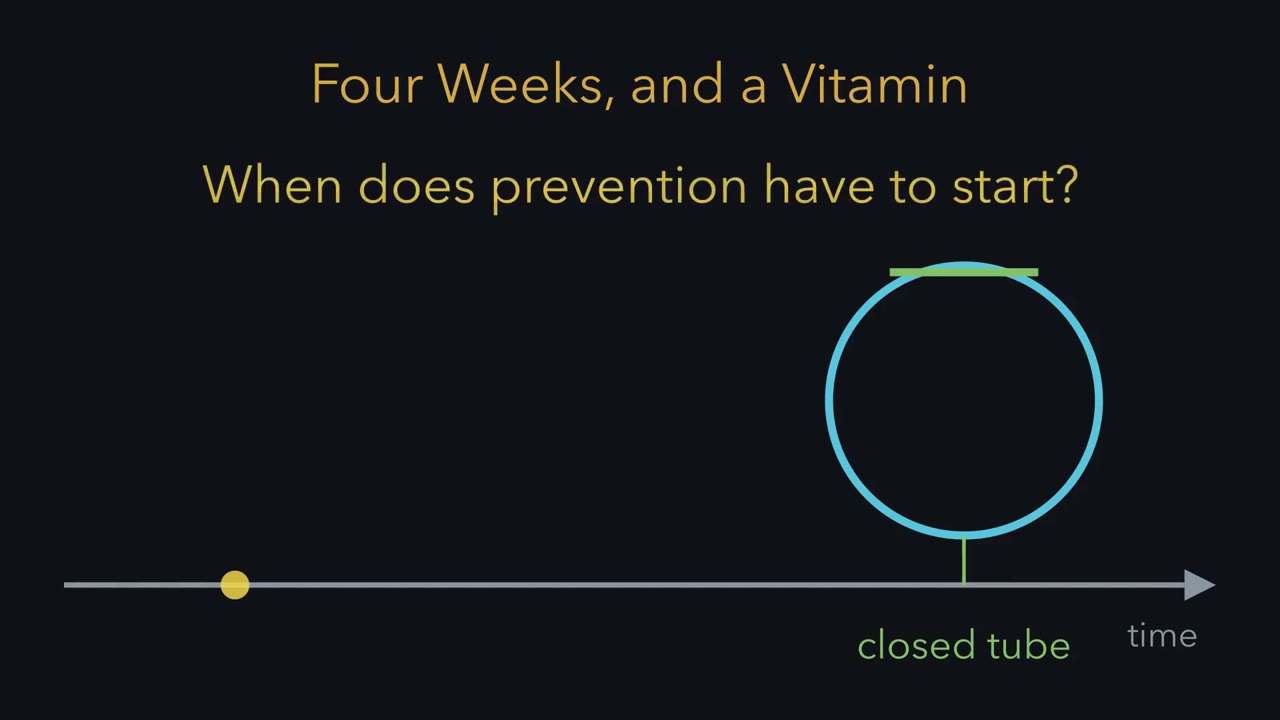
In a human embryo the neural tube has closed by the end of about the fourth week after fertilization. What happens if it doesn't? Part of the brain or spinal cord stays open, and folic acid taken before conception lowers the risk.
Continue in the lesson: Neurulation and Neural Tube Defects →
3:07 · Free, with captions and a transcript. The lesson has the full text, the questions and the sources.
More films from this lesson
How this film was made. Narration: an AI narrator voice (Kokoro, af_heart) reading narration written from this lesson's text. Animation: AI-generated in code (Manim) by Claude, a schematic with no drawn molecular structures. Captions come from the narration script. See something wrong? Report it.