Films · Developmental Neuroscience
One Stain, Two Readings
Read the transcript of “One Stain, Two Readings”
Film transcript: One Stain, Two Readings
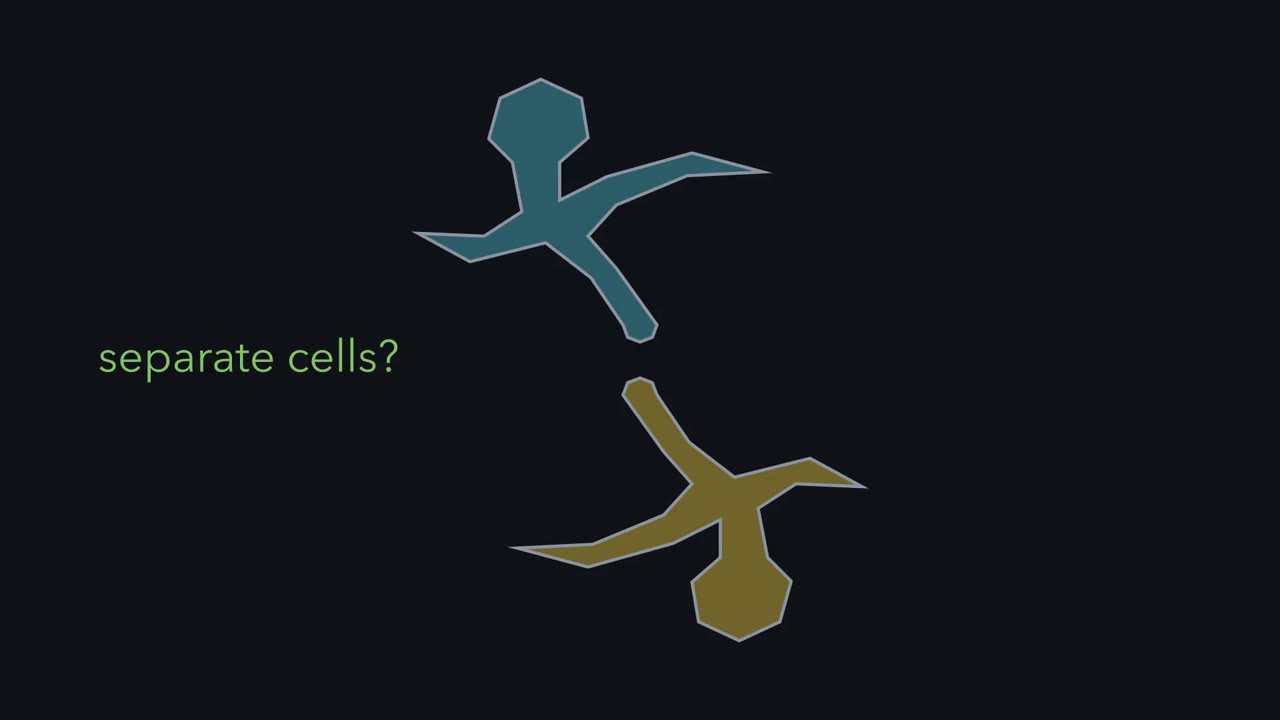
How do you see one whole cell in a crowded brain? A Nissl stain marks every cell body. But axons and dendrites, where the question of fusion lives, stay almost invisible. In 1873, Camillo Golgi found the black reaction. Most cells stay pale. A few fill with black, to the finest twig. This is sparse labelling: a few cells, filled completely, apparently at random. Picture a forest at night with a few trees lit. Each lit tree's shape stands out. Each black branch can be traced back to its own cell, where the section allows. But a contact has two sides, and both are rarely stained. Even where two black branches meet, the gap is far below what light can show.
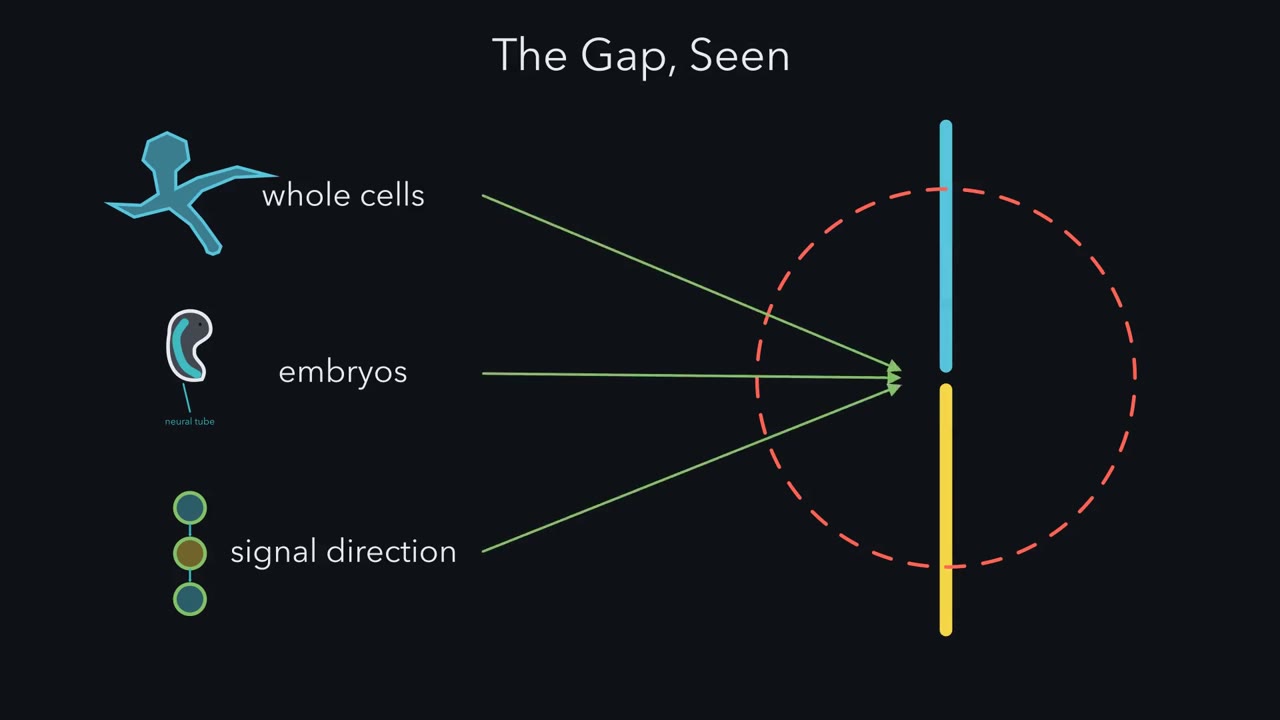
Where two lit branches cross in the dark, you still cannot tell whether they are grafted together. In 1887, Santiago Ramón y Cajal took up the stain. Golgi read the tangle of axon branches as a continuous net. Cajal found branches ending close to other cells without joining them, again and again. Neither could win at the contact. So Cajal turned to embryos, where cells are fewer and simpler. Wilhelm His argued that each fibre grows out of a single cell, a neuroblast. In 1890, Cajal named the growth cone. He read it as the advancing end of a growing fibre. Suppose every fibre does grow out of one cell. Does that rule out Golgi's net?
No. Outgrowth shows where a fibre begins, not how it ends. A fibre could grow out, then fuse at its far end. So embryos made separate cells more likely, without settling it. Cajal added a rule. Signals enter through the dendrites and cell body, and leave through the axon. In a chain of separate cells, their order sets a direction. Continuity alone sets none. The rule has exceptions. In 1906, Golgi and Cajal shared the Nobel Prize. Golgi still defended his net. No light microscope could show the gap. Separate cells were the better explanation, but nobody had seen it.
Are neurons separate cells that touch, or one fused network? The neuron doctrine says separate, and it took a new stain, a lot of embryos and the electron microscope to show it. Two men looked at the same stained brain and saw two different organs. Who was right, and how could anyone tell?
Continue in the lesson: Seeing Neurons: Golgi, Cajal and the Neuron Doctrine →
2:36 · Free, with captions and a transcript. The lesson has the full text, the questions and the sources.
More films from this lesson
How this film was made. Narration: an AI narrator voice (Kokoro, af_heart) reading narration written from this lesson's text. Animation: AI-generated in code (Manim) by Claude, a schematic with no drawn molecular structures. Captions come from the narration script. See something wrong? Report it.