Films · Developmental Neuroscience
Agrin Protects, Acetylcholine Disperses
Read the transcript of “Agrin Protects, Acetylcholine Disperses”
Film transcript: Agrin Protects, Acetylcholine Disperses
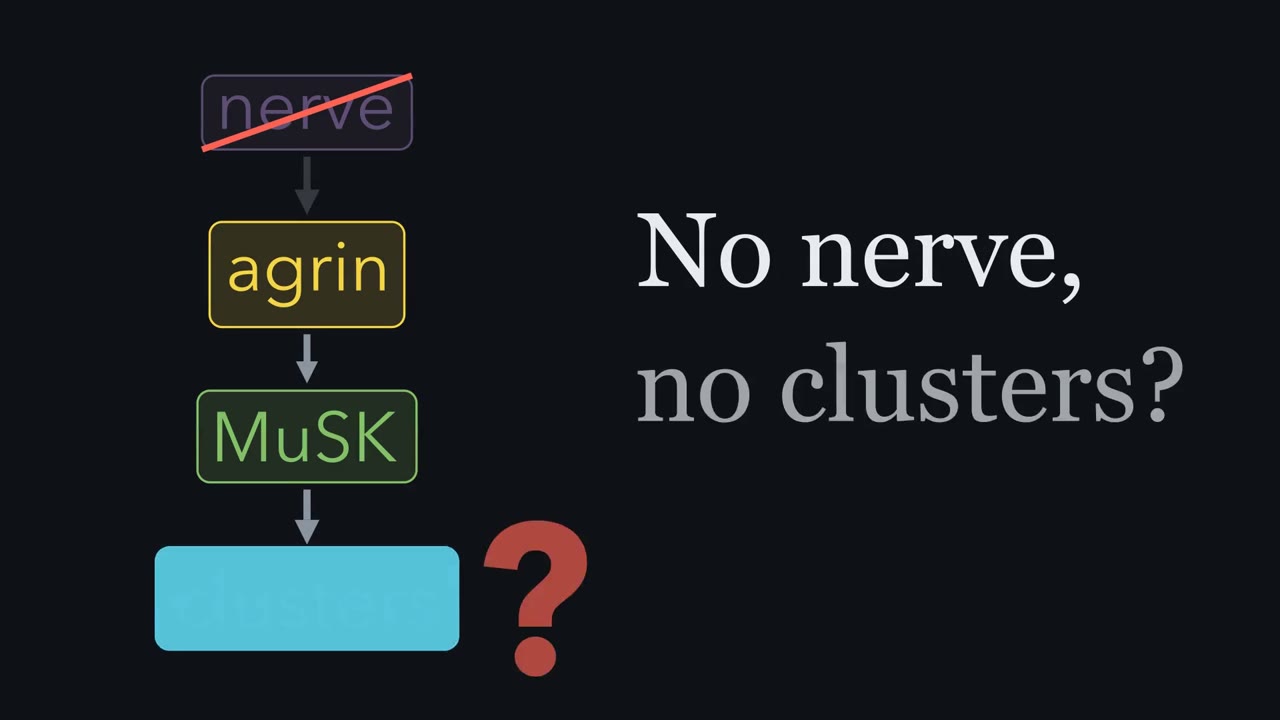
The muscle builds its band without agrin. So why do mice lacking agrin end up with so few clusters? Something must be removing the clusters the muscle made. What could the nerve bring that removes clusters? A second signal. Acetylcholine, released at every terminal, disperses clusters that agrin does not protect. To test that, use mice whose nerves release no acetylcholine. They lack the enzyme that makes it. Their receptors still cluster under the nerve. So acetylcholine is not what starts clusters. And they keep more clusters, spread over a wider band. Now lay out a grid. Agrin present or absent. Acetylcholine present or absent. Normal mice have a narrow band under the terminals.
Without agrin, early clusters form, then most are lost. Without acetylcholine, there are more clusters, over a wider band. Now predict the last cell. Remove both agrin and acetylcholine. What happens to the clusters? Clusters return, built by the muscle's own MuSK program. Two mouse studies reported this in 2005. Without acetylcholine, clusters persist even without agrin. So a major job of agrin in developing muscle is to protect clusters from acetylcholine. One puzzle remains. The cluster under the terminal gets the most acetylcholine. Why does it survive? In the working model, the two forces differ in reach. Agrin is anchored in the basal lamina, so its protection stays under the terminal.
The dispersing effect of acetylcholine reaches clusters along the rest of the fibre. Away from the terminal, they lack agrin's strong protection. How that effect reaches distant clusters is not fully settled. The two forces meet at one question. Does a cluster stay? Agrin, acting through MuSK, holds it. Acetylcholine's pathway pulls it apart. Without agrin, Lrp4 is thought to give MuSK some activity. That would explain why a few small clusters remain. Raise MuSK enough another way, and synapses can form even in mice lacking agrin. This rule is for receptor clusters in developing mouse muscle. There, the muscle proposes; the nerve disposes. Takeaway: agrin protects the clusters beneath it.
Acetylcholine disperses the rest.
A mouse without the muscle kinase MuSK dies at birth: its motor axons reach the muscle, but no junction forms.
Continue in the lesson: Building the Neuromuscular Junction: Agrin, Lrp4 and MuSK →
2:57 · Free, with captions and a transcript. The lesson has the full text, the questions and the sources.
More films from this lesson
How this film was made. Narration: an AI narrator voice (Kokoro, af_heart) reading narration written from this lesson's text. Animation: AI-generated in code (Manim) by Claude, a schematic with no drawn molecular structures. Captions come from the narration script. See something wrong? Report it.