Films · Developmental Neuroscience
Why Wrap, and How Much
Read the transcript of “Why Wrap, and How Much”
Film transcript: Why Wrap, and How Much
Why would a glial cell wrap an axon in dozens of layers of membrane? And why are some axons never wrapped? Start with one patch of membrane. Current spreads to it from the active stretch behind. Before it can fire, that current must charge it. In a bare axon, current also leaks out at every point. So the signal is rebuilt on every patch. Less current is left to charge the patch ahead. Myelin is glial membrane, wound many times around the axon and squeezed tight.
Each turn adds two membranes in series. So the wall's capacitance falls. And its resistance rises. Far more of the current now reaches the next gap. Those gaps are the nodes of Ranvier. The axon packs its sodium channels there. The signal is rebuilt at the nodes, so it seems to jump. This is saltatory conduction.
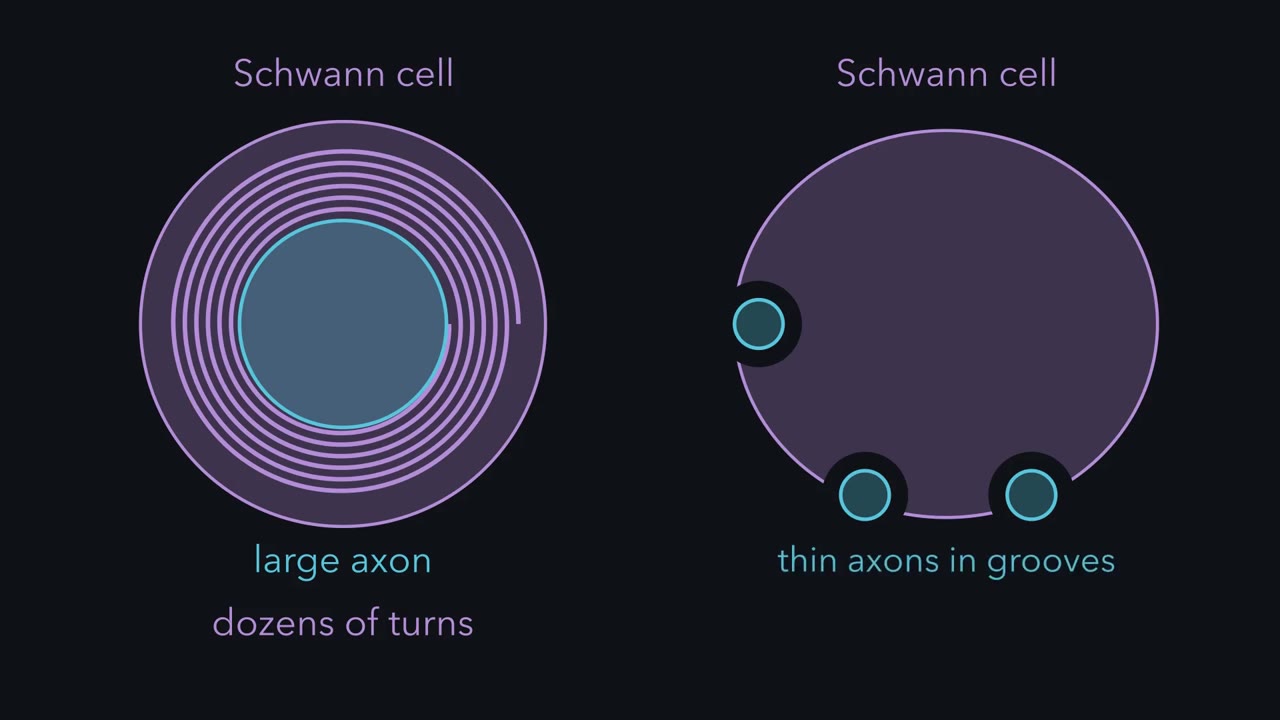
In a bare axon, speed rises with the square root of diameter. In a myelinated fiber, it rises in proportion to diameter. So which axon gains more from a wrap, a thin one or a thick one? The thick one. In a simple model, the gain grows with the axon's size. The axon diameter is the axon alone. The fiber diameter adds the myelin. Their ratio is the g ratio. A thinner sheath on the same axon gives a higher g ratio. Healthy peripheral fibers sit near 0.6 to 0.7. That is close to the fastest value, but the optimum is broad. Now the puzzle. In peripheral nerve, axons up to about 1 micrometer stay bare. Some cable models of small central fibers put the break-even for myelin much lower, so speed alone may not explain the cutoff.
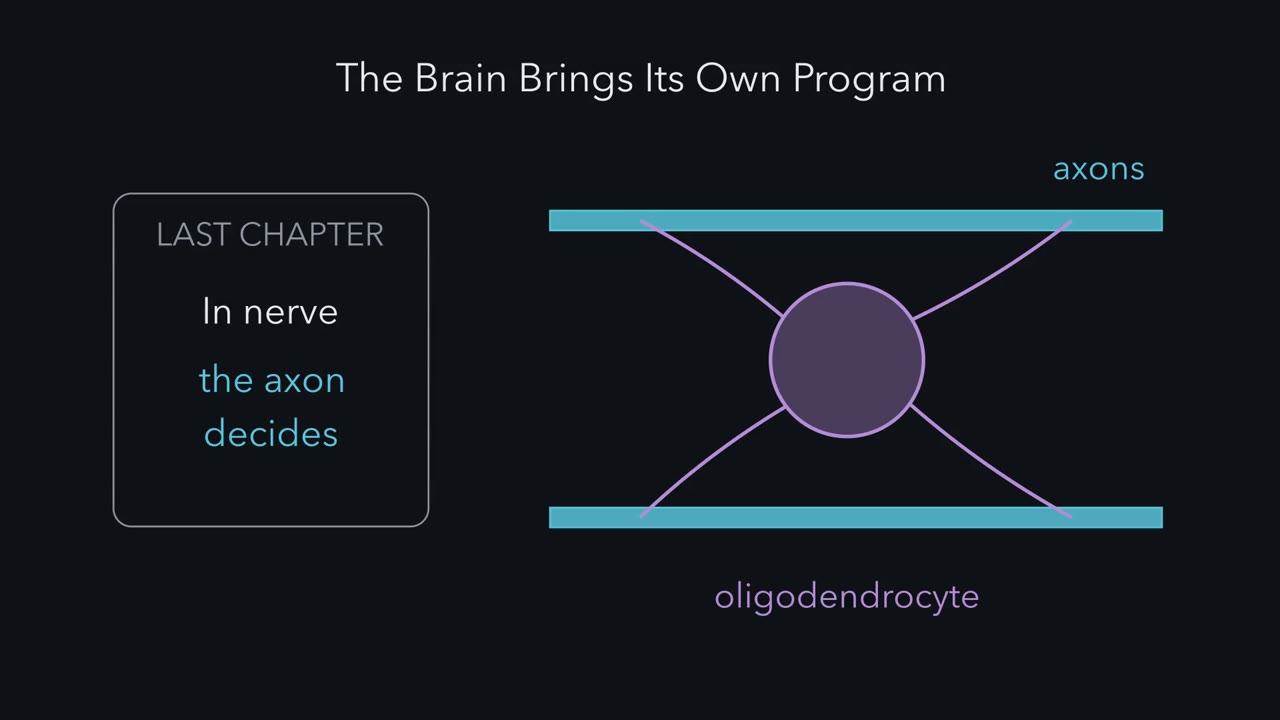
Space and energy cost may matter too. Something in the tissue may decide. Here is the idea to carry. The speed gain is largest on large axons, and nerves do match the wrap to the axon. In nerve, the axon decides. In the brain and spinal cord, the oligodendrocyte brings much of its own program.
Wrap an axon in tight layers of glial membrane, leave short bare gaps, and its signal jumps from gap to gap instead of creeping.
Continue in the lesson: Myelination: Wrapping the Axon So the Signal Jumps →
2:39 · Free, with captions and a transcript. The lesson has the full text, the questions and the sources.
More films from this lesson
How this film was made. Narration: an AI narrator voice (Kokoro, af_heart) reading narration written from this lesson's text. Animation: AI-generated in code (Manim) by Claude, a schematic with no drawn molecular structures. Captions come from the narration script. See something wrong? Report it.