Reading Evolution Across Time
Read the transcript of “Reading Evolution Across Time”
Film transcript: Reading Evolution Across Time
The first film scored each partner's side as a net. When both partners evolve, each resets the other's net. How can you see that? Take a bacterium and a phage, a virus that infects bacteria. Freeze samples of both every two weeks, to revive later.
Now cross them in a time-shift assay. Phages from one time meet hosts from the past, the same time and the future. If neither partner's heritable traits changed, every pairing should give about the same infection rate. A repeatable difference means at least one partner changed. The shape hints at how. First, an arms race. Host resistance and phage infectivity both rise, in repeated rounds. Take one phage from the middle of the series. Test it on past, same-time and future hosts. Which does it infect best?
The past hosts. This phage has never met the resistance that later hosts evolved. Infection falls from past hosts to future ones, and keeps falling as the gap grows. Fluctuating selection works differently. Whichever host type is common gets attacked most. Rare types then gain, and the advantage keeps shifting.
Phages track the common host type, so they tend to do best on hosts of about their own time. As the gap grows, infection rises and falls, with no long-run trend. So read the shape as evidence, not proof. A one-way trend points to escalation. A wave with no long-run trend points to tracking. Evolution can also act within a population cycle.
Picture a chemostat, a vessel with a steady inflow and a matching outflow. Rotifers graze on algae. In classical models, prey rise, predators multiply, prey crash, predators starve. Rotifer peaks trail algal peaks by about a quarter cycle. That delay, as a fraction of the period, is the phase lag. Takehito Yoshida and colleagues started the algae in two ways. A clone is a set of genetically identical cells. One clone cannot evolve by selection among clones.
Several clones can. One clone gave short cycles, close to the quarter lag. Several clones gave long cycles, with rotifer and algal peaks largely out of step. The algae carry their own balance. Defence against grazing costs them in nutrient competition. Many rotifers favour defence. Few rotifers favour fast growth.
These runs showed prey evolution changing population cycles. Predator evolution was not tested. So this is eco-evolutionary feedback, not shown coevolution. Pairing partners from different times reveals change. A trend points to escalation, a wave to tracking. Coevolution also needs heritable change in both partners, checked with controls.
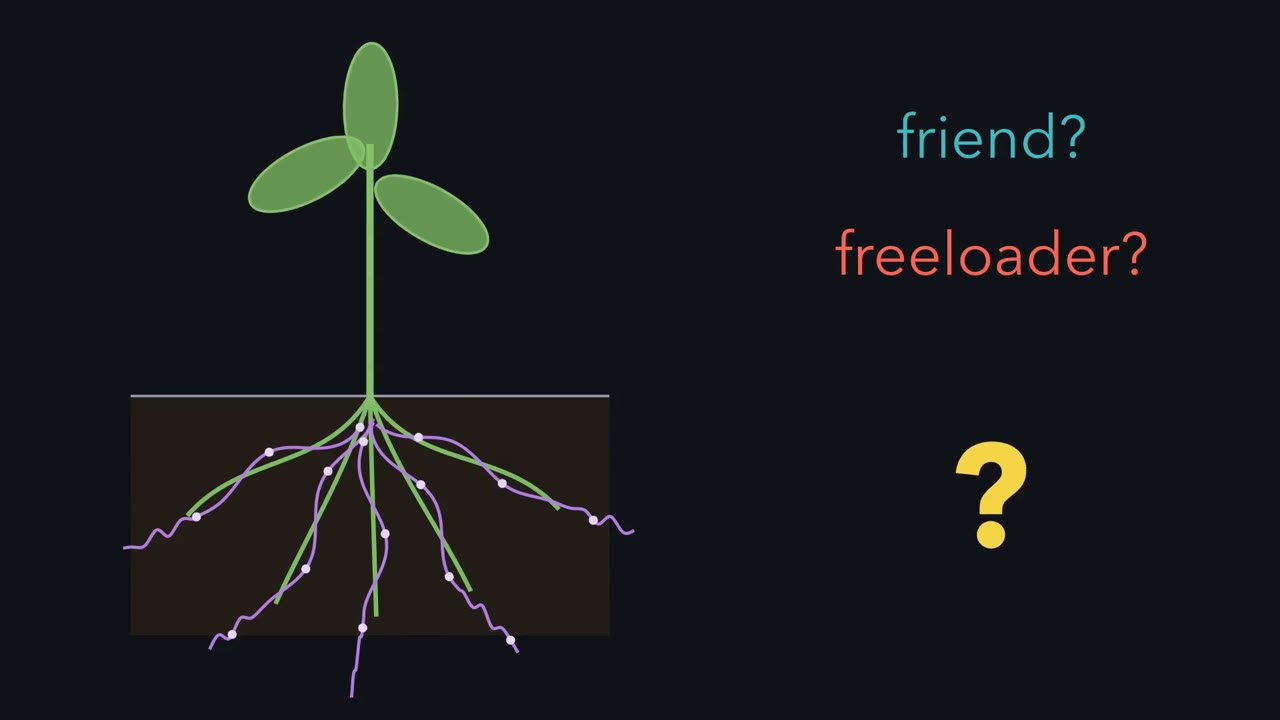
The same root fungus can help a plant in poor soil and cost it in rich soil. Is it a mutualist or a parasite?
Continue in the lesson: Mutualism, Parasitism and Coevolution →
3:46 · Free, with captions and a transcript. The lesson has the full text, the questions and the sources.
More films from this lesson
How this film was made. Narration: an AI narrator voice (Kokoro, af_heart) reading narration written from this lesson's text. Animation: AI-generated in code (Manim) by Claude, a schematic with no drawn molecular structures. Captions come from the narration script. See something wrong? Report it.