The Net Decides the Sign
Read the transcript of “The Net Decides the Sign”
Film transcript: The Net Decides the Sign
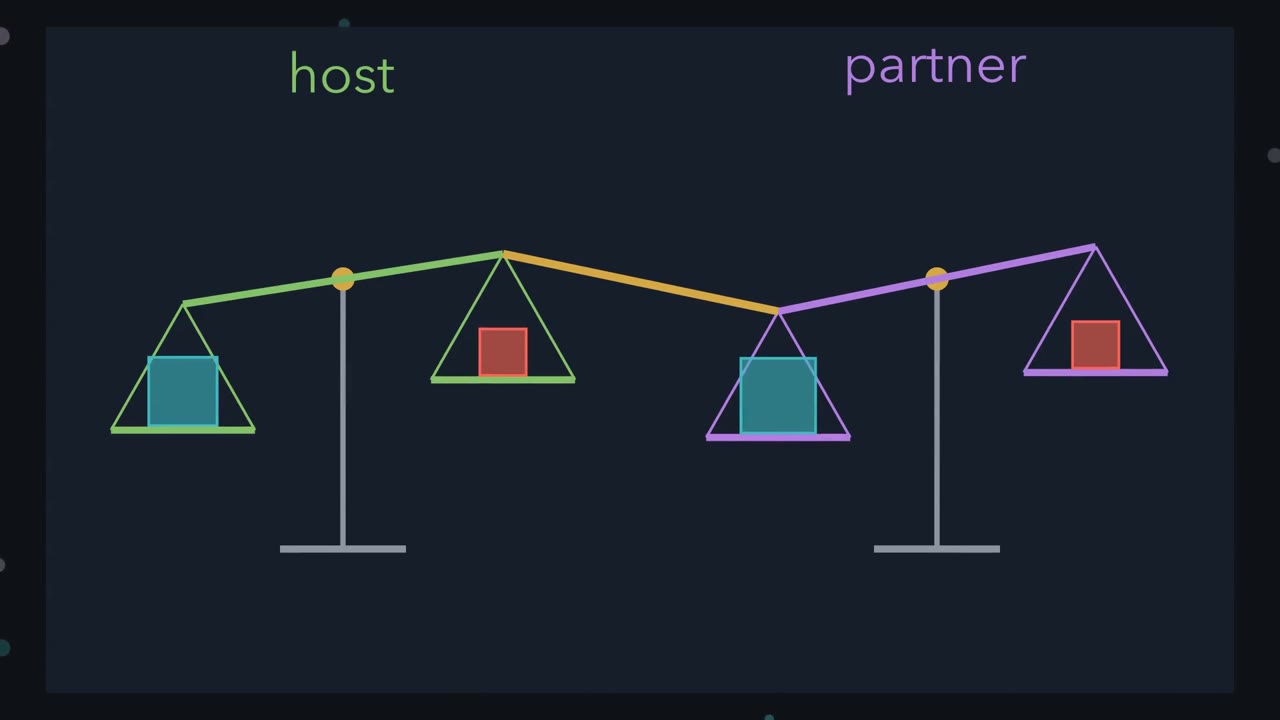
A fungus lives in a plant's roots. Is it a friend or a freeloader? You cannot tell by looking. So how would you find out? Measure each partner's fitness, its survival and reproduction. Then compare it with the same organism living without the partner. The difference is the partner's net effect. Picture a balance. On one side sits the benefit the partner brings. On the other sits the cost it takes.
Benefit minus cost is the net. The sign of that net names the interaction. Both partners gain: mutualism. One gains, the other shows no net change: commensalism. One gains, the other loses: parasitism. Now load the balance for a root fungus. The fungus takes carbon from the plant. That is the cost. It supplies soil nutrients, especially phosphorus. That is the benefit. In this sketch, phosphorus starts scarce, so the fungus's delivery is worth a lot. The benefit outweighs the cost. The plant's net is positive. Now add phosphorus until it is plentiful. Suppose the carbon cost stays the same. Where does the plant's net go?
The benefit shrinks, because phosphorus is no longer scarce. In this sketch, the net slides through zero. The same fungus now costs the plant. If the fungus still gains, the pair has moved from mutualism toward parasitism. Ecologists call this the mutualism-parasitism continuum. Where a pair sits depends on conditions. A net of zero needs care too. A large benefit and a large cost can cancel. A level balance can still be carrying heavy loads. The partner's own traits load the balance as well. Rhizobia are bacteria in legume root nodules, small swellings on the roots. They fix nitrogen from the air and take carbon in return. Now picture a strain that takes carbon but skips the fixing.
It could leave more offspring than an honest strain, and spread. What stops it? One answer is a host sanction. The host cuts the reproduction of rhizobia in nodules that do not fix. That puts a new weight on the cheater's cost side. Now let the partners evolve. A change in one shifts the other's balance, so selection on the other changes. If the other then evolves in response, that is coevolution.
Daniel Janzen set this standard. A good fit between two species is not the evidence. Change in both partners is. So an interaction's sign is not a label fixed to a species. Each partner's side is a net, measured against life without the partner. Conditions can move it.
The same root fungus can help a plant in poor soil and cost it in rich soil. Is it a mutualist or a parasite?
Continue in the lesson: Mutualism, Parasitism and Coevolution →
3:36 · Free, with captions and a transcript. The lesson has the full text, the questions and the sources.
More films from this lesson
How this film was made. Narration: written from this lesson's text and read by an AI narrator voice (Kokoro, af_heart). Animation: AI-generated in code (Manim) by Claude, a schematic with no drawn molecular structures. Captions come from the narration script. See something wrong? Report it.