Films · Genetics and Molecular Biology
When Damage Becomes Mutation
Read the transcript of “When Damage Becomes Mutation”
Film transcript: When Damage Becomes Mutation
The first film separated a variant's origin from selection. Now a DNA strip is damaged; is the cell mutated yet? Follow how that variant begins. The red mark appears before any daughter sequence has formed. A mutation is a heritable change in DNA sequence.
Heritable matters here. A temporary chemical lesion is damage, but it is not automatically a changed sequence. The sequence must change and persist when the cell divides. Changes can begin in two broad ways. Copying can place the wrong block. Or chemistry can damage a block before the next copy. Either route can end without a mutation. Damage enters a fork.
Repair may restore the original block. If repair misses it, copying may preserve the original sequence or produce a different one. The lesion's presence does not choose the outcome. Before the strip reaches that fork, predict: must a red damage mark become a mutation? Trace every possible path before choosing.
No. On one path, repair removes the lesion and restores the blue block. After copying, both daughter strips keep the original sequence. The cell had damage, yet no mutation remains. On another path, copying places a wrong block opposite the lesion. At the next copy, that wrong block templates a full base-pair change. The damaged strand goes to a separate daughter, where repair or bypass can follow. In the changed lineage the lesion is gone, but its consequence persists. Internal chemistry and ordinary copying create spontaneous mutations without an applied mutagen. Outside agents are mutagens when they raise mutation. Both routes end the same way.
A change becomes a mutation only if repair or copying leaves a heritable sequence change. The effect on a protein may range from none to loss of function, and occasionally a changed or gained function. Those consequences come after the inherited sequence change. Only after a heritable variant exists can an environment change its representation. The first film followed that later sorting step with phage resistance.
Selection cannot reach backward and request that earlier change. Damage becomes mutation when repair or copying leaves a heritable sequence change. Repair can erase the damage first. The inherited sequence, not the lesion, is the mutation. A red mark alone never satisfies the definition. The lesson now names the specific sources of these changes. Then the Ames test asks whether a chemical raises mutations in bacteria. Those details belong in the text that follows.
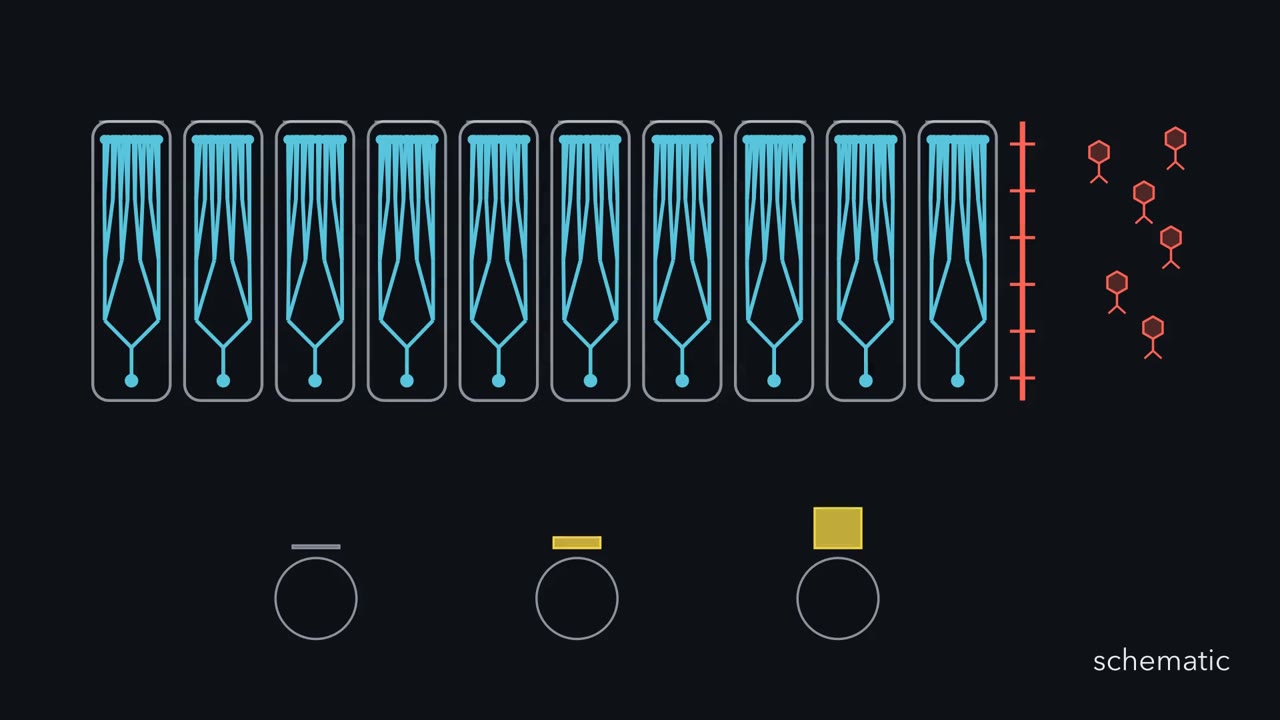
Ten bacterial cultures meet the same virus: why does one leave 52 resistant colonies while five leave none?
Continue in the lesson: Mutation: Where Variation Comes From →
3:29 · Free, with captions and a transcript. The lesson has the full text, the questions and the sources.
More films from this lesson
How this film was made. Narration: an AI narrator voice (Kokoro, af_heart) reading narration written from this lesson's text. Animation: AI-generated in code (Manim) by Claude, a schematic with no drawn molecular structures. Captions come from the narration script. See something wrong? Report it.