A Fish That Learns to Cancel Its Own Pulse
Read the transcript of “A Fish That Learns to Cancel Its Own Pulse”
Film transcript: A Fish That Learns to Cancel Its Own Pulse
An electric fish senses the world with its own pulses. Why does every pulse not mask what it listens for? Each pulse also stimulates its passive electroreceptors. These only listen, for weak fields from outside sources. The command that fires the electric organ is also copied to the electrosensory lobe. Bell found that the effect of that copy is not fixed. It changed to match the input from the receptors. Now the key test. Paralyse the fish. The brain still issues the command, but the electric organ no longer fires. Pair each command with an artificial stimulus that mimics a pulse. Then switch the stimulus off. Predict. What does the command alone now do in the lobe?
It evokes a mirror of the paired input. Where the stimulus excited the cells, the command alone inhibits them. This mirror is called a negative image. Added to the real input, it cancels it. It was learned, because it followed whatever stimulus had been paired.
How does one command become a mirror with the right timing? Kennedy and colleagues recorded in awake, paralysed fish. Granule cells respond to the command at different delays. Unipolar brush cells add delayed responses. Together they form a temporal basis, a bank of signals each peaking at a different moment. Two rules set their strengths. An input followed shortly by a broad spike in the cell's dendrites is weakened. And every active input is strengthened a little, whether or not the cell fires. On average, each active synapse weakens or strengthens according to the broad teaching spikes that follow it. With enough differently timed inputs, learning shrinks the predicted response.
So learning shrinks the response to the pulse. The command alone now dips where the pulse excited the cell. A model built on these recordings learned to cancel the predicted input. The limit: a paralysed fish, plus a model. Take this with you. Using a copy of the command, the circuit learns a timed negative image of the expected input.
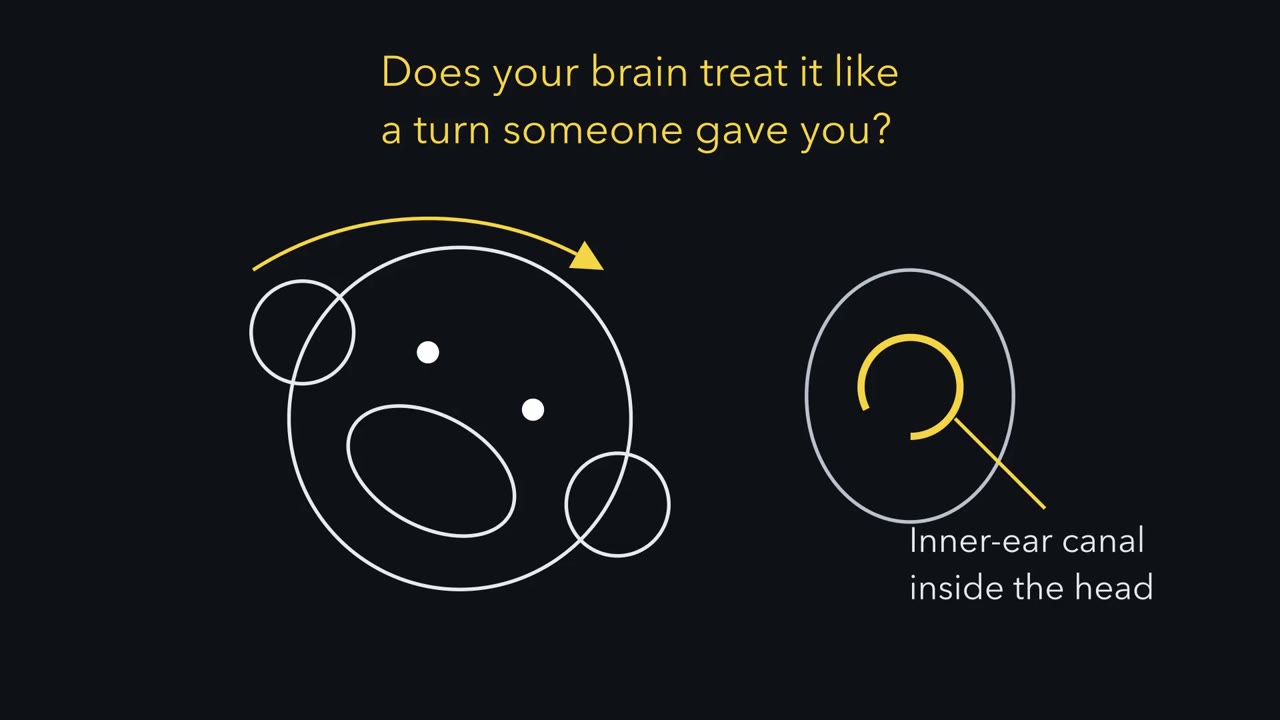
Your senses disagree, and some of what they report is only the result of your own movement. How does a nervous system decide which sense to trust, and what to subtract? Subtracting self-generated input is one candidate explanation for why you can hardly tickle yourself, though the full answer is not settled.
Continue in the lesson: Combining Senses and Predicting Them →
2:38 · Free, with captions and a transcript. The lesson has the full text, the questions and the sources.
More films from this lesson
How this film was made. Narration: an AI narrator voice (Kokoro, af_heart) reading narration written from this lesson's text. Animation: AI-generated in code (Manim) by Claude, a schematic with no drawn molecular structures. Captions come from the narration script. See something wrong? Report it.