Why Genes Keep Time
Read the transcript of “Why Genes Keep Time”
Film transcript: Why Genes Keep Time
Two species left no fossil of the moment they split. Can their genes still tell you when it happened? Line up the same gene from both, and some sites differ. Start with one ancestral population. It splits into two lineages, and each keeps gaining mutations. Some spread until every member of the lineage carries them. A mutation that has spread like that is a substitution. Substitutions build up on both branches, starting from the common ancestor. So the differences you count between two species come from both branches added together. If substitutions pile up at a steady pace, their count measures time. But why should the pace be steady at all?
The answer lies inside a population. Picture two populations, one small and one large. Every generation, each copies the same gene. Follow only the neutral mutations. They make no difference to survival or reproduction. Suppose the large population were ten times bigger. It makes ten times more new mutations each generation. Does it pile up substitutions ten times faster?
No. Each new neutral mutation starts as one copy among many. In the large population, its chance of spreading to everyone is smaller, by the same factor. More mutations, but each one is less likely to spread. The two effects cancel. On average, neutral mutations become substitutions at the rate they arise, whatever the population size. That steady input makes the clock tick.
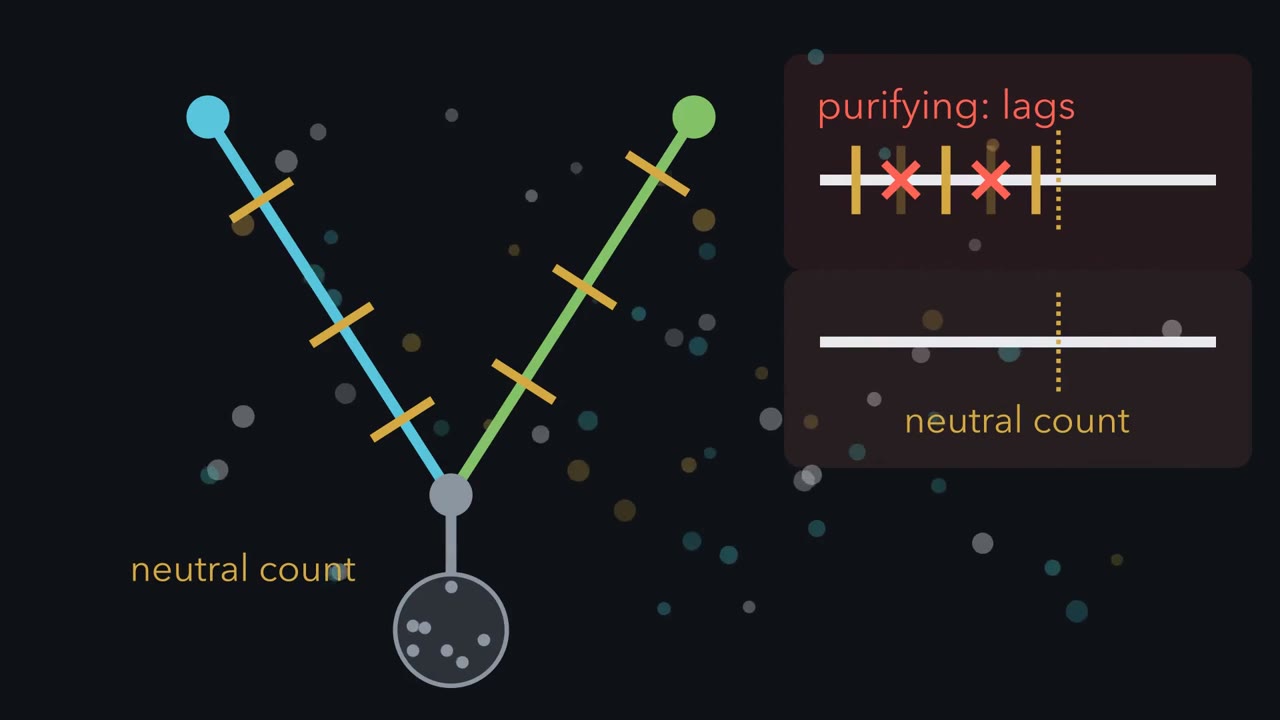
Now try to read a count as time. One distance could mean a fast rate over a short time. It could also mean a slow rate over a long time. The sequences alone cannot tell which. You need one date from outside the sequences. The commonest is a fossil. If two splits share a rate, one dated split can date the other. But a fossil only shows the group existed by then. The real split was earlier, by an unknown margin. So a fossil gives a minimum age. One limit already matters. The clock counts neutral changes. A mutation removed by selection never becomes a substitution, so a tightly constrained gene ticks slowly. So neutral changes pile up, on average, at the rate they arise.
Count them, add one dated split, and the count becomes time.
Two species left no fossil of their split. Can their genes still tell you when it happened?
Continue in the lesson: Molecular Evolution →
3:07 · Free, with captions and a transcript. The lesson has the full text, the questions and the sources.
More films from this lesson
How this film was made. Narration: written from this lesson's text and read by an AI narrator voice (Kokoro, af_heart). Animation: AI-generated in code (Manim) by Claude, a schematic with no drawn molecular structures. Captions come from the narration script. See something wrong? Report it.