Films · Developmental Neuroscience
Size Counts the Doublings
Read the transcript of “Size Counts the Doublings”
Film transcript: Size Counts the Doublings
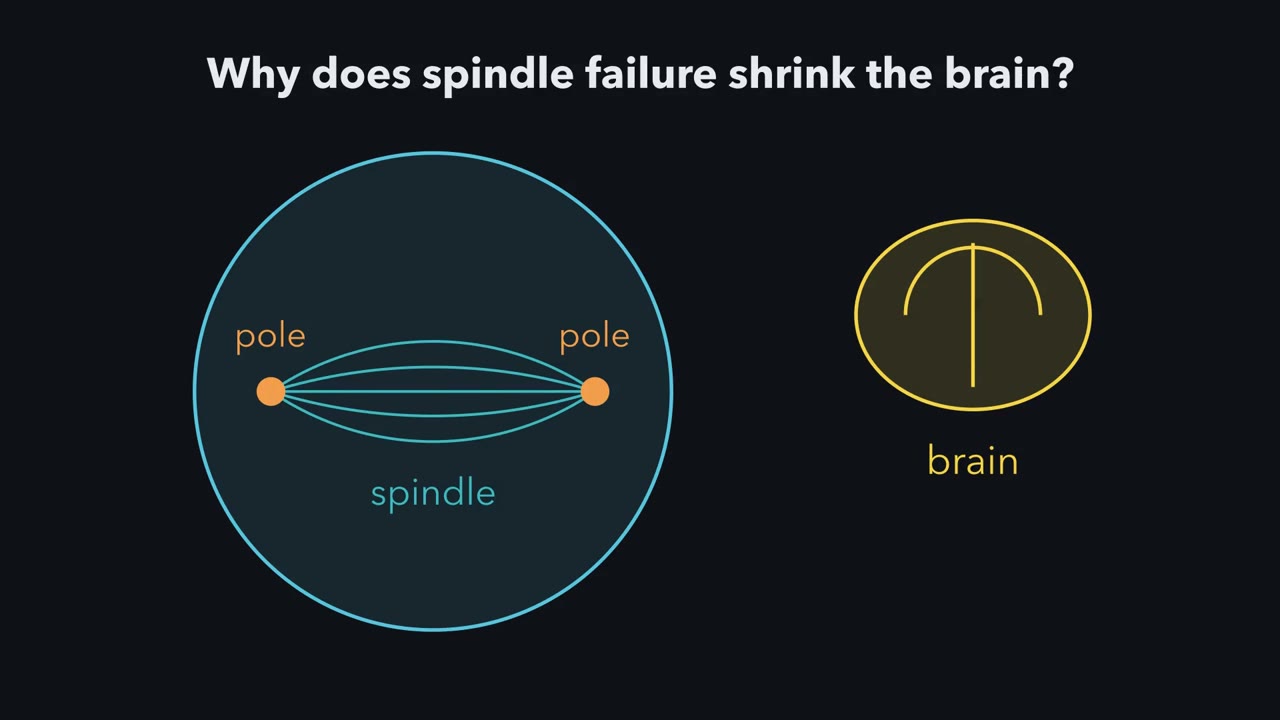
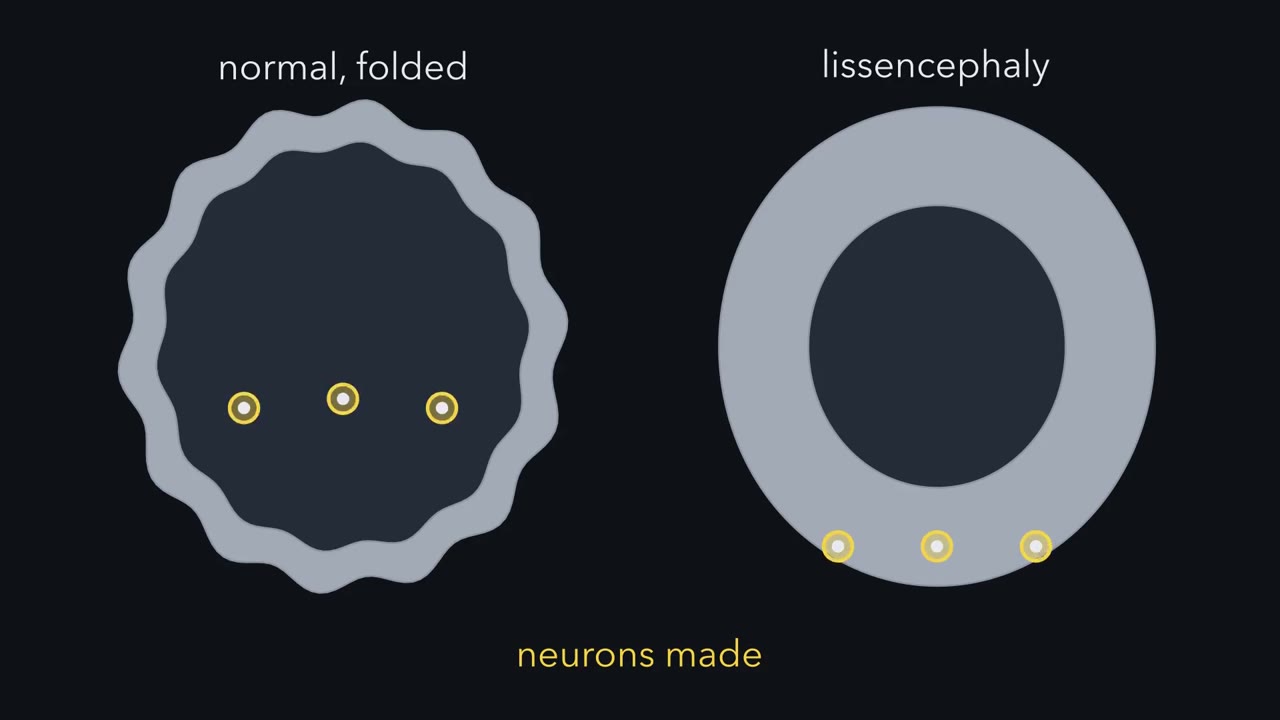
Two children have malformed cortices. One is small, with its layers in order. The other is thick and nearly smooth. Which step failed in each? Building a cortex takes two jobs. Radial glia at the ventricle divide, to make more of themselves and then neurons. Then each neuron climbs a glial fiber to its layer. So too few can be made, or they can stall. The first job multiplies. Early on, each division makes two progenitors. So every round doubles the pool. Switch one round early, and the pool is halved. Switch two rounds early, and it falls to a quarter. Now a subtler fault. Suppose each division has a one in ten chance of coming out neurogenic, for that round only.
Predict. Let the pool run ten rounds. How big is it then, compared with normal? About 60 Each neurogenic division is one progenitor short. So each round falls 5 percent short of doubling. Over ten rounds, that costs two-fifths of the pool. Small faults compound.
The second job does not multiply. A neuron that stalls takes no descendants with it. At the bedside, size is read with a tape measure. The cutoff for microcephaly is two standard deviations below the mean. On a rough sphere model, a head at the cutoff holds a brain only about a fifth smaller. That compares volumes. It does not count neurons, or lost divisions. Children with ASPM mutations often have far smaller heads, many standard deviations below the mean. In a bell-shaped population, about two babies in a hundred fall below the cutoff. A small head is a sign, not a diagnosis. Here is the one idea. Size counts the doublings. Layering records the journey.
Small with orderly layers points to production. Near-normal size with disordered layers points to migration. It is a first question, not a diagnosis. So when a cortex is malformed as it is built, ask first which job failed.
Why does the same doublecortin mutation give a boy a smooth brain and his mother a second band of cortex?
Continue in the lesson: When Building Goes Wrong: Microcephaly, Zika and Lissencephaly →
2:35 · Free, with captions and a transcript. The lesson has the full text, the questions and the sources.
More films from this lesson
How this film was made. Narration: an AI narrator voice (Kokoro, af_heart) reading narration written from this lesson's text. Animation: AI-generated in code (Manim) by Claude, a schematic with no drawn molecular structures. Captions come from the narration script. See something wrong? Report it.