Digest Outside, Fuse in Two Steps
Read the transcript of “Digest Outside, Fuse in Two Steps”
Film transcript: Digest Outside, Fuse in Two Steps
Sequences put fungi closer to animals than to plants. Yet a fungus eats like neither. So how does a mould on bread eat, with no mouth and no gut? Watch a spore land on the bread. It grows a single thread, called a hypha. The hypha branches again and again into a mass called a mycelium. That fuzz is the mould. Each thread is wrapped in a wall that contains chitin, a tough polymer also found in insect exoskeletons. Fungi do not photosynthesize. So this mould's food must come from the bread. At the growing tip, the hypha releases enzymes into the bread. The enzymes cut starch, a large molecule, into small sugars outside the fungus. Then the hypha takes the sugars in.
So a fungus digests first and takes food in second. Most animals do the reverse. They take food into a gut, and digest it there. A thin thread suits this way of eating. Every part of its cytoplasm stays close to the surface where the food comes in. Some fungi skip the threads. A yeast is a single cell. Baker's yeast reproduces by budding, pinching a small daughter cell off a larger one. Now, how many fungi mate. Two hyphae of different mating types grow toward each other and meet. Their cytoplasm joins. This step is called plasmogamy. Each partner brought a haploid nucleus, carrying one set of chromosomes.
Now the joined cell holds both nuclei, one from each partner, side by side. Two sets of chromosomes, in one cell. So is this cell diploid? Think about where the two sets are. Not yet. A diploid nucleus holds both sets in one nucleus. Here the two sets sit in two separate nuclei. A cell like this is called a dikaryon. In mushroom-forming fungi, this stage can last a long time. Only a later step fuses the two nuclei into one diploid nucleus. That step is karyogamy. Plasmogamy joins cells. Karyogamy joins nuclei. Then meiosis follows, and the cycle comes back to where it began. It makes haploid spores, each carrying one set of chromosomes again.
So a fungus eats by digesting outside itself and absorbing what it frees. And it mates in two steps. Cells fuse first, and nuclei later.
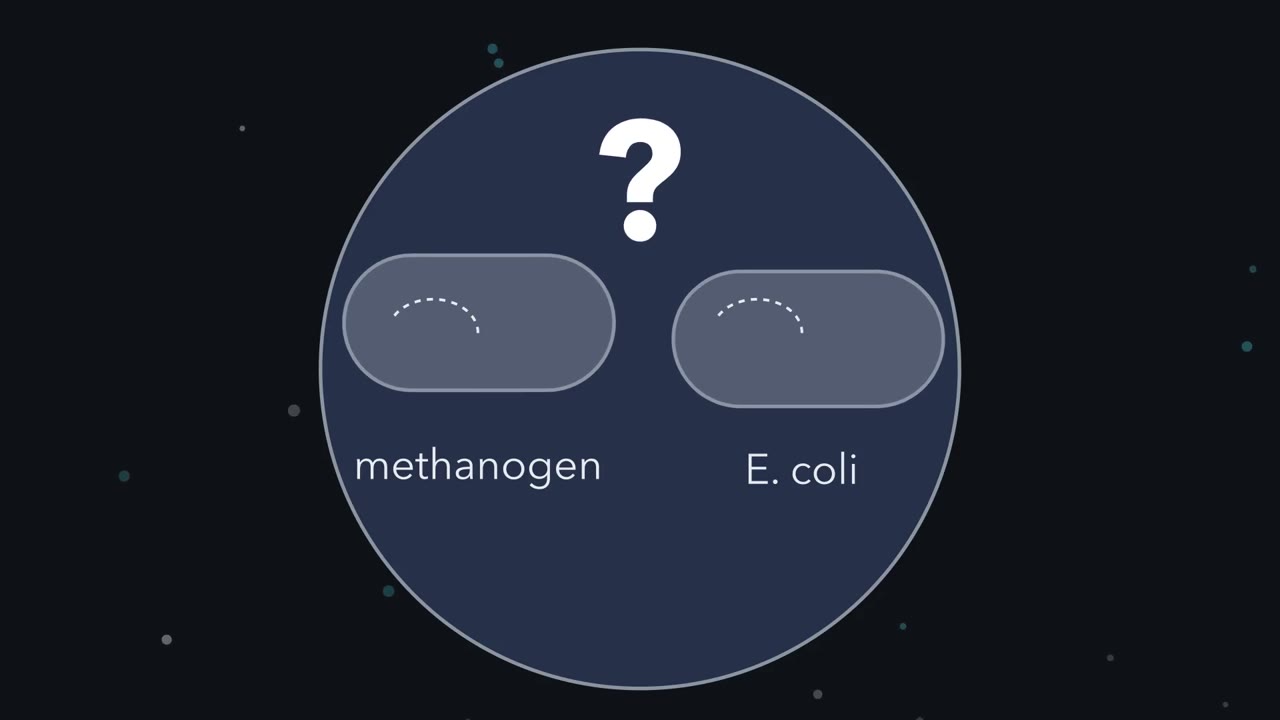
A methane-making microbe and E. coli look alike under a microscope. How can we tell whether they are close relatives?
Continue in the lesson: Microbes, Protists and Fungi →
3:11 · Free, with captions and a transcript. The lesson has the full text, the questions and the sources.
More films from this lesson
How this film was made. Narration: an AI narrator voice (Kokoro, af_heart) reading narration written from this lesson's text. Animation: AI-generated in code (Manim) by Claude, a schematic with no drawn molecular structures. Captions come from the narration script. See something wrong? Report it.