Read the Traffic
Read the transcript of “Read the Traffic”
Film transcript: Read the Traffic
Chapter one showed that the energy hill sets which way a solute moves. So how can data reveal whether it crossed through a channel or a carrier? Watch the traffic, not the protein's name. An open channel is a continuous pore between both sides. Ions stream through without waiting for a transport cycle. A channel can switch between open and closed; a carrier must finish each alternating-access cycle. A carrier opens to one side, closes around its solute, then opens to the other. That shape change limits each trip. A single channel gives the detector square current steps. Millions of ions per second can cross one pore, producing measurable current.
Each jump marks an opening. The step height is the unitary current through one open channel. The fraction of recording time spent open is its open probability. Those are different measurements. Now a drug makes the openings last longer, but every step keeps the same height. What changed: current through one open channel, or open probability?
Decide from the trace. Open probability increased: the channel spent more of its time open. Unchanged step height means unchanged unitary current at this voltage. A whole-cell current alone mixes channel number, unitary current, and open probability, so it cannot separate them. Carriers leave a different signature.
Raise substrate concentration and their limited binding sites become occupied. The rate bends toward a ceiling called Vmax. A pore or simple diffusion can stay nearly proportional over the tested range. Channels can saturate too, usually only at much higher concentrations.
Saturation points toward a carrier, but it is evidence, not proof. Tracer experiments add a detectable tag to some substrate molecules. The counter sees tagged molecules entering, not the total amount inside. Take carrier vesicles with substrate already equal inside and outside. Add tagged substrate outside. Tagged molecules enter as untagged ones leave, so the total inside stays the same. A chemical assay of total substrate supplies what the tracer counter lacks. That is exchange, not net uptake.
Label has its own concentration difference, so it can run in while total substrate stays level. A rising count alone never proves accumulation. So measure the total, and combine exchange with rate, saturation, and single-channel steps instead of trusting one clue. The hill from chapter one tells you which way traffic can run. The pattern of that traffic reveals the route. Square steps point to a pore. Saturation and exchange point toward a carrier. Mechanism lives in the measurements, not the family name.
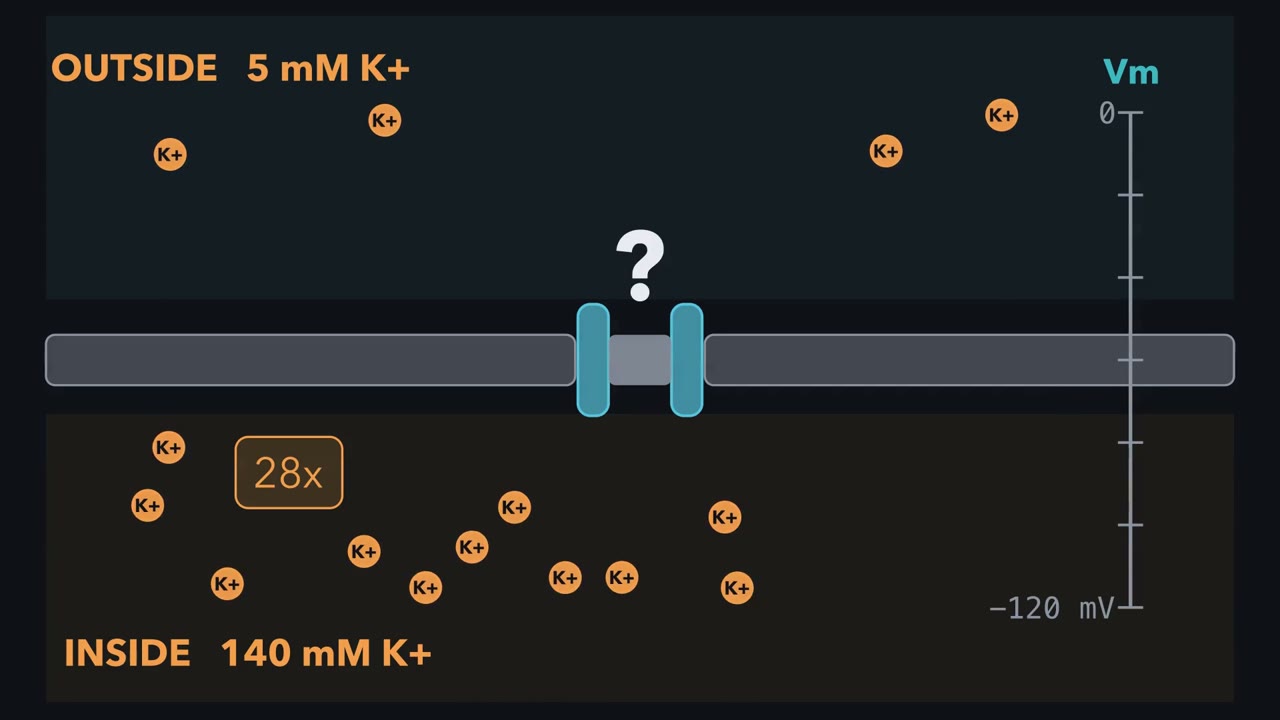
Which way will potassium flow if you hold a cell at −70 millivolts? Its concentrations alone will not tell you.
Continue in the lesson: Transport Across Membranes →
3:35 · Free, with captions and a transcript. The lesson has the full text, the questions and the sources.
More films from this lesson
How this film was made. Narration: an AI narrator voice (Kokoro, af_heart) reading narration written from this lesson's text. Animation: AI-generated in code (Manim) by Claude, a schematic with no drawn molecular structures. Captions come from the narration script. See something wrong? Report it.