Across or Along the Membrane?
Read the transcript of “Across or Along the Membrane?”
Film transcript: Across or Along the Membrane?
Chapter one showed why a membrane protein keeps its direction during traffic. But lipids are not locked in place. How does a cell keep different lipids on the two faces while molecules still move? A red blood cell gives the best-measured example. PS and PE sit mainly on the cytoplasmic leaflet. PC and sphingomyelin sit mainly outside.
Sideways drifting does not erase that pattern. Crossing is different. A phospholipid's polar head rarely enters the membrane's oily core unaided. Without help, most phospholipids change leaflets slowly. Slow is not zero, so cells spend energy to maintain asymmetry. An ATP-driven flippase selects lipids such as PS and PE and moves them inward. A scramblase does something different. When switched on, it lets lipids cross both ways without energy. The two leaflets then mix. Together, slow leakage, pumps, and regulated scrambling create a steady state, not a permanent arrangement. Flippases keep restoring selected lipids. Switching on a scramblase lets the pattern collapse.
Now predict. Suppose every phospholipid slides sideways, but none crosses to the other leaflet. Will the two faces become mixed? No. Each leaflet becomes well stirred, yet the lipids remain on their original face. Across and along are independent directions. Lateral diffusion is that motion along the membrane. Fluorescence recovery after photobleaching, or FRAP, measures lateral motion. Fluorescent membrane proteins begin bright. A brief laser makes one spot dark. Unbleached proteins then diffuse into it. The recovery curve answers two questions. How much fluorescence returns gives the mobile fraction. How quickly it reaches half of that return gives the half-time.
Dark molecules still move; bleaching only removed their fluorescence. Take the film's computed example. Fluorescence starts at one hundred, falls to twenty, then plateaus at eighty. Sixty units returned, but eighty were bleached. The mobile fraction is sixty divided by eighty, or zero point seven five. Half of the recoverable increase is thirty. Add that to twenty, making the halfway level fifty. The curve reaches fifty at four seconds, so its recovery half-time is four seconds. Under a stated diffusion model, spot size and half-time can estimate a diffusion coefficient. The estimate is approximate because the bleach and membrane must match that model. Binding or barriers can change recovery.
So a membrane can preserve two different faces while its components move. Fast crossing needs a machine; sideways motion does not. Pumps build lipid asymmetry, scramblases erase it, and FRAP measures lateral diffusion.
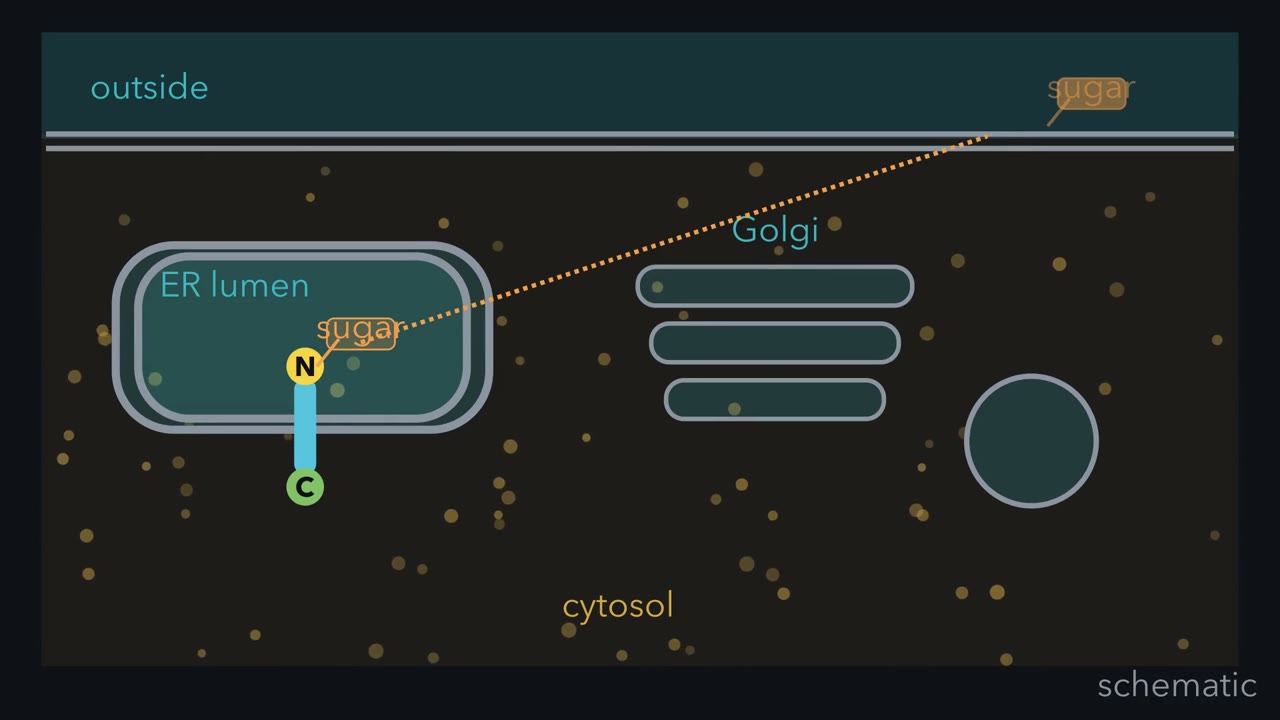
A membrane has two faces that differ in their lipids and in the parts of each protein they carry. Who builds that difference, and why does vesicle traffic never flip it?
Continue in the lesson: Membrane Organization and Topology →
3:43 · Free, with captions and a transcript. The lesson has the full text, the questions and the sources.
More films from this lesson
How this film was made. Narration: an AI narrator voice (Kokoro, af_heart) reading narration written from this lesson's text. Animation: AI-generated in code (Manim) by Claude, a schematic with no drawn molecular structures. Captions come from the narration script. See something wrong? Report it.