Which Side Is Outside?
Read the transcript of “Which Side Is Outside?”
Film transcript: Which Side Is Outside?
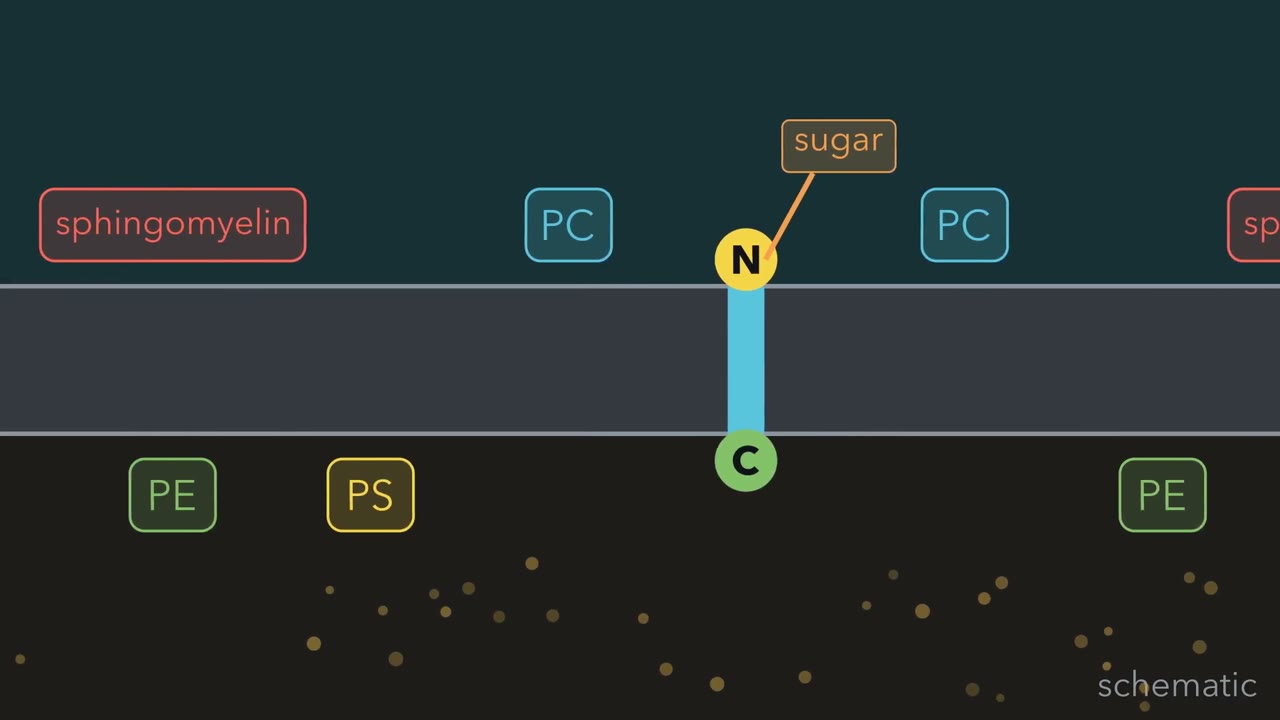
How does a sugar added to a protein inside its ER end up outside the cell? No vesicle ever carries it across a membrane. Every membrane here is two sheets of lipid, so it has two faces. One face always touches the cytosol, the fluid around the organelles. The other face touches either the outside of the cell, or a lumen, the space inside an organelle. Every space touching a cytosol face is gold. Every lumen on these routes, and the outside, is teal. On these routes, each membrane has one gold face and one teal face. A patch of the plasma membrane dimples inward and pinches off as a sac. Predict: what fills the sac, and which face touches the cytosol?
It holds a gulp of outside fluid, so its lumen is teal. The gold face still touches the cytosol. Nothing crossed a membrane. It only changed shape. Here is the rule. On these routes, lumens count as outside because budding and fusing connect them without crossing a membrane. So where does a protein get its direction? It is normally set once, at the ER, as the chain is made. A channel called the translocon threads one end into the lumen. Here the N terminus goes into the lumen, and the C terminus stays in the cytosol. That is called type I. In the lumen, an enzyme adds the sugar to the N-terminal region.
A vesicle buds from the ER and fuses with the Golgi. Its lumen joins first the ER lumen, then the Golgi lumen. The sugar never leaves teal. A secretory vesicle then fuses with the plasma membrane. Its lumen opens to the outside. The sugar now faces the fluid around the cell. It rode inside a lumen the whole way.
Endocytosis can bring the protein back in. Now the sugar faces the endosome lumen. At no step did the C terminus leave the cytosol. So the cell chooses a protein's sides once, usually at the ER. After that, traffic only carries it from lumen to lumen. Secretory and endocytic lumens count as outside; traffic never flips proteins.
A membrane has two faces that differ in their lipids and in the parts of each protein they carry. Who builds that difference, and why does vesicle traffic never flip it?
Continue in the lesson: Membrane Organization and Topology →
2:53 · Free, with captions and a transcript. The lesson has the full text, the questions and the sources.
More films from this lesson
How this film was made. Narration: written from this lesson's text and read by an AI narrator voice (Kokoro, af_heart). Animation: AI-generated in code (Manim) by Claude, a schematic with no drawn molecular structures. Captions come from the narration script. See something wrong? Report it.