Amount over Volume
Read the transcript of “Amount over Volume”
Film transcript: Amount over Volume
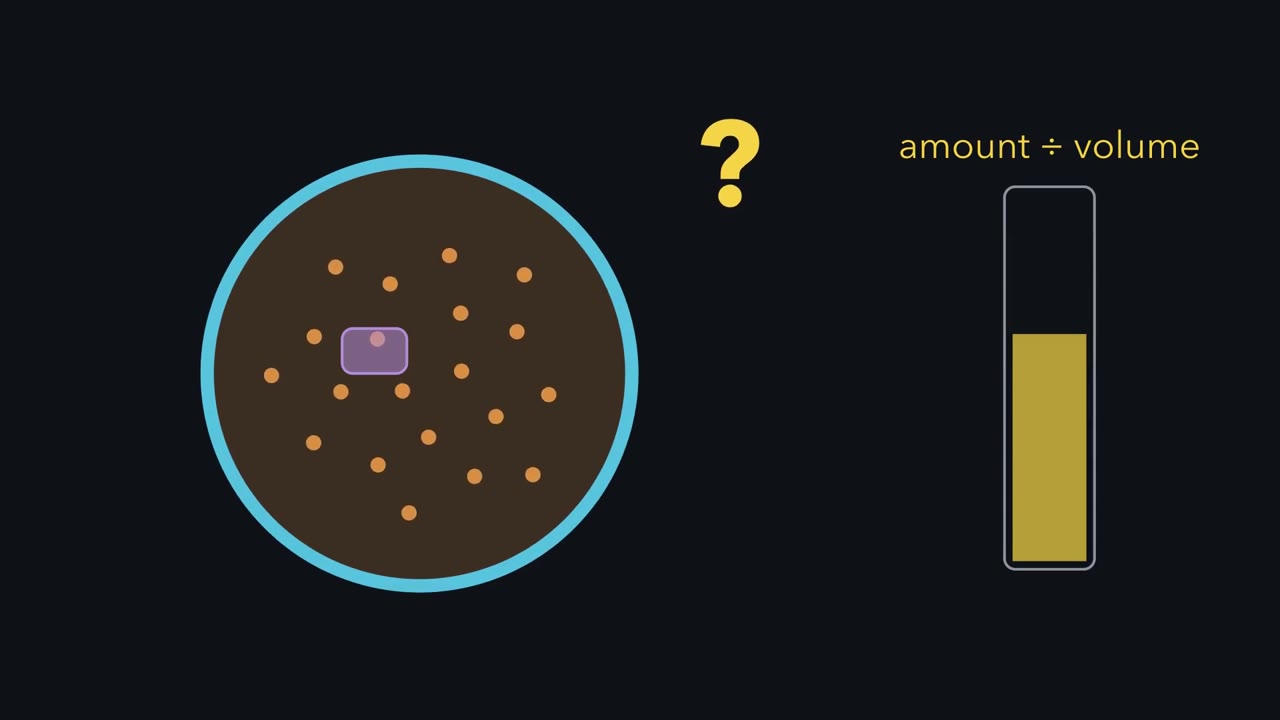
A yeast cell has no ruler. So how does it know when it is big enough to divide, and why would being too big hurt? One thing a cell can sense is a concentration: the amount of something, divided by the room it has. The gauge on the right reads it. Watch ten red dots. The number stays the same, the room grows, and the concentration falls. A leading model, still debated, says budding yeast uses this as a ruler. Each newborn daughter, whatever its size, gets about the same dose of a brake protein called Whi5. It holds back Start, the point where the cell commits to dividing. As the cell grows, the brake spreads through more room and the gauge sinks.
At the green line the brake gives way, and the cell commits. Now two newborns, one small and one large, each with the same red dose. Which must grow more before it commits? Pause and decide. The small one. Its dots start crowded, so its gauge starts higher, and it must grow more to dilute them. That works only because both got the same dose. In this simple model, both commit at the same size. Real cells are noisier, and close only part of the gap.
That is the one idea: amount over volume. As a cell grows, it dilutes anything whose amount does not keep pace. For most other contents, dilution is a danger. RNA and protein, the orange dots, do the cell's work. So most growing cells make them roughly in step with their volume. Their gauge stays flat. Their total amount grows with the cell, but their concentration does not, so it cannot be the ruler. Two things can fall behind. First, the genome, the cell's DNA, drawn as the purple block. Yeast held so they grow without dividing kept one copy while they swelled many times over. Their synthesis fell behind, so their cytoplasm, the material outside the nucleus, was diluted: the orange dots thinned out.
RNA is copied from the DNA. At such sizes, one genome copy appears to become a limit. The second is the surface. Everything the cell takes in crosses its membrane, the blue rim. But it uses what it takes in throughout its volume. Take a sphere, the simplest shape, and double its radius. The rim's area rises four times, the volume eight. So each bit of the inside has half as much membrane feeding it.
So one gauge does four jobs. A diluted brake may tell yeast its size. RNA and protein keep pace, so their concentrations stay steady. A single genome can fall behind, and so can a sphere's surface: two costs of being big.
A cell has no ruler, so how does it know its size, and what does being big cost it?
Continue in the lesson: Cells Control Their Size: A Measured Eukaryotic Cell →
3:33 · Free, with captions and a transcript. The lesson has the full text, the questions and the sources.
More films from this lesson
How this film was made. Narration: written from this lesson's text and read by an AI narrator voice (Kokoro, af_heart). Animation: AI-generated in code (Manim) by Claude, a schematic with no drawn molecular structures. Captions come from the narration script. See something wrong? Report it.