Parts Reveal the Difference
Read the transcript of “Parts Reveal the Difference”
Film transcript: Parts Reveal the Difference
The first film classified bacteria and viruses by what they can do. If both carry genes, why can a bacterium grow while a virus waits? Open them and follow the work. Start with the bacterium, a prokaryotic cell. Its membrane controls what enters and leaves.
Cytoplasm fills the inside. Ribosomes build proteins from instructions in DNA. That DNA sits in a nucleoid, a region without a membrane. Many bacteria also have a cell wall that helps prevent bursting when water enters. Some have a capsule outside. Some have flagella that spin to push them through water. These parts vary, but the working cell remains. Now open the virus. Its DNA or RNA sits inside a protein capsid. Some viruses add a lipid envelope outside. There is no cytoplasm and no ribosome workbench. A host cell must build every viral protein. Genes are the shared part, not proof that both are cells. The bacterium reads its genes with its own ribosomes.
Viral genes can be read only after they reach a suitable host cell. A working cell also needs energy and carbon. Energy powers the work. Carbon supplies material for new parts. For a useful first model, sort bacteria into common patterns by where those inputs come from. Heterotrophs take in carbon compounds for both energy and carbon.
Photoautotrophs use light for energy and carbon dioxide for carbon. Chemoautotrophs use chemicals for energy and carbon dioxide for carbon. Predict the pattern in a dark spring. The bacterium uses sulfur compounds for energy and carbon dioxide for carbon. Which name fits, and which input tells you?
Chemoautotroph fits. Chemical energy selects chemo, and carbon dioxide supplies the carbon. The model is a simplification. Energy source and carbon source are separate questions, and a few bacteria mix the patterns. Dependence alone does not make a cell nonliving. Some bacteria grow only inside other cells, yet keep ribosomes and metabolism.
Viruses remain different because they are not cells and have no ribosomes of their own. Size does not decide the case either. Most viruses are smaller than typical bacteria. But some giant viruses are longer than small bacteria, so that shortcut breaks. Parts and work matter more than length. The comparison now has a reason. Bacterial parts let the cell obtain inputs and build proteins.
Viral parts carry genes between hosts. Bacteria are living cells; viruses are not cells and are classed nonliving.
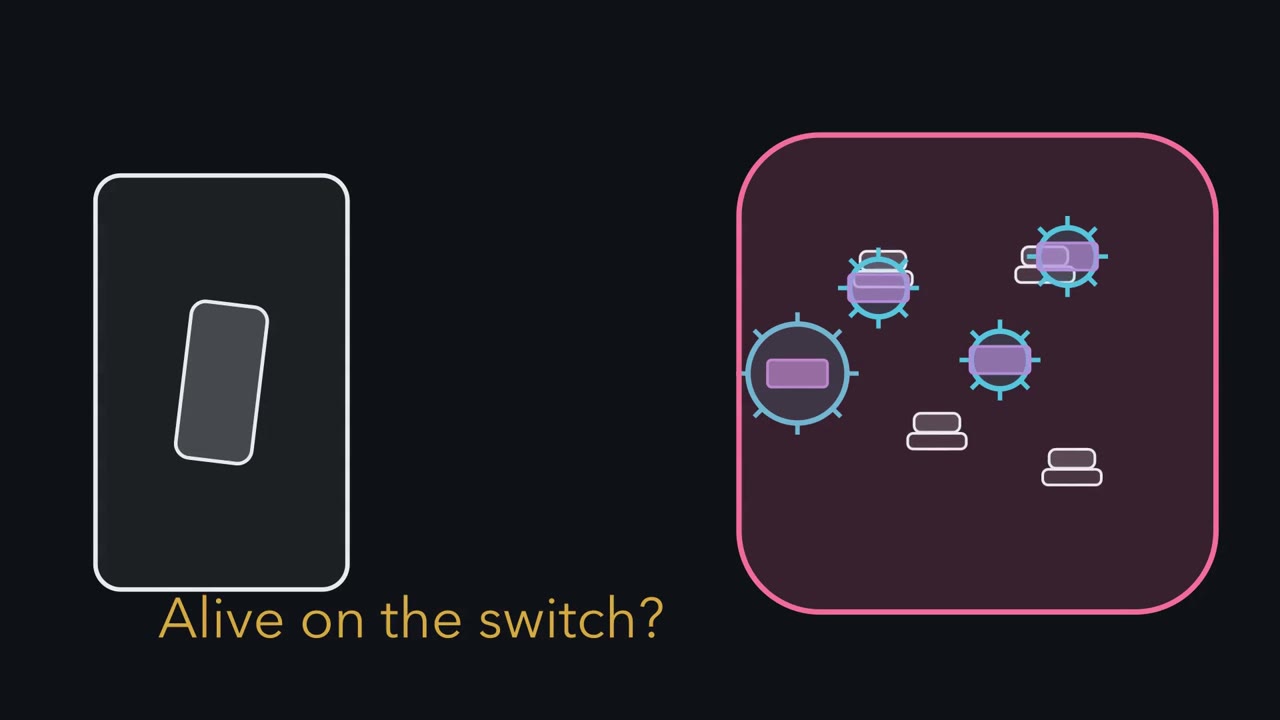
A cold virus on a light switch does nothing on its own for hours, yet inside your nose it gets cells to build new copies of it. Is it alive?
Continue in the lesson: Living or Not? Viruses and Bacteria →
3:33 · Free, with captions and a transcript. The lesson has the full text, the questions and the sources.
More films from this lesson
How this film was made. Narration: an AI narrator voice (Kokoro, af_heart) reading narration written from this lesson's text. Animation: AI-generated in code (Manim) by Claude, a schematic with no drawn molecular structures. Captions come from the narration script. See something wrong? Report it.