Who Can Act Alone?
Read the transcript of “Who Can Act Alone?”
Film transcript: Who Can Act Alone?
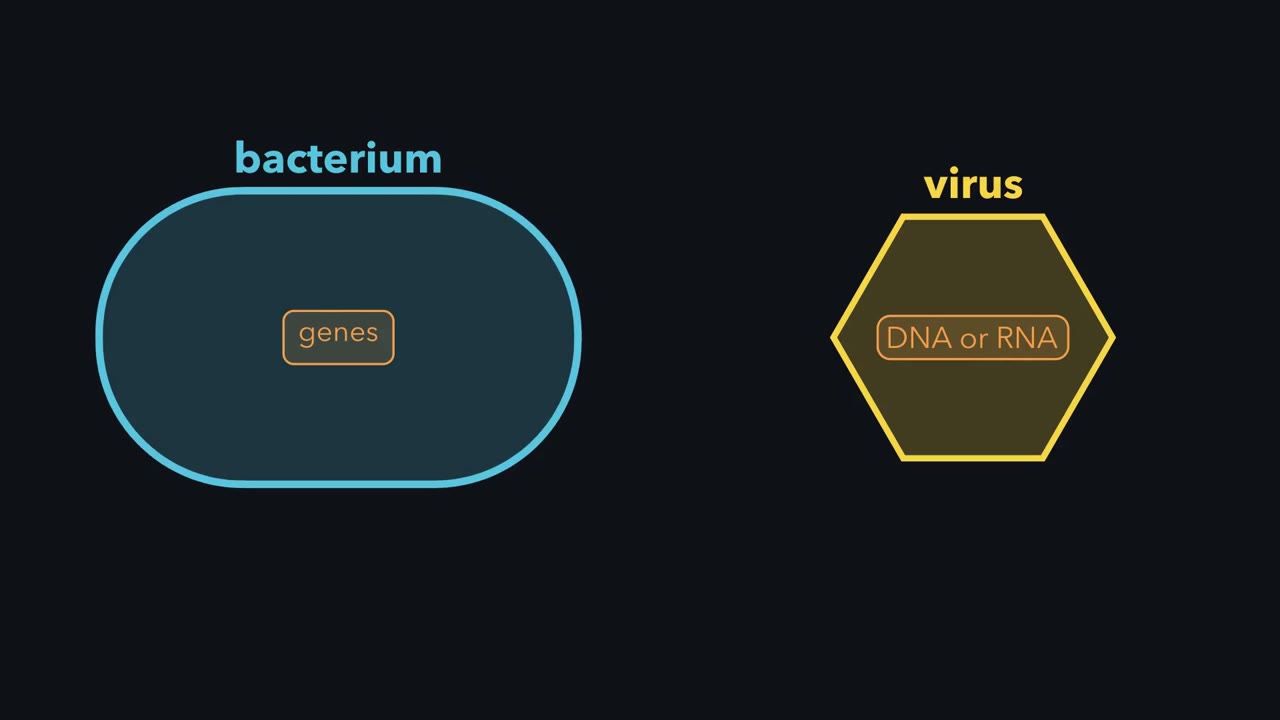
A virus waits on a light switch, then reaches a cell that makes new copies. Was the virus alive on the switch? Watch what each object can do, and who supplies the work. Biologists organize evidence with characteristics of life. Living things have cells, use energy, grow, respond, keep conditions steady, reproduce, and evolve. The list guides a decision. It is not a score where an individual tick wins. Bring in a bacterium. It is a single cell with a membrane, cytoplasm, genes, and ribosomes. This prokaryote has no nucleus and, typically, no membrane-covered organelles. In suitable conditions, materials cross its membrane. Its ribosomes build proteins.
It uses energy, grows, responds, and divides. Now bring back the virus. It carries genes inside a protein capsid, but it is not a cell. The capsid protects the genes. Some viruses add a fatty envelope outside the capsid. It has no cytoplasm or ribosomes. Outside a host, it does not take in food, use energy, or grow. Predict what changes when the virus enters the host cell. Does the virus gain cell machinery, or does the host supply what it lacks? Keep your eye on the ribosomes.
The host supplies what the virus lacks. It provides ribosomes, energy, and building blocks. Viral genes use them to make virus parts. Host enzymes or viral enzymes copy the viral genes, depending on the virus. The parts assemble around the copies. The virus never gains its own metabolism. Edge cases show why a box cannot decide alone. A mature red blood cell cannot divide, yet it remains a cell. A crystal gets bigger, but it has no cells and no metabolism.
Growth alone is not enough. Viruses carry genes and evolve, so scientists still discuss their place near life's edge. Virginia biology classes viruses as nonliving because they are not cells and have no metabolism of their own. They depend on a host cell to be copied. Return to the switch. The virus can wait there and later be copied, but waiting is not living. The host cell supplies the ribosomes and energy. The bacterium carries its own cell machinery and can act when conditions suit it. So ask these questions. Is it a cell, and does it have its own ribosomes and metabolism? That leads to the course rule. Bacteria are living cells; viruses are not cells and are classed nonliving.
A cold virus on a light switch does nothing on its own for hours, yet inside your nose it gets cells to build new copies of it. Is it alive?
Continue in the lesson: Living or Not? Viruses and Bacteria →
3:19 · Free, with captions and a transcript. The lesson has the full text, the questions and the sources.
More films from this lesson
How this film was made. Narration: written from this lesson's text and read by an AI narrator voice (Kokoro, af_heart). Animation: AI-generated in code (Manim) by Claude, a schematic with no drawn molecular structures. Captions come from the narration script. See something wrong? Report it.