Press play to start at .
Three Drugs, One Gauge
From the film
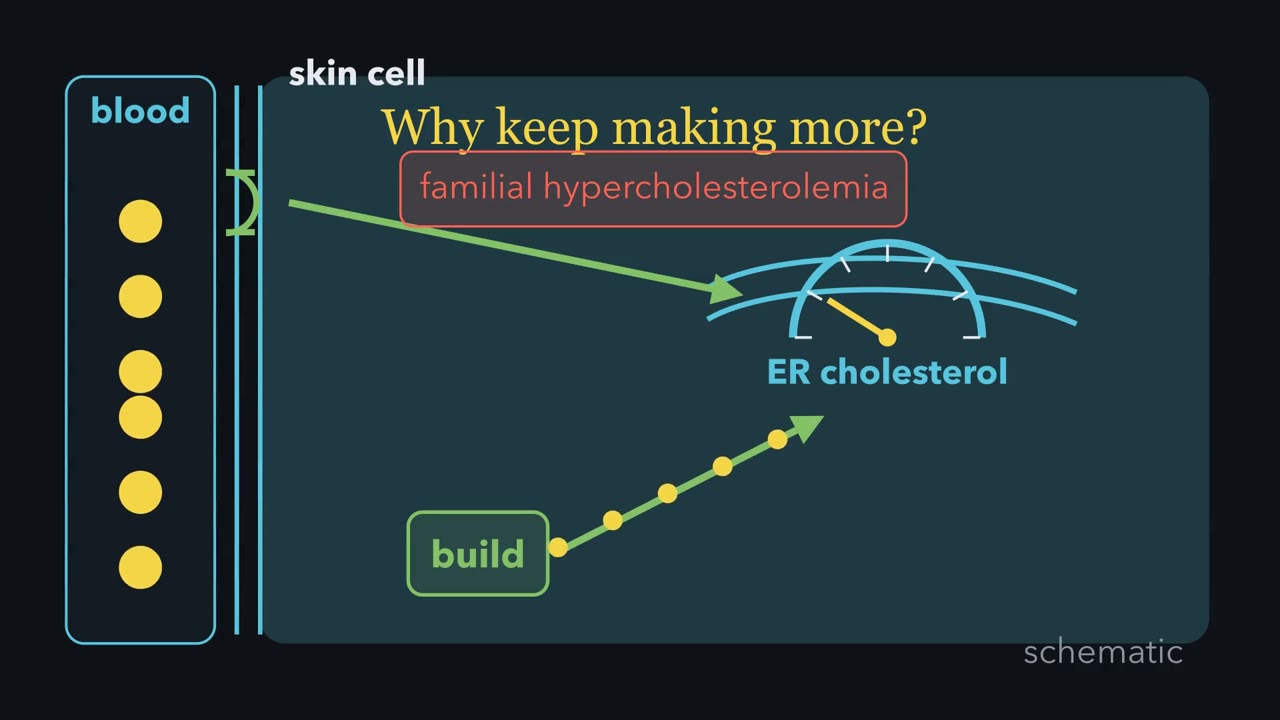
- A statin, ezetimibe and a bile-acid resin each lower cholesterol in the liver cell's ER.
- Ezetimibe blocks cholesterol absorption, and a resin traps bile acids so the liver turns more of its own cholesterol into new ones.
- Any drug that lowers liver-cell ER cholesterol tends to raise LDL receptors, because the gauge reads the level, not the cause.
- The same switch turns on PCSK9, which sends LDL receptors to the lysosome, so a statin gives back part of its gain.
Read the transcript of “Three Drugs, One Gauge”
Film transcript: Three Drugs, One Gauge
Tap a sentence to play from there.
- 0:00 A liver cell reads cholesterol in its ER membrane.
- 0:05 When the reading falls, it makes more LDL receptors.
- 0:09 Now meet three drugs.
- 0:12 A statin blocks the cell's own making line.
- 0:15 The other two act in the gut.
- 0:18 How can a drug in the gut change receptors in the liver?
- 0:24 Start with the drug from before.
- 0:27 A statin blocks HMG-CoA reductase, the main throttle.
- 0:33 Less new cholesterol reaches the ER, so the gauge reads low.
- 0:37 Cholesterol also reaches the liver from the gut.
- 0:42 Ezetimibe blocks cholesterol absorption, so less arrives by that route.
- 0:47 A different door, yet the ER reading drops again.
- 0:51 The third drug is a bile-acid resin.
- 0:55 The liver makes bile acids from its own cholesterol.
- 0:59 The resin traps bile acids in the gut.
- 1:02 Predict: what happens to cholesterol in the liver cell's ER?
- 1:12 It falls. With bile acids trapped in the gut, the liver turns more of its own cholesterol into new bile acids.
- 1:21 So ER cholesterol drops.
- 1:24 Here is the one idea.
- 1:27 Any drug that lowers cholesterol in the liver cell's ER tends to raise LDL receptors. The gauge reads the level, not where the shortage began.
- 1:38 Freed SREBP-2 turns on the LDL-receptor gene.
- 1:44 Liver cells carry most of the body's LDL receptors.
- 1:49 More of them at the surface pull more LDL from the blood.
- 1:53 This takes hours, because the gauge changes how much protein is made.
- 1:58 But the same switch turns on one more gene.
- 2:01 It makes PCSK9, a protein the cell secretes.
- 2:07 PCSK9 binds the LDL receptor and sends it to the lysosome to be destroyed.
- 2:13 Fewer receptors return to the surface.
- 2:16 So a statin raises PCSK9 along with the receptors, and gives back part of its gain.
- 2:24 The gauge brakes its own answer.
- 2:27 Three drugs, three doors: the making line, absorption, and the bile-acid drain.
- 2:33 Each one lowers the same ER pool.
- 2:36 Whatever drains it, the liver tends to answer the same way, with more receptors at its surface.
Cholesterol: the same idea, other levels
A level is a place to start, not a rank. If this loses you, the rung below teaches the same idea, told more simply.
College, upper level · the level you chose
Lipid Synthesis: Building Cholesterol from Acetyl-CoA · this lesson
One ER gauge (SCAP, SREBP-2) sets both cholesterol synthesis and LDL-receptor production.
Biochemistry · about 25 min · film 3:15 · 3 practice questions
Next door
- The cell membrane: Lipids: The Building Blocks That Refuse to Polymerize Cholesterol sits in the membrane and changes how fluid it is.
- Endocytosis: A Loop and a One-Way Trip · 3:19 · College: the core Cells import LDL cholesterol by taking its particle in through a pit that pinches inward.
- Bile acid recycling: Absorption, the Liver and Enterohepatic Circulation The liver turns cholesterol into bile acids, which the gut then takes back and sends around again.
More films from this lesson
Continue in the lesson: Lipid Synthesis: Building Cholesterol from Acetyl-CoA →
Free, with captions and a transcript. The lesson has the full text, the questions and the sources.
How this film was made. Narration: an AI narrator voice (Kokoro, af_heart) reading narration written from this lesson's text. Animation: AI-generated in code (Manim) by Claude, a schematic with no drawn molecular structures. Captions come from the narration script. See something wrong? Report it.