How a Membrane Writes an Address
Read the transcript of “How a Membrane Writes an Address”
Film transcript: How a Membrane Writes an Address
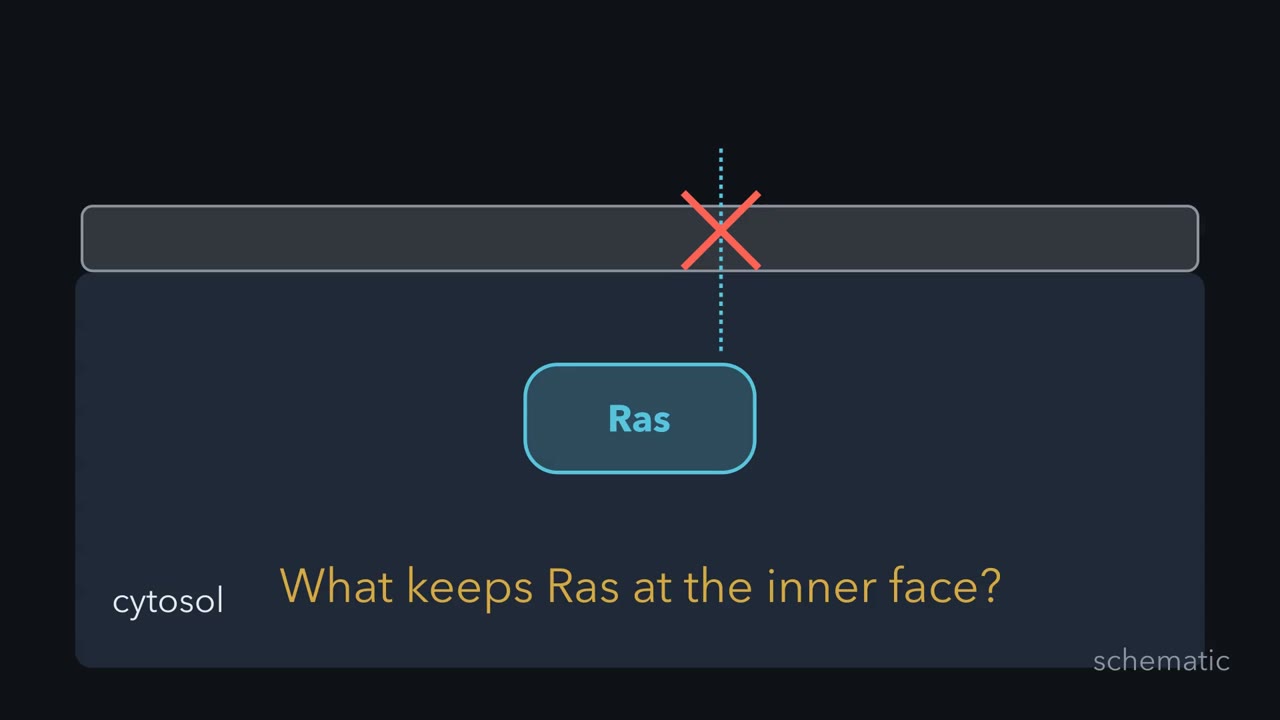
A drug that blocks anchor installation leaves newly made proteins without grip. But a cell can also move a protein without changing its anchor. How does a protein choose one membrane region over another? The membrane itself can carry a changing address.
Phosphoinositides are membrane lipids with head groups facing the cytosol. Enzymes can add or remove phosphates from those heads. The tails stay buried, while the exposed head-group pattern changes what cytosolic proteins can recognize. In this pathway, PI3-kinase is the writer. When recruited and activated, it converts membrane PIP2 into PIP3. Production can be local, so one membrane region gains the address before another. PIP3 does not stay under one enzyme.
Lipids diffuse sideways, while phosphatases remove the mark. The visible pattern reflects production, spread, and removal together. The address can therefore move. It is a dynamic address, not a fixed postal code. A blue reporter now floats beneath two membrane regions. Only one region contains PIP3. Where should a matching reader accumulate? Keep watching the reporter, not just the lipid.
The reporter accumulates at the PIP3 region. Its reader is a pleckstrin homology domain, shortened to PH domain. Drawn as a cup, it grips a compatible lipid head group and recruits the attached protein. Akt uses such a domain. Before its matching lipid appears, Akt can remain in the cytosol. When the address rises, Akt is recruited to that membrane region. A green fluorescent PH-domain fusion makes this movement visible. PTEN is an eraser. It removes the phosphate that distinguishes PIP3 from PIP2. As the address fades, the matching readers lose that contact and return toward the cytosol. The reporter is evidence, not a direct photograph of one lipid.
Its binding preference, competing contacts, and cell shape can affect the glow. Controls must test the binding pocket, the writer, and imaging geometry. This is the address half of the lesson's rule. Lipids control signaling protein location by supplying grip, address, or both.
Writing and erasing the lipid pattern changes which readers gather at a membrane. So read a lipid signal as a process. Ask where the writer acts, which domain recognizes the product, and which eraser removes it. Those three answers predict the changing recruitment pattern.
How does a protein with no membrane-spanning segment end up stuck to a membrane, and how does a lipid label tell it where?
Continue in the lesson: Lipids as Anchors and Addresses →
3:19 · Free, with captions and a transcript. The lesson has the full text, the questions and the sources.
More films from this lesson
How this film was made. Narration: an AI narrator voice (Kokoro, af_heart) reading narration written from this lesson's text. Animation: AI-generated in code (Manim) by Claude, a schematic with no drawn molecular structures. Captions come from the narration script. See something wrong? Report it.