Why One Farnesyl Tail Is Usually Not Enough
Read the transcript of “Why One Farnesyl Tail Is Usually Not Enough”
Film transcript: Why One Farnesyl Tail Is Usually Not Enough
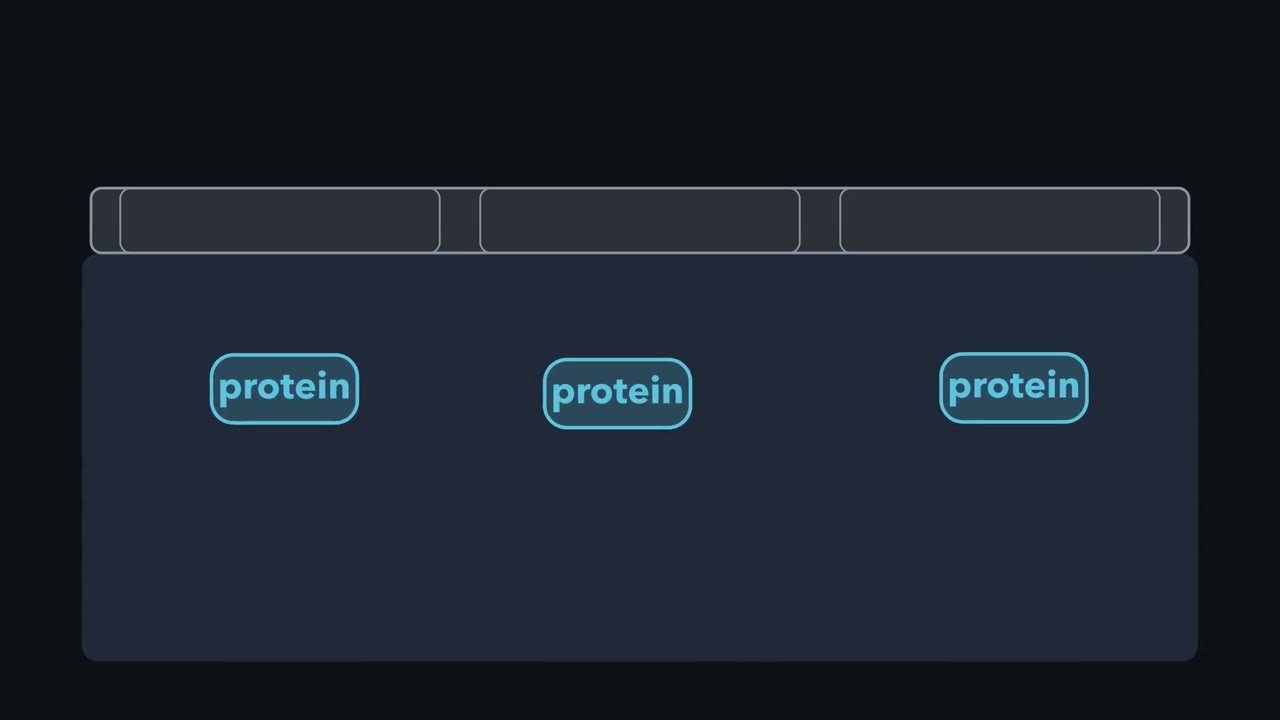
Ras has no segment crossing the membrane, yet it works at the membrane's inner face. What keeps it there? The puzzle has two parts. A lipid must join the protein, and that lipid must remain in a bilayer. First, separate two interactions that students often mix up. A covalent bond joins the lipid to the protein. A much weaker, non-covalent contact holds the lipid tail in the bilayer. The covalent bond can last while the tail repeatedly enters and leaves membranes. Permanent attachment to Ras does not mean permanent membrane binding. Watch one farnesyl tail sample the membrane and release. What should happen if Ras gains a compatible second contact?
Will its visits remain brief, or become much longer? The visits become longer. Both contacts must release together before the protein escapes. That coincidence is rarer. A second lipid can provide that contact. So can a positive patch attracted to negative lipids on the membrane's inner face. H-Ras and N-Ras use farnesyl plus palmitate. K-Ras4B uses farnesyl plus a lysine-rich positive patch. In both, farnesyl supplies the first contact. These are not identical addresses. They are two ways to combine membrane contact with another signal. Why is the change so large? Favorable free-energy contributions add. The equilibrium effect grows exponentially, not step by step.
This is a thermodynamic effect, not a new covalent bond. A computed curve shows how a modest extra contribution can greatly raise the share of time on the membrane. The second contact also creates control. Remove palmitate, or weaken a positive patch, and the strong hold becomes weak again. That is a switch in location. The protein can leave without breaking its permanent farnesyl attachment. Palmitate is especially useful because cells can remove and replace it. It goes on mainly at the Golgi, and it can come off on any membrane.
Farnesyl remains attached while palmitate changes whether H-Ras is tightly trapped or loosely sampling membranes. The same protein changes residence without losing farnesyl. This is the grip half of the lesson's rule. Lipids control signaling protein location by supplying grip, address, or both. The rule applies within this membrane-targeting scope. Here, the second signal converts a brief encounter into regulated membrane residence. So ask three questions about any lipid-modified protein. Which contact puts it on membranes? Which additional signal strengthens or directs that contact? And what can remove or oppose it? The answers predict both localization and the switch that can change it.
How does a protein with no membrane-spanning segment end up stuck to a membrane, and how does a lipid label tell it where?
Continue in the lesson: Lipids as Anchors and Addresses →
3:39 · Free, with captions and a transcript. The lesson has the full text, the questions and the sources.
More films from this lesson
How this film was made. Narration: written from this lesson's text and read by an AI narrator voice (Kokoro, af_heart). Animation: AI-generated in code (Manim) by Claude, a schematic with no drawn molecular structures. Captions come from the narration script. See something wrong? Report it.