Films · Genetics and Molecular Biology
When Four Classes Refuse to Be Equal
Read the transcript of “When Four Classes Refuse to Be Equal”
Film transcript: When Four Classes Refuse to Be Equal
Why do two test-cross classes overwhelm the other two? A blue chromosome and a gold partner pair in meiosis. Each carries the same marker positions. Their allele combinations begin intact, yet the offspring bins grow unevenly. The puzzle is what those bins reveal about gametes.
With scorable traits, a test cross makes one parent's gametes visible. The heterozygote can contribute big A big B or big A little b. It can also contribute little a big B or little a little b. The tester always contributes recessive alleles. Each offspring therefore carries a readable copy of the heterozygote's gamete. Independent assortment would feed every bin equally. Instead, the inherited combinations repeatedly fill two bins faster. That excess is the signature of linkage in this cross.
Linked means the loci share a chromosome closely enough for their association to appear in the scored progeny. First read the chromosomes the heterozygote received. Big A with big B is one inherited combination. Little a with little b is the other. Those are parental, even before counting offspring. The mixed combinations are recombinant. This inherited arrangement is phase. Class size can support that assignment, but phase defines it. Each homologue has already copied itself, so four chromatids lie side by side. A crossover joins matching positions on non-sister chromatids. When the exchange falls between the markers, the right-hand segments trade places.
Two chromatids keep their inherited combinations. The exchanged chromatids carry new combinations, which feed the recombinant bins. Now slide the right marker farther away while crossover positions keep appearing along the chromatids. Which pair of bins should claim a larger share over a short interval? Hold the chromosome picture in your mind.
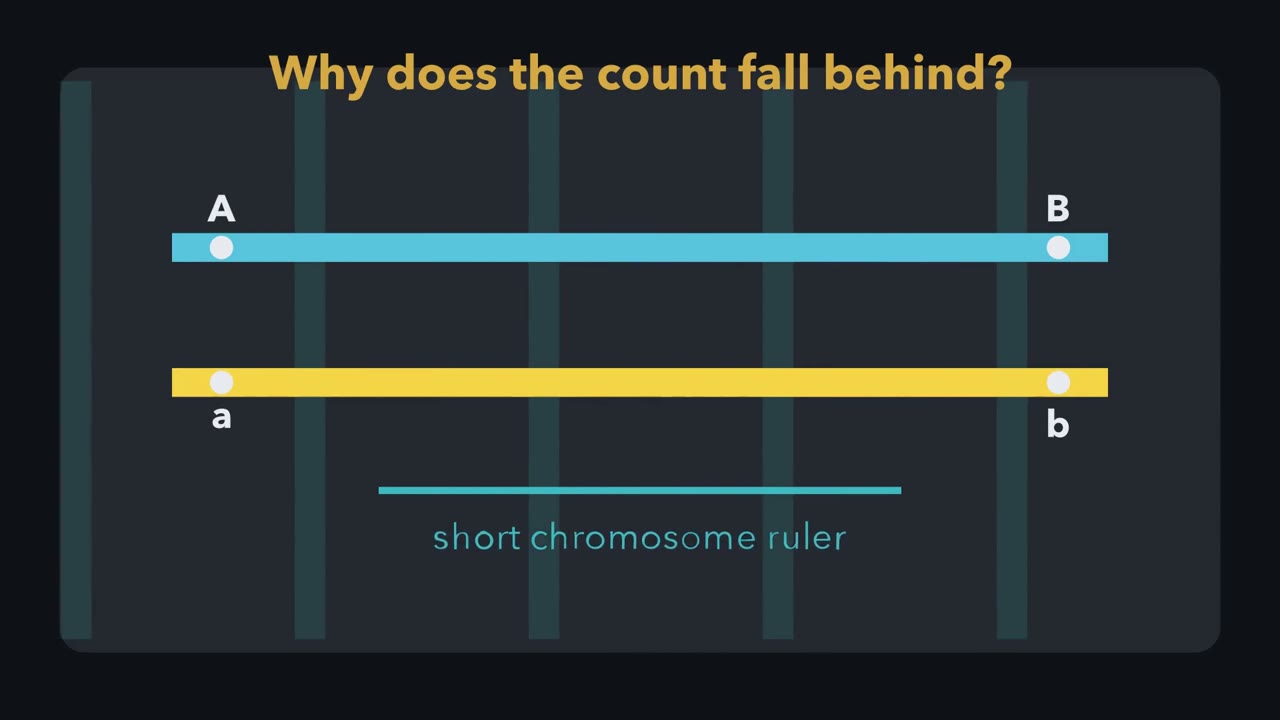
The recombinant pair grows. A wider interval offers more places for a crossover to land between the markers. Over a short interval, a second crossover between the markers is rare, so few exchanges stay hidden. The recombinant share can therefore serve as an estimate of genetic map distance. Add both recombinant classes before dividing by all offspring. Write the result as a percentage. For a short interval, that percentage estimates centimorgans on the genetic map. It does not measure a fixed length of DNA.
Different chromosome regions and different sexes can convert physical spacing differently. The workflow is now stable. Read the parents. Name the parental and recombinant classes from phase. Add the recombinant classes, then divide by the total. Only then use the short-interval ruler. The next question is what happens when crossovers can hide one another.
Independent assortment predicts four equal test-cross classes. Why do two classes dominate?
Continue in the lesson: Linkage and Recombination Mapping →
3:41 · Free, with captions and a transcript. The lesson has the full text, the questions and the sources.
More films from this lesson
How this film was made. Narration: written from this lesson's text and read by an AI narrator voice (Kokoro, af_heart). Animation: AI-generated in code (Manim) by Claude, a schematic with no drawn molecular structures. Captions come from the narration script. See something wrong? Report it.