Films · Genetics and Molecular Biology
Does the Mutation Stay or Travel?
Read the transcript of “Does the Mutation Stay or Travel?”
Film transcript: Does the Mutation Stay or Travel?
The first film showed a repressor moving on and off its operator. A broken repressor and broken operator can both look constitutive, so how can another lac copy tell them apart? Geneticists place a chromosomal lac region and an F′ lac copy in one cell. This partial diploid is diploid only for that region. Each rail carries its own operator and lacZ reporter. Both DNA copies share the same pool of regulatory proteins. Read the reporter before judging the mutation. Find the working lacZ. Then check the operator beside it. Finally ask which repressor proteins anywhere in the cell can reach that operator. This order prevents a broken reporter from misleading you.
Start with a lacI− allele that makes no working repressor. A normal lacI on the other rail makes red repressor protein. That protein diffuses through the shared cell and binds either normal operator. The missing product arrives from the other copy, so the defect is complemented. lacI− is recessive. Inducer can still release the repressor. Now change an operator itself. The altered orange block never leaves its rail. No other copy can supply a working site. The site cannot diffuse, so its effect stays beside linked genes. A linked working reporter escapes repression. A reporter beside the normal operator remains inducible. Predict this arrangement.
The only working reporter sits beside a normal operator. Normal repressor comes from the other DNA rail. Will the reporter remain controllable by inducer? Yes. The normal repressor reaches the normal operator beside the working reporter. Without inducer, it holds transcription at a low basal level. With inducer, the clamp opens and the reporter turns on. The cell is inducible for active enzyme. The altered operator is linked only to a broken reporter. Swap the reporters while leaving both operators fixed. Now the working reporter sits beside the altered operator. It glows with or without inducer. The phenotype follows the reporter's linkage to the DNA site, not a signal travelling across the cell.
Notice what this test never needed: a purified repressor. Geneticists mapped a travelling product before anyone knew what it was made of. Biochemists later isolated it and found a protein. The genetic rules did not change. Partial diploids turn location into evidence. If an effect stays linked to one rail, suspect a control site. If it reaches both rails, suspect a diffusible regulator. This logic separates a local DNA defect from a shared cellular product. Always read the working reporter first.
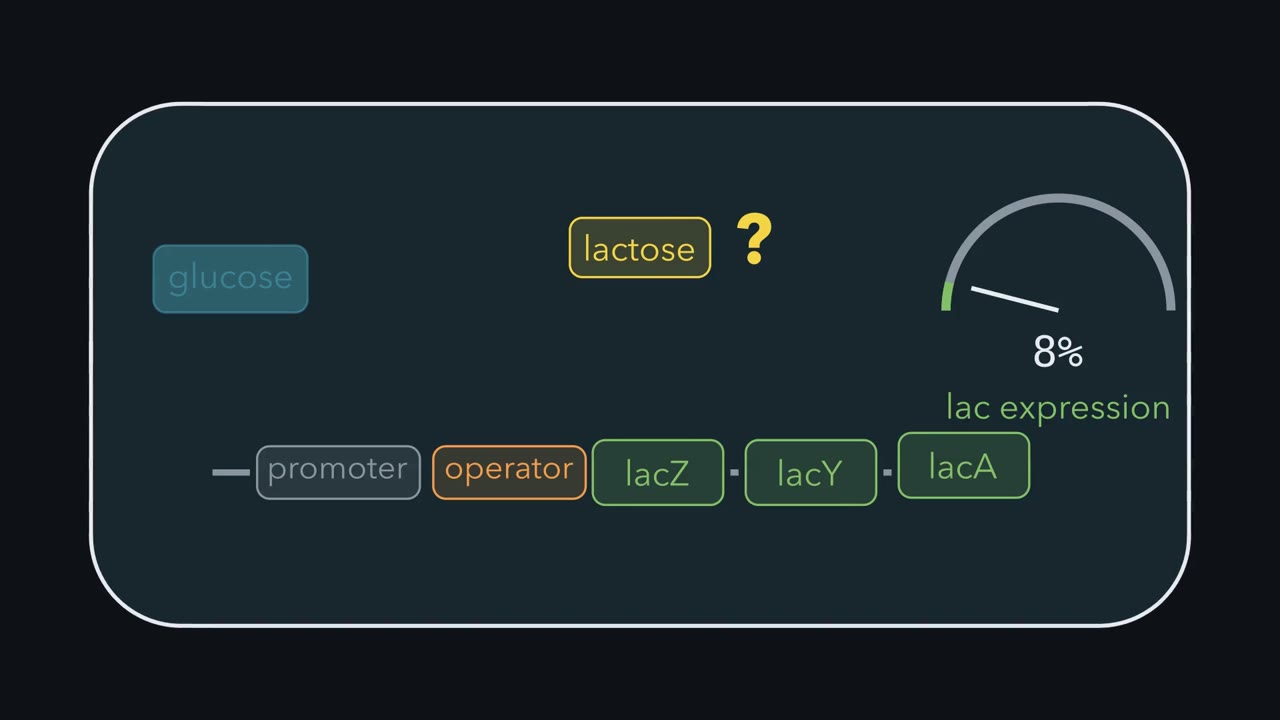
Give E. coli glucose and lactose together and it uses the glucose first, pauses, then starts on lactose. How does one cell choose which genes to express, and when?
Continue in the lesson: The lac Operon: How Bacteria Regulate Genes →
3:40 · Free, with captions and a transcript. The lesson has the full text, the questions and the sources.
More films from this lesson
How this film was made. Narration: an AI narrator voice (Kokoro, af_heart) reading narration written from this lesson's text. Animation: AI-generated in code (Manim) by Claude, a schematic with no drawn molecular structures. Captions come from the narration script. See something wrong? Report it.