Making Urine More Concentrated Than Blood
Read the transcript of “Making Urine More Concentrated Than Blood”
Film transcript: Making Urine More Concentrated Than Blood
The first film showed the kidney taking back almost all filtered water. The last litres are the hardest. A water-deprived adult can make urine about four times as concentrated as plasma. Yet no pump in the kidney moves water. So how does it pull water out of such urine? Concentration here means osmolality, the number of dissolved particles in each kilogram of water. Water moves by osmosis, toward the more concentrated side. So the tissue outside must be a little more concentrated than the urine. Salt supplies most, and deep down, urea helps. Picture a slice of kidney. The outer layer is the cortex. Beneath lies the medulla, an outer zone above an inner zone.
It ends at the papilla, where urine drains. A hairpin tube, the loop of Henle, dips into it. Start with the loop's upward arm. In the outer medulla it is thick, the thick ascending limb. It moves salt out, but its wall lets almost no water through. Salt leaves, water stays, and the tissue gets saltier. Now the thin descending limb, the downward arm. In rabbit tubules, it lets water through but holds its salt.
Passing salty tissue, it loses water by osmosis, so its fluid concentrates on the way down. The two arms carry fluid in opposite directions. Concentrated fluid rounds the bend, so the ascending limb works from a saltier start. Level by level, a modest difference adds up. This is the countercurrent multiplier. Deeper down, how the rise continues is still debated. Suppose the thick ascending limb let water through as easily as the descending limb. Would the multiplier still work well? Pause and decide.
Badly weakened. Water would follow the salt out, and most of the difference across the wall would collapse. Salt moving without water is the trick. Is real tissue graded like this? Wirz, Hargitay and Kuhn measured the freezing point of thin rat kidney slices from different depths. More particles mean a lower freezing point. Osmolality rose from cortex toward papilla. The collecting duct runs from cortex to papilla through ever more concentrated tissue. Antidiuretic hormone, ADH, acts on its cells. They insert stored water channels, aquaporin-2, facing the urine. Water leaves the urine by osmosis into the concentrated medulla. The urine comes out concentrated.
Take ADH away, the channels withdraw, and dilute urine flows out. So the kidney never pumps water. It moves solute first, building a medulla more concentrated than blood. Water follows where ADH opens the way.
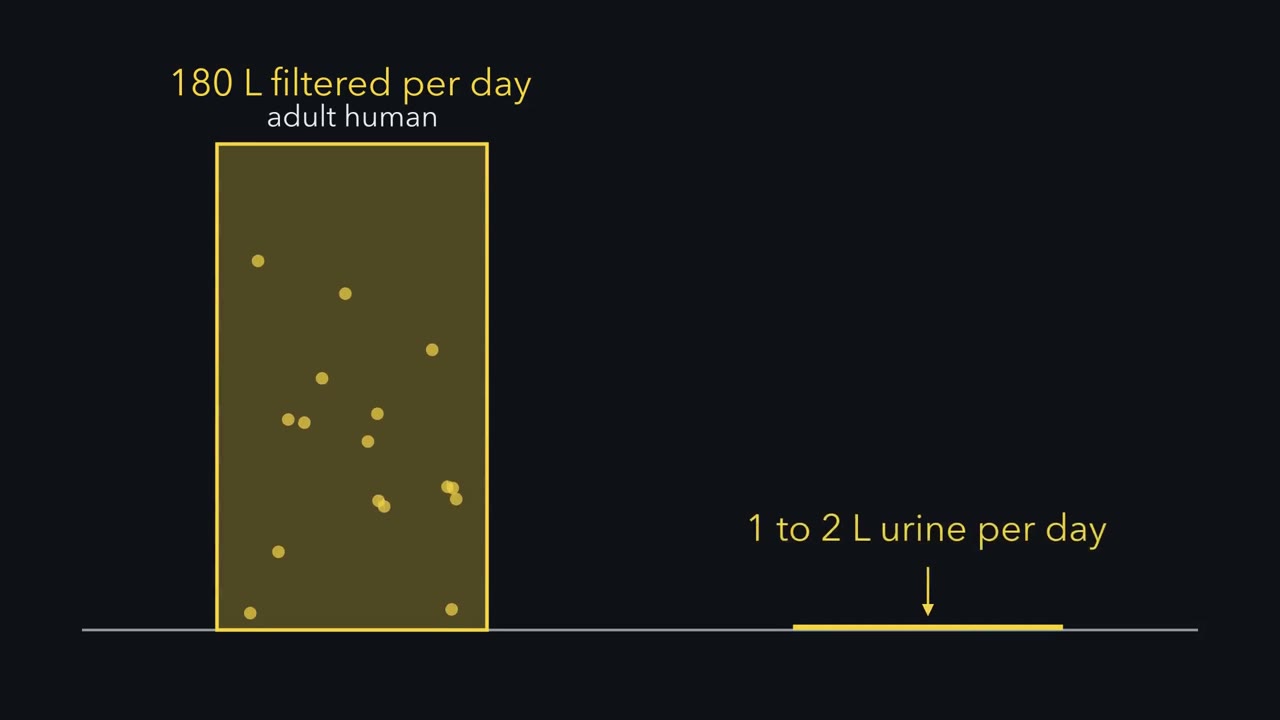
Your kidneys filter about 180 litres of plasma a day. Why filter so much only to take almost all of it back?
Continue in the lesson: The Kidney →
3:33 · Free, with captions and a transcript. The lesson has the full text, the questions and the sources.
More films from this lesson
How this film was made. Narration: an AI narrator voice (Kokoro, af_heart) reading narration written from this lesson's text. Animation: AI-generated in code (Manim) by Claude, a schematic with no drawn molecular structures. Captions come from the narration script. See something wrong? Report it.