Order the Relay, Find the Brake
Read the transcript of “Order the Relay, Find the Brake”
Film transcript: Order the Relay, Find the Brake
Chapter 1 separated an itch-producing input from the neurons carrying it. Once those neurons fire, how can experiments order a spinal relay? Carry the same teal pathway from skin into the dorsal horn. In one mouse model, the afferent supplies Nppb. Without Nppb, almost all tested itch responses disappeared. Injecting Nppb around the cord itself evoked scratching. The missing signal was upstream; downstream machinery could still respond. Next, researchers removed about 70 percent of spinal cells carrying NPRA, the Nppb receptor. If GRP acts later, should added GRP still evoke scratching?
It still evoked scratching. The simplest order is sensory Nppb, then NPRA cells, GRP and GRPR. follow. A downstream signal bypassed loss of the proposed upstream population. Independent tests support the later GRPR step.
Grpr-mutant mice scratched less to tested itch-producing agents. Removing GRPR-expressing spinal neurons also lowered scratching, while measured pain behaviours remained. This orders functions, not complete anatomy. The experiments did not show direct synapses. They did not identify one source of GRP. The sequence is one supported route in mice, not every itch route or a human circuit. Relays are only half the story.
Bhlhb5-dependent spinal interneurons provide inhibition. Mice missing that developmental population scratched excessively. Removing a brake can raise output without strengthening the incoming itch-producing signal. Light touch can use another control route. Removing or silencing NPY-lineage spinal interneurons increased mechanical scratching in one paradigm. Tested chemical itch and pain did not rise. Mechanical scratching also survived GRPR-cell ablation there. Scratching can feed back too. In primate recordings, scratching suppressed histamine-evoked activity in spinothalamic neurons. It spared baseline and capsaicin-evoked activity. That is a firing measurement, not a reported sensation.
The guiding rule now has its full circuit. Trigger, recruited population, spinal route, and inhibition together shape scratching. Use perturbations to order links, but do not mistake functional order for complete wiring.
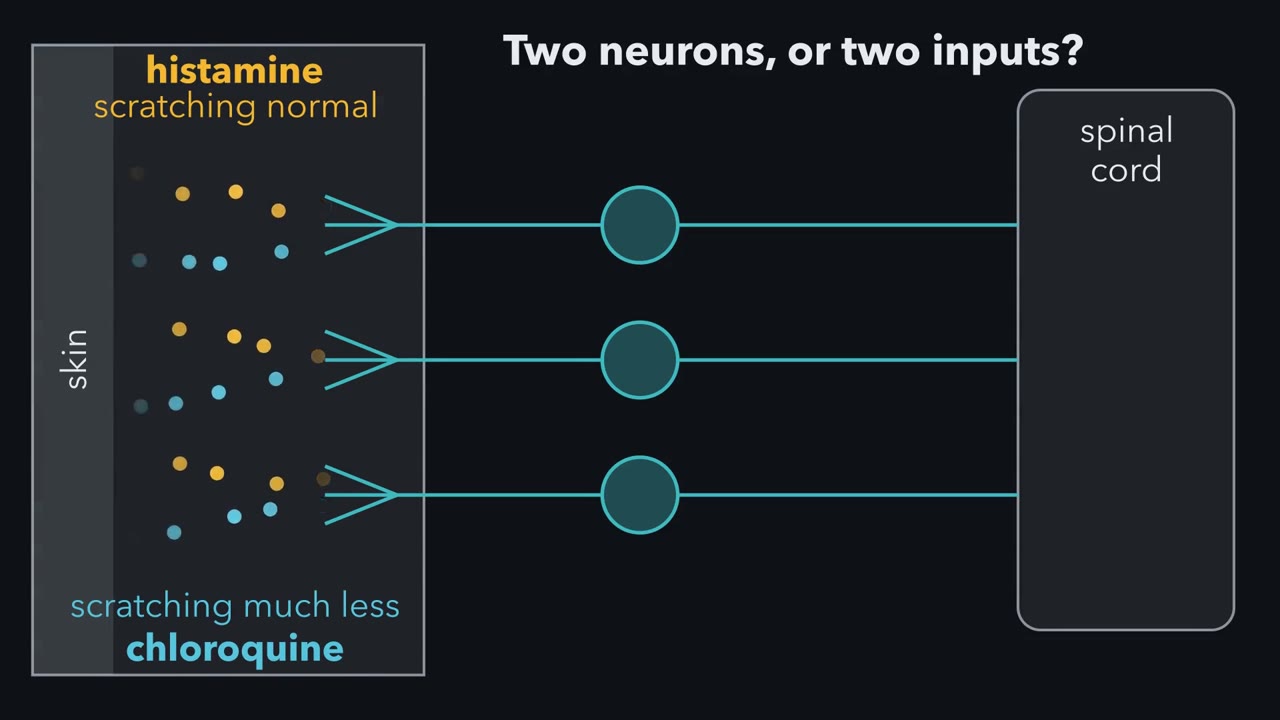
A mouse missing one cluster of Mrgpr genes scratches normally to histamine but much less to chloroquine. Which parts of the itch pathway are shared with pain, and which are not?
Continue in the lesson: Itch: A Sense of Its Own →
3:14 · Free, with captions and a transcript. The lesson has the full text, the questions and the sources.
More films from this lesson
How this film was made. Narration: an AI narrator voice (Kokoro, af_heart) reading narration written from this lesson's text. Animation: AI-generated in code (Manim) by Claude, a schematic with no drawn molecular structures. Captions come from the narration script. See something wrong? Report it.