Which Line Carries the Itch?
Read the transcript of “Which Line Carries the Itch?”
Film transcript: Which Line Carries the Itch?
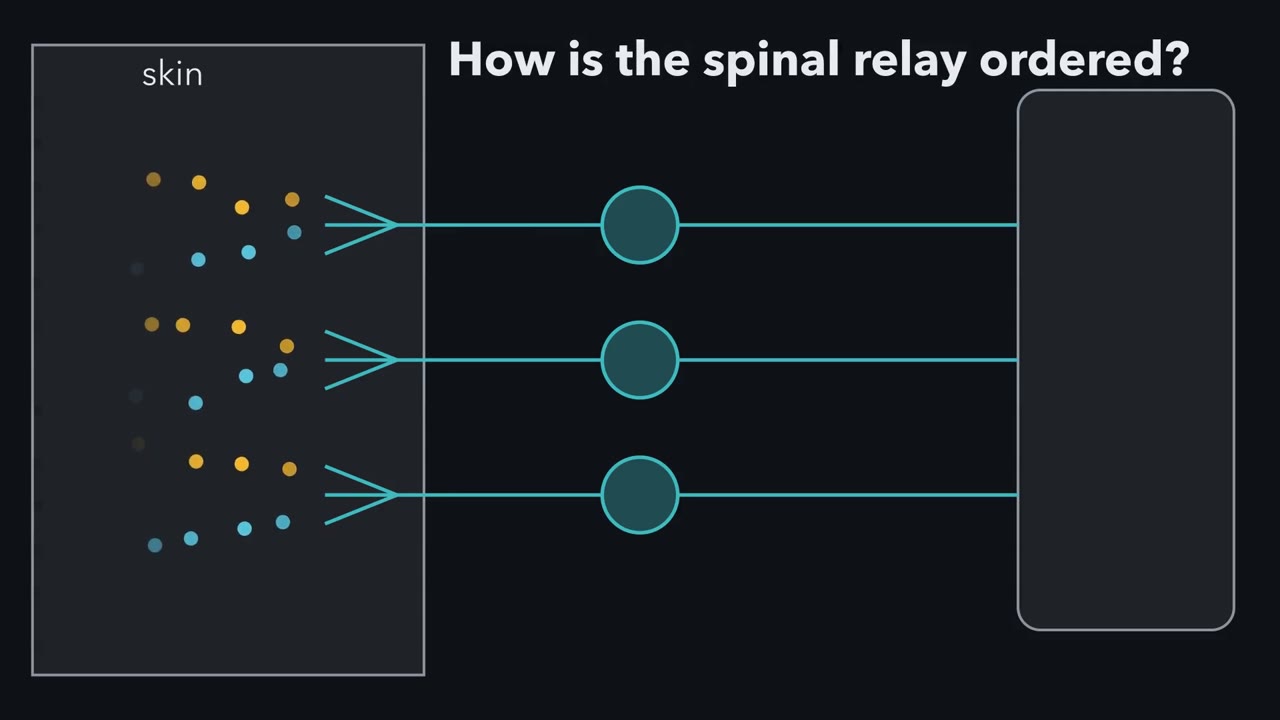
One mouse scratches normally to histamine, yet scratches much less to chloroquine. Did one experiment separate two neurons, or only two inputs? Watch one skin-to-cord pathway. Gold histamine and blue chloroquine approach the same teal sensory population. Researchers deleted one cluster of Mrgpr receptor genes. The blue chloroquine route broke, so scratching fell. Gold histamine scratching remained. The intervention separated receptor routes. It did not yet separate the neurons carrying them. The routes also recruit different channel machinery in mice. Histamine itch involves PLC-beta-3 and TRPV1. Chloroquine and BAM8-22 scratching instead falls markedly without TRPA1.
Now remove every sensory neuron marked by MrgprA3. What should happen to histamine scratching? Predict before the cells disappear. Does the gold route survive, as it did before? Histamine scratching also fell. Removing a receptor route and removing its whole neuron population are different interventions. The neurons receive several itch-producing inputs. Ablation shows they are needed for much scratching in these mouse assays. A second test started with mice lacking working TRPV1. Researchers restored that channel only in the teal neurons.
Capsaicin could now recruit only that population. The mouse produced itch-related behaviour instead of its usual pain-related wiping. The rescue shows what these neurons can drive when they alone respond to capsaicin. It does not prove every activation means itch. Later, fast ionotropic stimulation mostly evoked pain-related defence. Gq-linked stimulation evoked itch behaviour. Behaviour matters too. In the cheek assay, hindpaw scratching counts as itch-related output. Forelimb wiping counts as pain-related output. Those readouts distinguish actions, not a mouse's reported sensation.
Human MRGPRX1 is also a different gene. Both receptors respond to chloroquine in transfected cells, but not equally. The human receptor's functional potency was lower in that assay. Shared ligand responses do not make the genes, neurons, or sensations equivalent across species. Here is the rule for this lesson.
Trigger, recruited population, spinal route, and inhibition together shape scratching. Each perturbation supports only the link it tests. Chapter 2 will carry this pathway into the spinal cord.
A mouse missing one cluster of Mrgpr genes scratches normally to histamine but much less to chloroquine. Which parts of the itch pathway are shared with pain, and which are not?
Continue in the lesson: Itch: A Sense of Its Own →
3:21 · Free, with captions and a transcript. The lesson has the full text, the questions and the sources.
More films from this lesson
How this film was made. Narration: written from this lesson's text and read by an AI narrator voice (Kokoro, af_heart). Animation: AI-generated in code (Manim) by Claude, a schematic with no drawn molecular structures. Captions come from the narration script. See something wrong? Report it.