Emptying Islands
Read the transcript of “Emptying Islands”
Film transcript: Emptying Islands
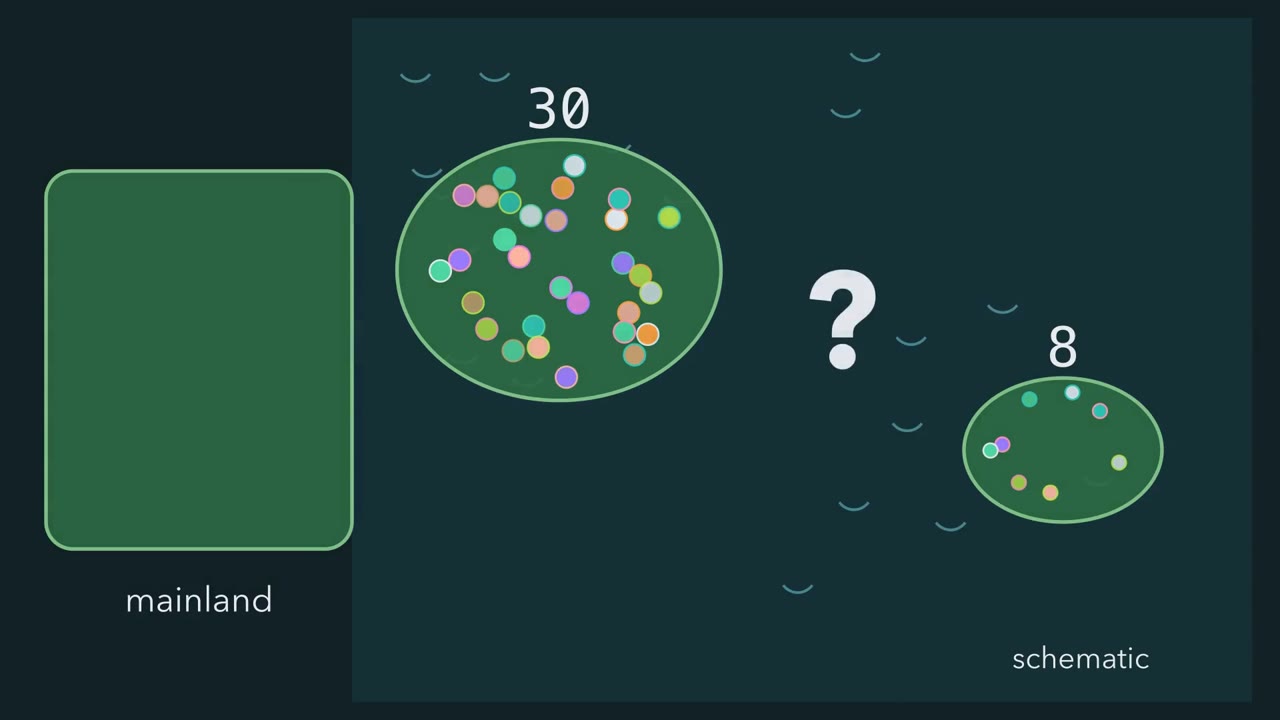
The worked island refilled on paper, toward a steady count, while species kept coming and going. So empty a real island of every insect and spider. How many species come back, and are they the same ones? Most islands were colonised long ago, so nobody saw their rates from the start.
Daniel Simberloff and Edward Wilson chose islands small enough to empty, and then watched them fill. They used six small islands of red mangrove in the Florida Keys. Each carried a community of terrestrial arthropods: insects, spiders, mites and their relatives. First they recorded every arthropod species on each island. Then they covered each island with a tent and fumigated it. Afterwards they censused the islands again and again for a year. The count climbed back. By about day 250, most islands held about as many species as untreated islands. The exception was E1, the most distant.
Population densities, though, were still abnormally low. Now the second question. The count came back. How much of the old species list do you expect the new list to share? Take three mite kinds from island E9, chosen because their records are clear. One was there before and after. One was there only before. One was there only after. Two kinds before, and two kinds after, so the count is unchanged. But only one of the three is shared. The Jaccard similarity is shared species divided by species in either list. Here it is 1/3. Read it with care. These three are a chosen subset, not the whole community. And finding the shared mite at both censuses does not mean it survived.
It was recorded again after recolonisation. A second report followed four islands to the end of the second year. Species numbers had changed little from the year before, while immigrations and extinctions continued at high rates. A steady count with continuing replacement is what the model calls a dynamic equilibrium. The result fits the model, though on its own it does not prove the model's mechanism. And the rates themselves were rough. Censuses came at intervals, so some arrivals and losses fell between visits and were never seen. And a resident overlooked at one census looked like a loss and a return.
Empty an island of every insect and spider. How many species come back, and are they the same ones?
Continue in the lesson: Island Biogeography →
3:03 · Free, with captions and a transcript. The lesson has the full text, the questions and the sources.
More films from this lesson
How this film was made. Narration: an AI narrator voice (Kokoro, af_heart) reading narration written from this lesson's text. Animation: AI-generated in code (Manim) by Claude, a schematic with no drawn molecular structures. Captions come from the narration script. See something wrong? Report it.