Two Rates, One Crossing
Read the transcript of “Two Rates, One Crossing”
Film transcript: Two Rates, One Crossing
Why does a big island near a mainland hold more kinds of animals than a small, remote one? One process can give both patterns. It is a balance between two rates. Start with the mainland. It holds a pool of species that could reach the island, P species in all. The number living on the island is S, its species richness. Now let animals cross the water. On an empty island, every arrival belongs to a new species, so the count climbs fast. Immigration, here, means only the arrival of a species not already present. As the island fills, more arrivals belong to species already there. An arrival of a kind already present changes nothing in the count.
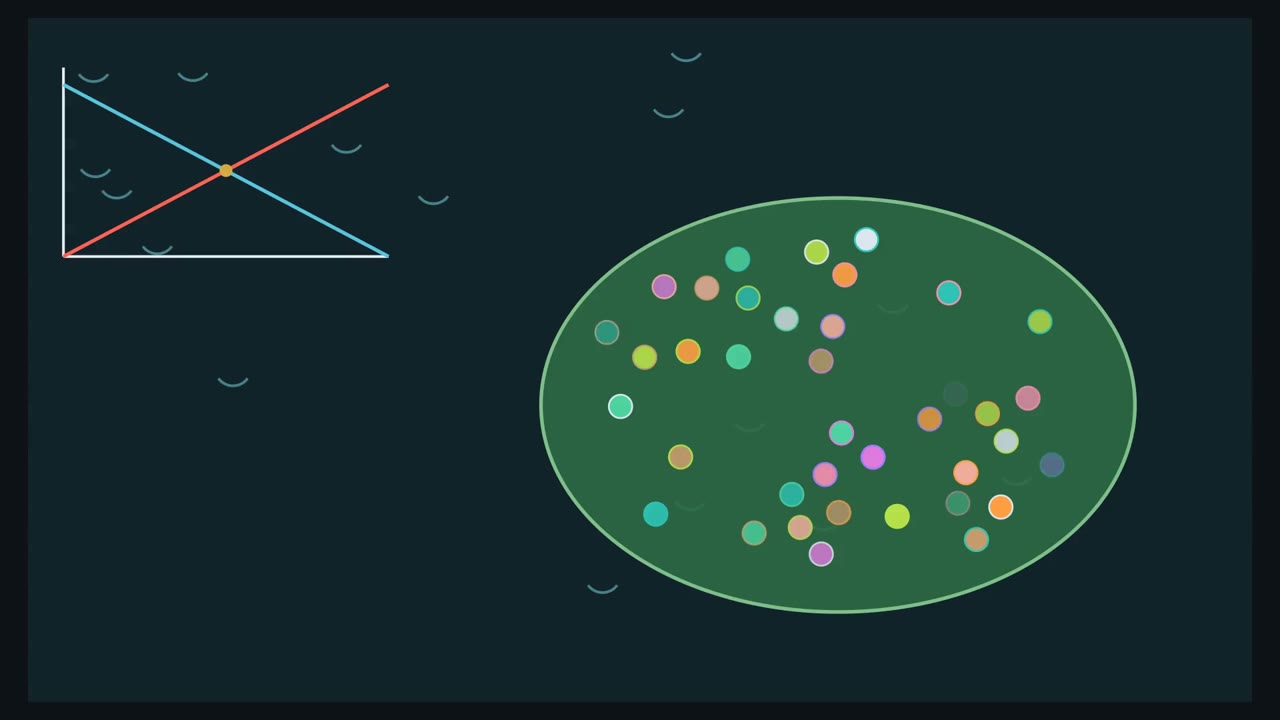
So new arrivals slow, and stop when all P species live there. Plot that rate of new arrivals against the number of species on the island. The blue line starts high on an empty island and falls to zero when S reaches P. Residents also disappear. This is local extinction, a loss from this island only. Suppose each resident has the same, independent chance of being lost. Then more residents mean more losses, and the red line rises. Where the blue line meets the red, new arrivals equal losses. That richness is the equilibrium, S Below it, arrivals win and the count climbs. Above it, losses win and the count falls back. At the crossing, nothing stops.
Species keep arriving and keep vanishing, at the same rate. That shared rate is the turnover. The count settles near S star and wobbles a little, while the list keeps changing. Now push the island farther from the mainland, keeping its size the same. Which line moves, and which way does the gold point go?
Fewer new species reach a distant island at every richness. So the blue line drops, the crossing slides left, and S star falls. The far island holds fewer species. Now keep the distance and shrink the island instead. A small island loses residents faster at every richness. The red line rises, and S star moves left again. So near, large islands hold the most species, and far, small ones the fewest. One balance of two rates gives both of the old patterns. Keep the scope. This is a model. It leaves out new species forming on the island. Real curves need not be straight, because species differ and affect one another. And it predicts how many species, not which ones.
Empty an island of every insect and spider. How many species come back, and are they the same ones?
Continue in the lesson: Island Biogeography →
3:15 · Free, with captions and a transcript. The lesson has the full text, the questions and the sources.
More films from this lesson
How this film was made. Narration: written from this lesson's text and read by an AI narrator voice (Kokoro, af_heart). Animation: AI-generated in code (Manim) by Claude, a schematic with no drawn molecular structures. Captions come from the narration script. See something wrong? Report it.