A Pore That Pays for Potassium
Read the transcript of “A Pore That Pays for Potassium”
Film transcript: A Pore That Pays for Potassium
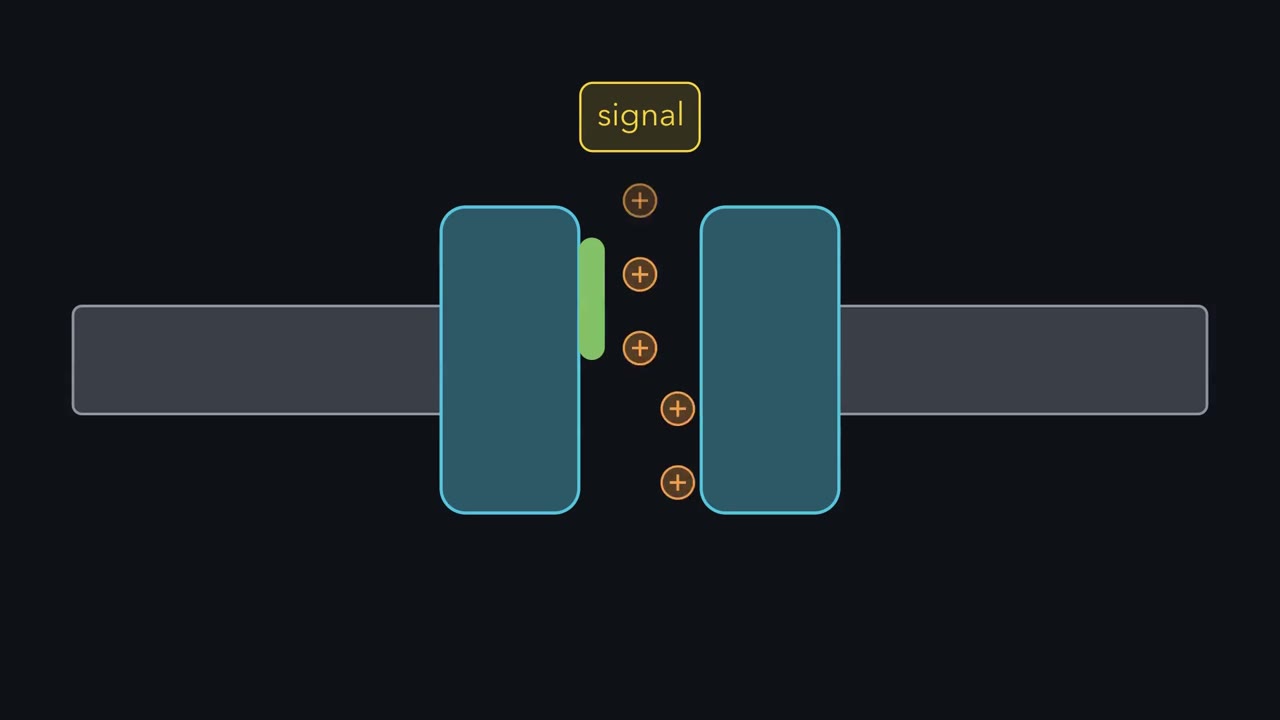
A potassium channel can pass up to about a hundred million potassium ions a second. Yet for every thousand potassium ions, fewer than one sodium ion gets through. Sodium is the smaller ion. Its radius is 0.95 Å, against 1.33 Å for potassium. So the pore cannot be a simple sieve. Think of it as a trade. In water, every ion wears a coat of water molecules, and stripping that coat costs energy. An ion will enter a narrow pore only if the pore pays the cost back. In 1998, Roderick MacKinnon's laboratory showed how, with the structure of KcsA, a potassium channel from a soil bacterium. Four identical subunits surround one pore. Near the outer end it narrows to a selectivity filter, 12 Å long, too tight for an ion to keep its water.
The filter is lined with carbonyl oxygen atoms from the protein's backbone, set in rings that surround a potassium ion much as the oxygens of water did. Potassium swaps water for protein and loses almost nothing. Sodium is too small to touch all the oxygens of a ring at once, and in the 1998 account the filter is held too stiffly to close in on it. For sodium, leaving water costs more than the filter repays, so it stays outside. Two potassium ions sit in the filter in single file, and the repulsion between them pushes one out as the next arrives. That is the answer for potassium channels; sodium and calcium channels build their filters differently.
A chilli pepper and a hot stove open the same protein. How does its message reach your brain in milliseconds?
Continue in the lesson: Ion Channels as Receptors →
2:04 · Free, with captions and a transcript. The lesson has the full text, the questions and the sources.
More films from this lesson
How this film was made. Narration: an AI narrator voice (Gemini, Charon) reading narration written from this lesson's text. Animation: AI-generated in code (Manim) by Claude, a schematic with no drawn molecular structures. Captions come from the narration script. See something wrong? Report it.