One Cell, Many Jobs, Shared Space
Read the transcript of “One Cell, Many Jobs, Shared Space”
Film transcript: One Cell, Many Jobs, Shared Space
Your heart muscle cell and a white fat cell share many of the same kinds of parts. So why do they look nothing alike inside? Let's build a cell and find out. Start with the outline. The cell membrane is the thin boundary around the cell. It controls what enters and leaves.
Inside is the cytoplasm: a jelly-like fluid and the parts in it, except the nucleus. The parts inside are called organelles. An organelle is a small part that does a special job. The nucleus holds the cell's instructions. The ER is a network of folded membranes. It helps make and move many proteins and fats.
Mitochondria release energy stored in food, such as sugar and fats. They release it in a form the cell can use. A vacuole is a sac that stores water, food and wastes. Plant cells have one large vacuole. Many animal cells have only small sacs. Now give the cell one job: replacing a worn-out protein. The nucleus holds the instructions. The ER helps make the new protein and move it. The mitochondria release the energy that building uses. The membrane lets in food and oxygen.
Four parts, one job. Every life job needs a team like this. Growth, repair and response each need several parts working at once. So what if only the mitochondria stop? Does only energy use slow down, or do other jobs slow down too? Pause and decide.
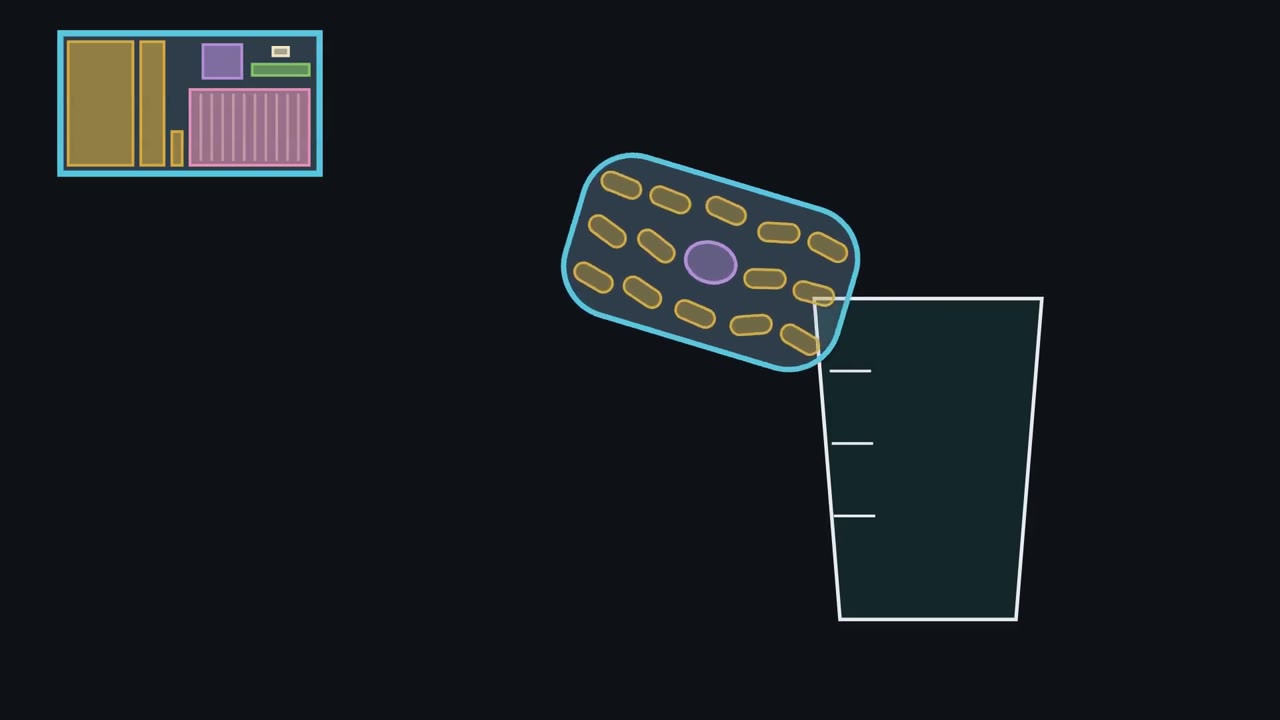
Other jobs slow down too. The nucleus and the ER are still fine. But building needs energy, so the repair path slows and stalls. Growth and response slow down with it. No part decides anything; each one simply follows chemistry. Here is the second idea. Picture the cell from above, as a floor plan. Each part is a room. Together, the rooms make up the whole cell. So when one room takes a big share, the others take smaller shares.
Cells with different jobs often hold their parts in different amounts. A heart muscle cell works without a break. It releases a lot of energy, mostly from fats. So mitochondria fill a large share of its space. A white fat cell stores fat. So one big fat drop fills most of its space. The other parts sit in a thin rim around the edge. Many of the same parts, very different floor plans. A part's size alone does not tell you a cell's job. But comparing parts with jobs can show a pattern.
Why is a heart muscle cell crowded with mitochondria, while a fat cell is mostly one big drop of fat?
Continue in the lesson: Inside a Cell →
3:18 · Free, with captions and a transcript. The lesson has the full text, the questions and the sources.
More films from this lesson
How this film was made. Narration: written from this lesson's text and read by an AI narrator voice (Kokoro, af_heart). Animation: AI-generated in code (Manim) by Claude, a schematic with no drawn molecular structures. Captions come from the narration script. See something wrong? Report it.