Cells or Serum?
Read the transcript of “Cells or Serum?”
Film transcript: Cells or Serum?
In the first film's model, defenses must remove more than half the bacteria every doubling time. But who does the removing: cells, or something dissolved in the blood? In the 1880s and 1890s, immunologists argued over exactly this. Elie Metchnikoff, a zoologist, championed the cells. He chose an animal he could see through.
The water flea Daphnia is small and transparent. Some fleas swallow the needle-shaped spores of a budding yeast with their food. The spores pierce the gut wall into the body cavity. Suppose the flea's blood cells were passive, or even carried the infection. What would you expect them to do with the spores?
Passive cells should ignore the spores, or spread them. Instead, Metchnikoff saw mobile cells crowd onto the spores, surround them, and engulf them. The outcome tracked the flea's fate. Where the cells destroyed the spores, the infection stopped. Where spores escaped and grew into budding yeast, the flea died. His 1884 paper made the eating cell, the phagocyte, an active defender. But it did not show that the cells work alone. In Paris in the 1890s, Jules Bordet studied serum, the fluid that remains once blood clots. Serum from an animal immunized against a cholera bacterium killed those bacteria. Heated to about 55 °C, the immune serum lost its power.
Fresh serum from an animal never immunized could not kill the bacteria on its own either. Then Bordet mixed the heated immune serum with the fresh normal serum. The mixture killed again. So the killing needs two separate parts. One part survives heat and is raised by immunization. We now call it antibody. The other is destroyed by heat and is present in all fresh serum. We call it complement. So which side was right? Watch a bacterium meet complement. Small green tags, a piece called C3b, coat its surface. A neutrophil grabs the coated bacterium quickly. Coated microbes are eaten far more readily. In the first film's race, that raises k. The cells eat, and the proteins make the eating faster.
In 1908, Metchnikoff shared the Nobel Prize with Paul Ehrlich, who stressed the defenses in serum. Each side had described part of one system.
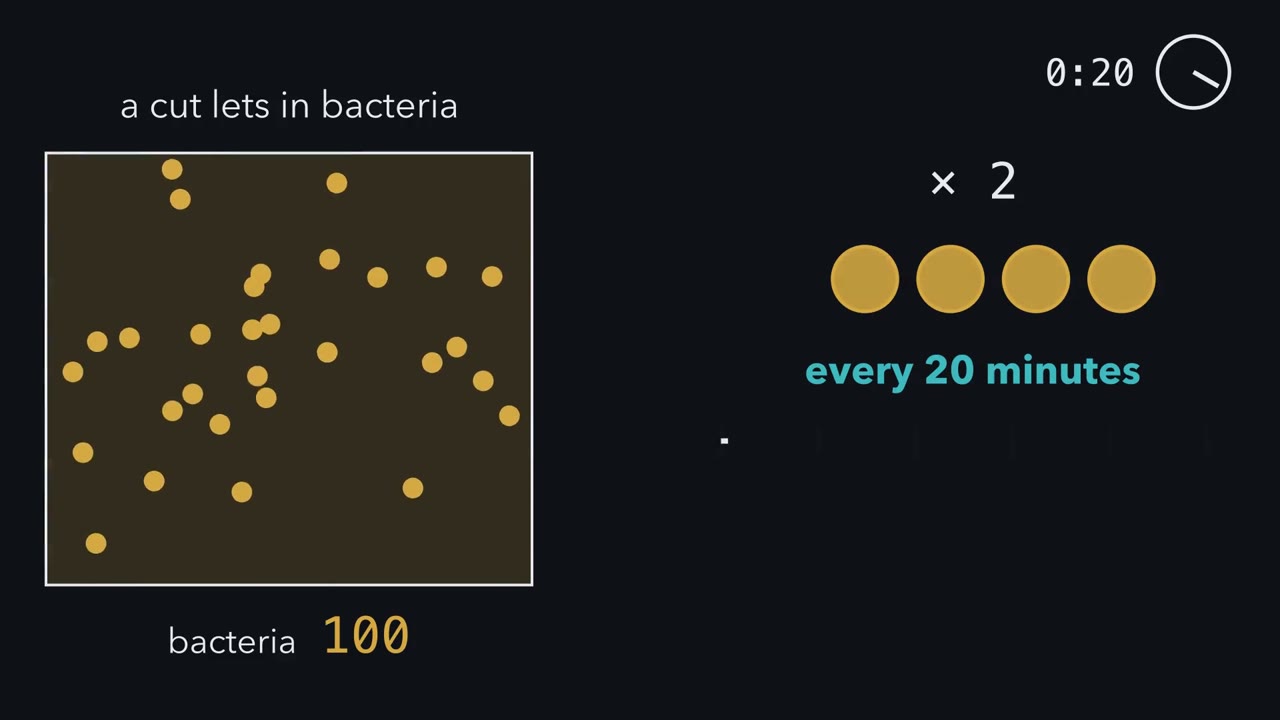
A cut lets in 100 bacteria that double every 20 minutes, and new antibodies take days. What does your body have to do in the first few hours to stay ahead?
Continue in the lesson: Innate Immunity: Recognize and Respond →
3:03 · Free, with captions and a transcript. The lesson has the full text, the questions and the sources.
More films from this lesson
How this film was made. Narration: an AI narrator voice (Kokoro, af_heart) reading narration written from this lesson's text. Animation: AI-generated in code (Manim) by Claude, a schematic with no drawn molecular structures. Captions come from the narration script. See something wrong? Report it.