Winning the First Hours
Read the transcript of “Winning the First Hours”
Film transcript: Winning the First Hours
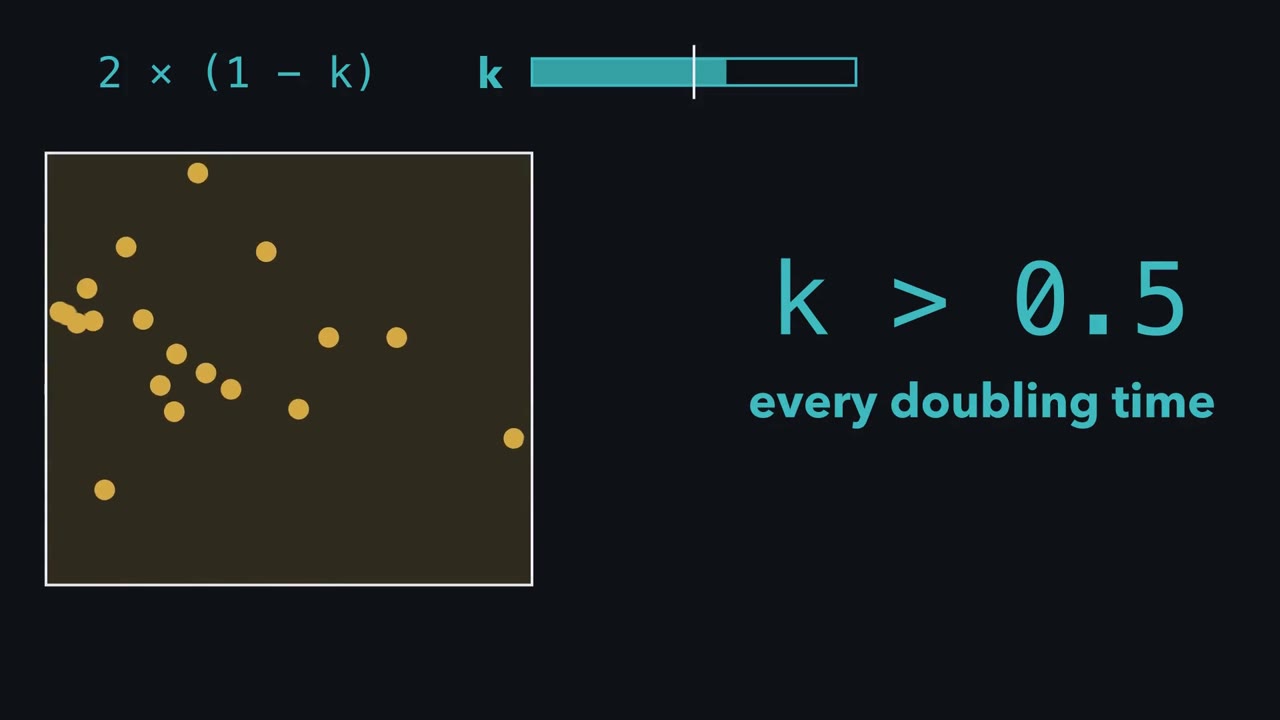
A cut lets in 100 bacteria, and each one doubles every 20 minutes. New antibodies take days, so what has to happen in the first few hours? Start with no defense at all. Every 20 minutes, the count doubles. The clock runs for four hours, and the counter climbs past 400,000. Now add a defense. In each doubling time, it removes a fraction of the bacteria. Call that fraction k. The survivors then double, just as before. So each doubling time multiplies the count by 2 × (1 − k). That factor is the whole race. Above 1, the count grows. Below 1, it shrinks. Suppose the defenses remove three quarters of the bacteria every 20 minutes. Does the count rise or fall?
Decide before the counter moves. It falls. The factor is 1/2, so every 20 minutes the pile halves. After four hours, the expected count is far below one bacterium. The infection is very likely cleared. Now slide the dial down. At exactly one half removed the factor is 1, and the counter freezes. So in this model, the rule is simple: remove more than half every doubling time. But when does the removal start? Keep the same strong defense and make it wait one hour. The pile reaches 800 before it turns. Wait two hours, and it reaches 6,400.
Each hour of waiting multiplies the pile eightfold. That is why the receptors must be ready before infection. In this model of a bacterial wound, the defenses we follow do three jobs. First, fewer get in. Skin and other barriers lower the starting number. Second, the clock starts early. A macrophage, a long-lived eating cell in the tissue, carries ready-made receptors. One, Toll-like receptor 4 senses a molecule from the outer membrane of many bacteria. Third, more are removed per doubling.
Sensing sets off inflammation. A nearby vessel widens and leaks. Neutrophils pour out first, then monocytes, which become macrophages. Inflammation runs in four steps: sense, vessels change, cells arrive, then clear and repair. As the eating cells gather, the fraction removed in each doubling time climbs. Keep them out, see them at once, and remove more than half every doubling time. This is an illustrative model of one wound, not a measured infection.
A cut lets in 100 bacteria that double every 20 minutes, and new antibodies take days. What does your body have to do in the first few hours to stay ahead?
Continue in the lesson: Innate Immunity: Recognize and Respond →
3:17 · Free, with captions and a transcript. The lesson has the full text, the questions and the sources.
More films from this lesson
How this film was made. Narration: written from this lesson's text and read by an AI narrator voice (Kokoro, af_heart). Animation: AI-generated in code (Manim) by Claude, a schematic with no drawn molecular structures. Captions come from the narration script. See something wrong? Report it.