Films · Developmental Neuroscience
The Stump That Kills Itself
Read the transcript of “The Stump That Kills Itself”
Film transcript: The Stump That Kills Itself
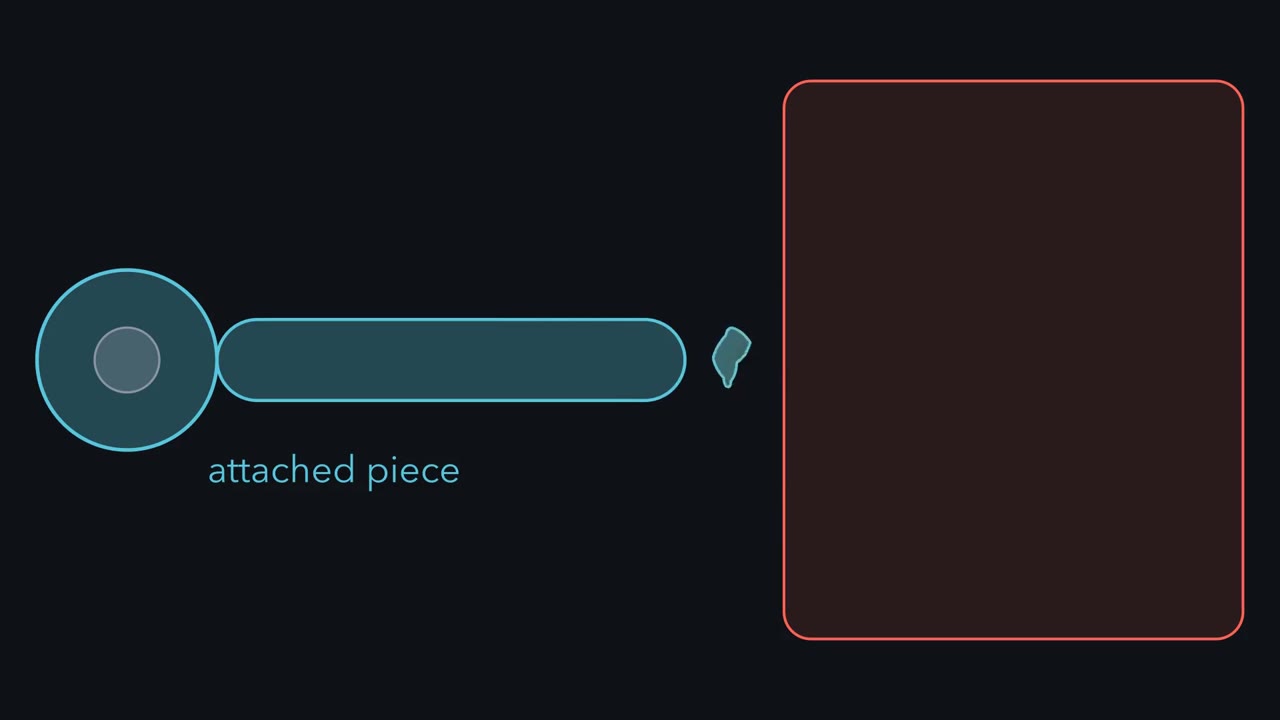
Why does a cut-off axon fall apart? Is it starving, or following orders? In 1850, Augustus Waller saw cut frog nerve fibres break up beyond the cut. He read it as a matter of nutrition. If it is starving, only replacing what it lacks should save it. If it is a program, deleting one part should stop it. What mouse would decide it?
One missing a part of the program, whose cut axons stay whole. But the first clue came by accident. In the slow mouse, cut axons last two weeks or more. Its mutation makes an odd fusion with an enzyme that makes NAD+. Remember that enzyme. So it might replace what the stump lacks. That alone cannot prove a program. Then came the deciding mouse. Mice lacking an ordinary gene, Sarm1, kept cut axons intact for a long time. The stump carries a program.
Why is a long axon so exposed? Picture a metre-long axon, 10 micrometres wide, holding about a thousand times the volume of a cell body 50 micrometres wide. It depends on deliveries from that body. The key delivery is NMNAT2, the least stable enzyme of its family. It turns NMN, nicotinamide mononucleotide, into NAD+.
The slow mouse's fusion protein is a longer-lived NMNAT. It keeps that job going after a cut. After a cut, it stops arriving. What happens to NMN, and to NAD+? NMN piles up, and NAD+ plus falls. Their ratio climbs as the enzyme fails. SARM1 senses that ratio. It is a ring of eight, held off while NAD+ Plus is bound. In the leading model, NMN competes for that site. Its binding shifts the outer domains and frees the TIR domains. The freed TIR domains come together into an enzyme that cleaves NAD+. In this model, each loss may push the ratio higher, and the slow drift becomes a crash.
Energy fails, calcium rises, and calpains, proteases switched on by calcium, cut the cytoskeleton. Mice lacking NMNAT2 from the start die around birth. Their growing axons stall. Remove Sarm1 too. What happens? Their axons grow, and the mice survive. Losing NMNAT2 works by tripping SARM1.
And it is not apoptosis. The stump degenerates even when caspases are blocked. So the cut-off piece is not simply starving. It carries a switch that waits for the deliveries to stop.
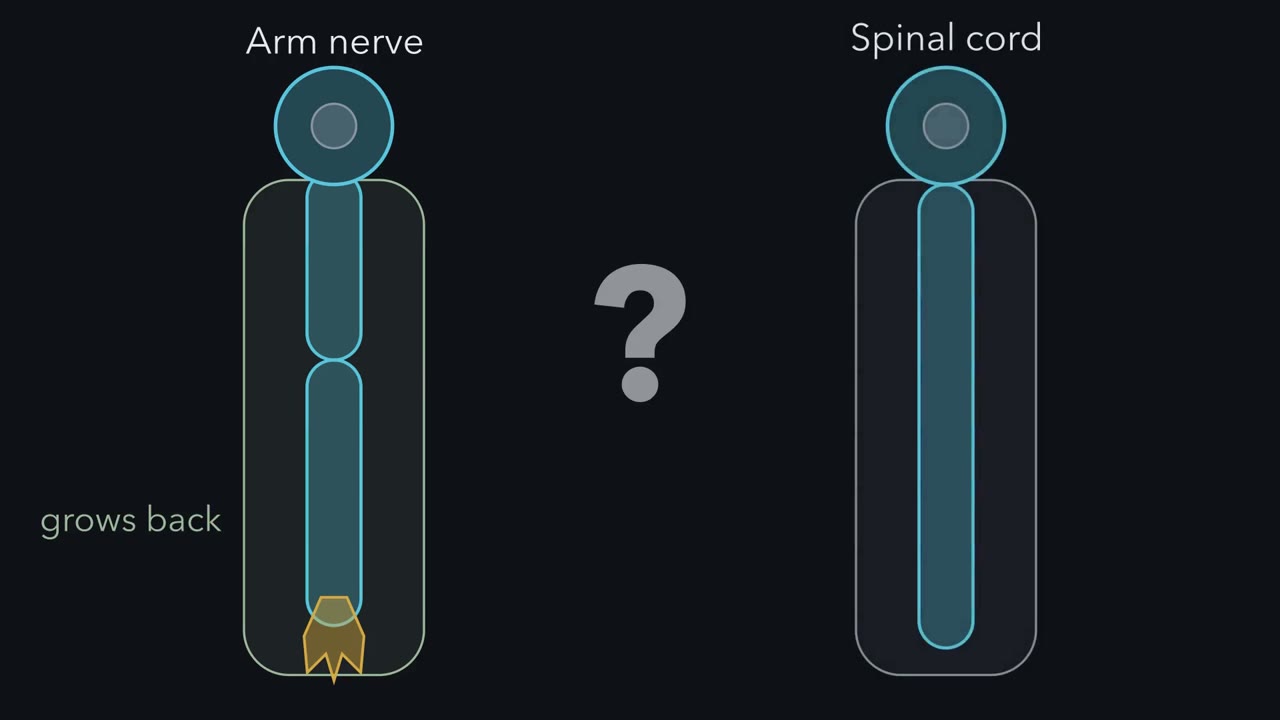
A cut nerve in your arm can grow back. A cut tract in your spinal cord mostly cannot. Is the fault in the neurons or in what surrounds them?
Continue in the lesson: Injury and Regeneration: Why the Brain Does Not Regrow →
3:29 · Free, with captions and a transcript. The lesson has the full text, the questions and the sources.
More films from this lesson
How this film was made. Narration: an AI narrator voice (Kokoro, af_heart) reading narration written from this lesson's text. Animation: AI-generated in code (Manim) by Claude, a schematic with no drawn molecular structures. Captions come from the narration script. See something wrong? Report it.