Built Now, or Carried Along
Read the transcript of “Built Now, or Carried Along”
Film transcript: Built Now, or Carried Along
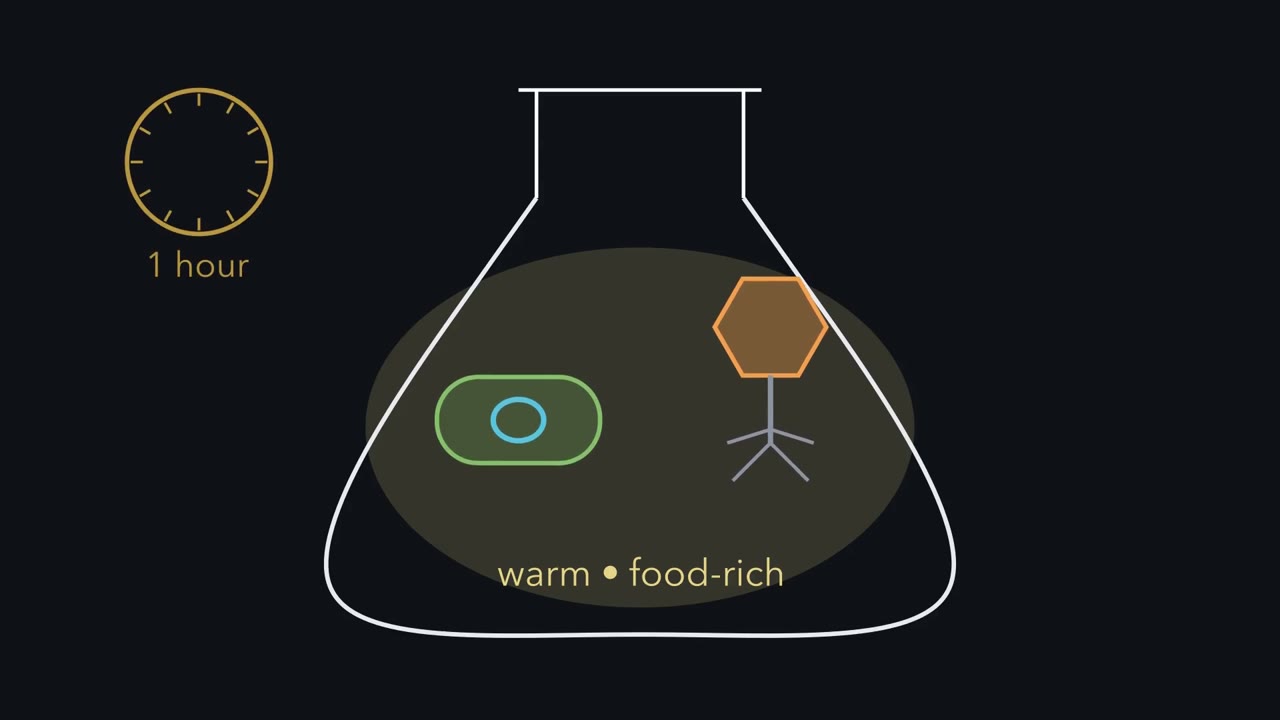
The first film ended with phage DNA inside a bacterium, and the cell building phage parts. So how does one phage, which never divides, become many? Scientists tested this. They infected bacteria with phages, then broke some cells open at different times. Each time, they looked for whole phages. Early in the infection, the cells already hold plenty of phage material. How many whole phages will they find inside?
None. There are phage parts, but no whole phages. So a phage is not split from a parent. It is built from parts. Later, the parts are put together into many new phages. Then the cell bursts open. The new phages escape, and the host cell dies. This path is the lytic cycle. The phage takes over now. The host builds new phages, and then the cell bursts to release them. Some phages have a second path. The best known is phage lambda, which infects E. coli. Its DNA does not have to take over right away. Lambda's orange DNA slips into the blue chromosome and becomes part of it. Stored viral DNA like this is called a prophage. The cell stays alive and keeps dividing by binary fission.
Each time, it copies its chromosome, prophage and all. Both new cells get a copy. Here is the counter from the first film. One cell, two, four, eight, sixteen, each one carrying the orange DNA. Now look at the second counter. New phages: zero. The viral DNA multiplies by riding along with the host's doubling. This path is the lysogenic cycle. The prophage can stay for many generations. But something such as damage to the cell's DNA can switch it into the lytic cycle. In that one cell, the host now builds new phages. The cell bursts and dies. The other cells carry on, prophage and all. So the two paths do not have to end the same way. The lytic path builds new phages now.
The lysogenic path copies only the phage DNA, maybe for many generations. New phages come only if it switches to lytic, which may never happen. Here is the rule to keep. A virus never builds itself. For lambda's two paths, a host cell builds new phages only on the lytic path.
One bacterium can become millions of cells in an afternoon, yet a virus never divides at all. How, then, can a cold sore heal and come back in about the same spot?
Continue in the lesson: How Microbes Multiply →
3:04 · Free, with captions and a transcript. The lesson has the full text, the questions and the sources.
More films from this lesson
How this film was made. Narration: an AI narrator voice (Kokoro, af_heart) reading narration written from this lesson's text. Animation: AI-generated in code (Manim) by Claude, a schematic with no drawn molecular structures. Captions come from the narration script. See something wrong? Report it.