Copy Yourself, or Be Copied
Read the transcript of “Copy Yourself, or Be Copied”
Film transcript: Copy Yourself, or Be Copied
One bacterium and one virus land in a warm flask full of food. An hour later, which has made more of itself? And how did it do it? Start with the bacterium. It is a single cell, with its DNA in one loop called the chromosome. There is no nucleus around it. First the cell copies its chromosome. Then it grows longer, with one copy at each end. Then it pinches in the middle and splits in two. This is binary fission. Each new cell gets a complete copy of the chromosome. So the two cells match, except for rare copying mistakes. Now each new cell does the same thing. One becomes two. Two become four, then eight, then sixteen. Every round doubles the count.
The time for one round is called the doubling time. In the best lab conditions, an E. coli cell can double about every 20 minutes. Keep that pace for seven hours, with no cells dying. Will one cell become closer to a thousand cells, or closer to a million?
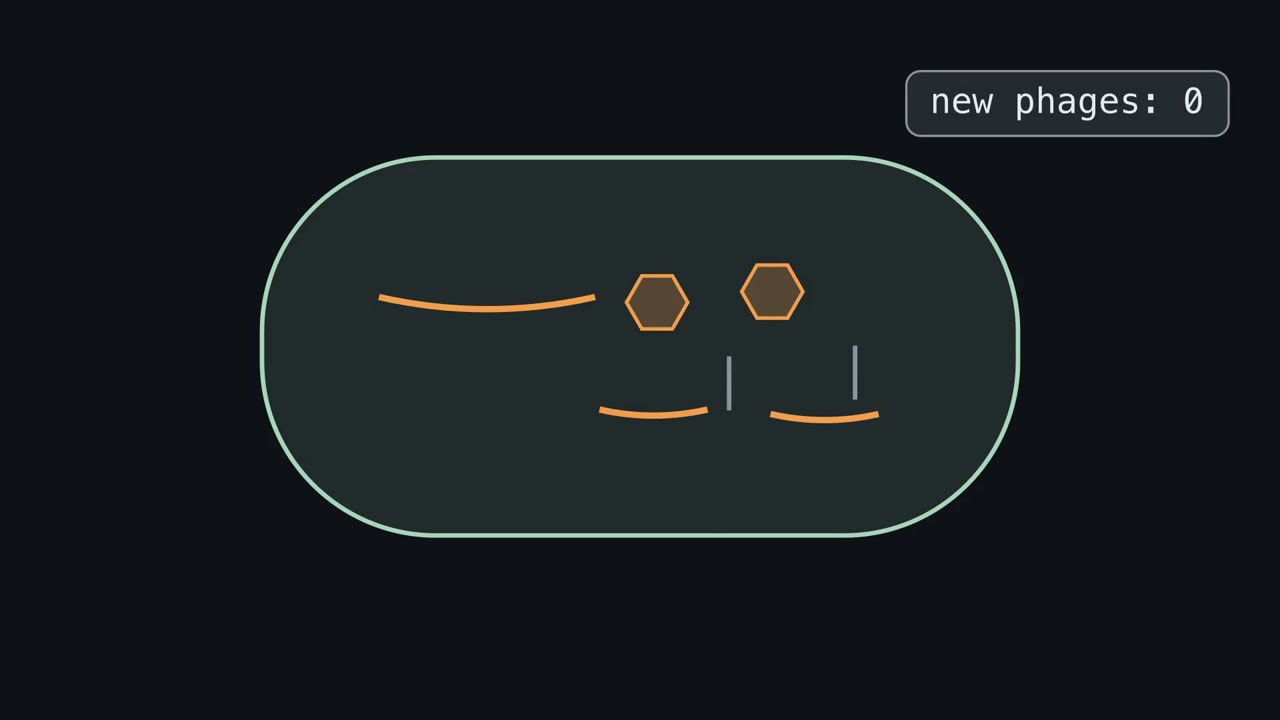
More than a million. The counter reaches 21 doublings, about two million cells. That is a calculated number, not a count of real cells. But a real flask is closed. As the cells multiply, they use up the food. Their wastes build up in the liquid around them. So the climb slows, and the count levels off. Doubling makes numbers huge, but only while food lasts and wastes stay low. Now the virus. This one is a phage, a virus that infects bacteria. Left alone in all that food, what does it do? Nothing. It does not grow. It does not split. It cannot make anything on its own. Its counter stays at one. Then it lands on a bacterium and injects its DNA.
Soon, orange phage parts start to appear inside the cell. The phage is not making them. The cell is. The cell reads the phage genes as if they were its own, and builds phage parts. So the two multiply in opposite ways. The bacterium grows and splits on its own. The virus never divides. A host cell builds every new virus. Here is the one rule to keep from this film. A bacterium copies itself. A virus is copied by a host cell, never by itself.
One bacterium can become millions of cells in an afternoon, yet a virus never divides at all. How, then, can a cold sore heal and come back in about the same spot?
Continue in the lesson: How Microbes Multiply →
3:05 · Free, with captions and a transcript. The lesson has the full text, the questions and the sources.
More films from this lesson
How this film was made. Narration: written from this lesson's text and read by an AI narrator voice (Kokoro, af_heart). Animation: AI-generated in code (Manim) by Claude, a schematic with no drawn molecular structures. Captions come from the narration script. See something wrong? Report it.