Floors and Brackets
Read the transcript of “Floors and Brackets”
Film transcript: Floors and Brackets
The first film put dates on its fossil flags and on the last cliff. But how can a rock say when a bone was buried, with no one there to see? Fossils are rarely dated directly. Often, minerals in the rocks around them are. A favourite is zircon. It crystallizes in molten rock, and an eruption carries it into volcanic ash. As zircon crystallizes, it takes up uranium but almost no lead. So nearly all the lead inside it comes from later decay. Each uranium atom has the same small chance of decaying in any given year. So half the parent atoms decay in a fixed time, the half-life. It is constant for each isotope. Watch the grid. On average, after one half-life, half the uranium has become lead.
After the next, half of what was left. The crystal keeps time from the moment it formed. Suppose the crystal stayed closed and started with no lead. Then the parent left and the lead built up count the half-lives. That count gives the age. Now take a stack of rock layers. A bed of fossils lies between two layers of volcanic ash. Each ash can be dated by its zircons. In undisturbed layers, younger ones settle on top of older ones. So the oldest lies at the bottom. How old, then, are the fossils between the two ashes?
Younger than the ash below, and older than the ash above. The answer is a bracket, not a single date. Now look at the oldest known fossil of a group. It shows the group was here by then. It does not show when the group began. Earlier members may never have been preserved, or may not have been found yet. So a first fossil is a floor, a minimum age. The group may be older. Oxygen in the air is a different kind of date. The start of the Great Oxidation Event was bracketed by dated volcanic rocks, from both sides. The clock must also fit the age.
Carbon-14 decays quickly. Long before the age of dinosaurs, too little is left to measure. So dinosaur bones are not carbon-dated. Where volcanic ash lies near them, slower clocks date those layers. Elsewhere, other methods tie the rocks to dated layers. Two kinds of date run through this lesson. Dated layers around a fossil give a bracket. A group's oldest known fossil gives a floor.
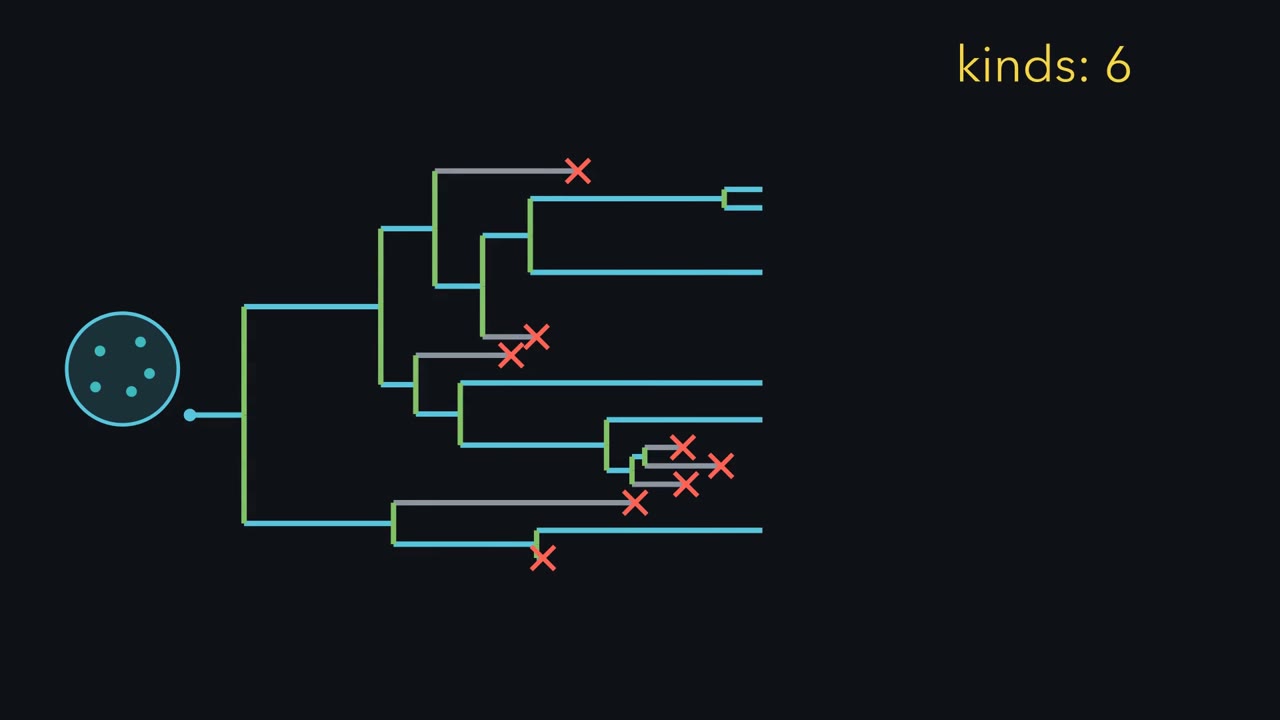
Species have been dying out for as long as there has been life. So how did a planet of microbes end up with so many kinds of living things?
Continue in the lesson: History of Life: Transitions, Extinctions and Radiations →
3:06 · Free, with captions and a transcript. The lesson has the full text, the questions and the sources.
More films from this lesson
How this film was made. Narration: an AI narrator voice (Kokoro, af_heart) reading narration written from this lesson's text. Animation: AI-generated in code (Manim) by Claude, a schematic with no drawn molecular structures. Captions come from the narration script. See something wrong? Report it.