Births Minus Deaths
Read the transcript of “Births Minus Deaths”
Film transcript: Births Minus Deaths
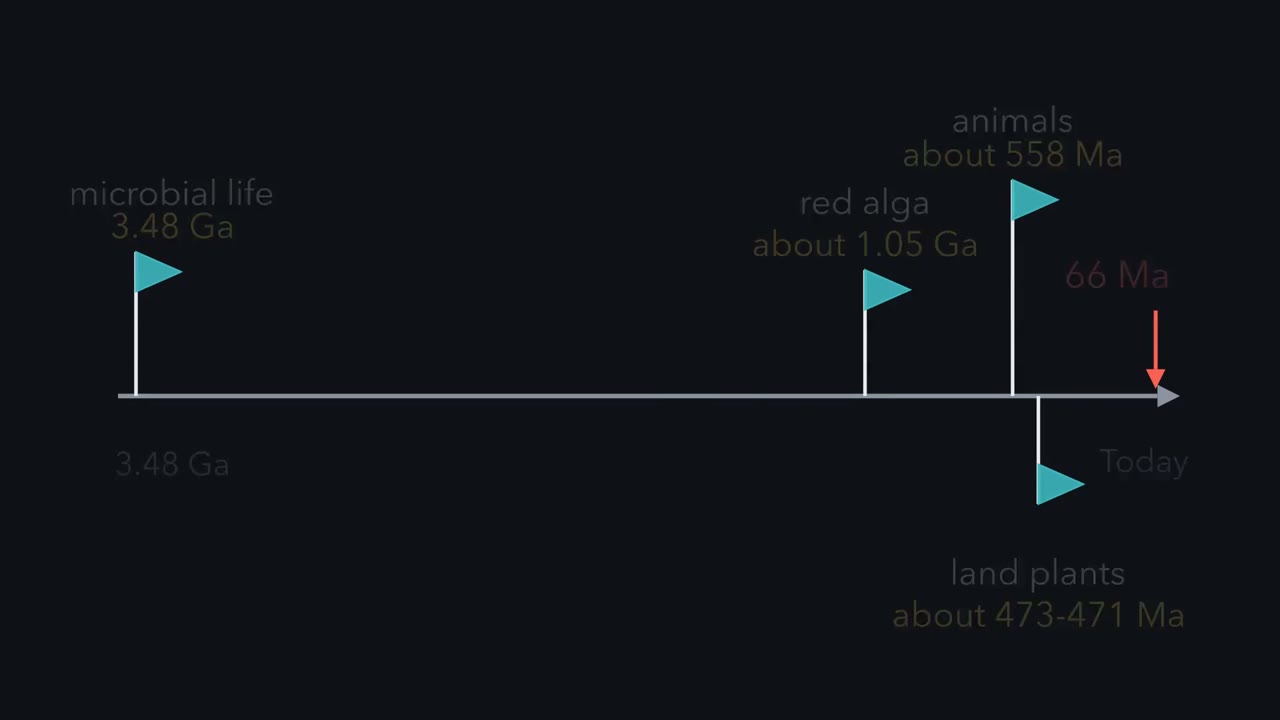
Species have been dying out for as long as there has been life. So how did a planet of microbes end up with so many kinds of living things? In a simple model, only two events change the count of lineages. A new lineage branches off: speciation. Or a lineage ends: extinction. So the count changes by births minus deaths: the net rate r is λ minus μ. If both rates are high and nearly equal, lineages turn over fast while the total creeps up. A slow total alone cannot reveal the two rates. Now stretch the time axis back to life's earliest traces. For most of that time, life was microbial. New kinds arrive later, as flags. Each flag marks an early fossil record: by this time, at the latest.
Oxygen in the air is a band instead, a change dated from both sides. In the most recent stretch, five drops are called the Big Five mass extinctions. By the benchmark on screen, each lost most species, quickly. How sharply each stands out is debated. Take the last cliff, the end of the Cretaceous. What tipped the balance? Alvarez and colleagues found extra iridium in boundary rocks at three distant sites. Iridium is scarce in Earth's crust, but richer in many meteorites. They proposed, as a hypothesis, that an asteroid struck. That predicted a crater of the right age. A buried crater, Chicxulub, was found in Mexico.
Dating tied impact and extinction closely in time. The evidence points to the impact as the trigger. Volcanic eruptions in India, the Deccan flood basalts, overlapped in time, and both causes were weighed. After the cliff, survivors can spread into emptied niches. Placental mammals diversified mainly afterward. But timing alone cannot show why. The fossil record cannot be rerun. Bacteria can. Rainey and Travisano grew one genotype of Pseudomonas fluorescens in two kinds of flask. One flask sits still, so the broth changes from the surface down. The other is shaken and stays uniform. Which will grow new types?
Only the still flask. New heritable types arose and settled into different zones. One, the wrinkly spreader, mats the surface. The shaken flask kept only the smooth type. Open niches plus heritable variation gave repeatable diversification. These were new types of one bacterium, not new species. So diversity changes by births minus deaths. Mass extinctions are short intervals when deaths far outrun births. Then survivors can diversify into the space left behind.
Species have been dying out for as long as there has been life. So how did a planet of microbes end up with so many kinds of living things?
Continue in the lesson: History of Life: Transitions, Extinctions and Radiations →
3:30 · Free, with captions and a transcript. The lesson has the full text, the questions and the sources.
More films from this lesson
How this film was made. Narration: written from this lesson's text and read by an AI narrator voice (Kokoro, af_heart). Animation: AI-generated in code (Manim) by Claude, a schematic with no drawn molecular structures. Captions come from the narration script. See something wrong? Report it.