A Net, a Lineage and a Mouse That Cannot Say
Read the transcript of “A Net, a Lineage and a Mouse That Cannot Say”
Film transcript: A Net, a Lineage and a Mouse That Cannot Say
A mouse cannot say a touch feels nice. Which of its cells detect a stroke, and what can we measure? In mouse hairy skin, at least three afferent classes are candidates for detecting a stroke. First, unmyelinated touch afferents marked by tyrosine hydroxylase. Their endings run lengthwise along a hair follicle. Second, unmyelinated neurons marked by a receptor called MrgprB4. Their fibres innervate hairy skin only. Third, Aβ beta field afferents. They are myelinated, and their endings wrap around the follicle. A field afferent ignores any single hair. Indenting the skin drives it only at high force.
But one neuron can form as many as 180 endings, around many follicles. Predict. What does a gentle stroke across the skin do to this neuron? It fires. The authors proposed that it sums many weakly sensitive endings. A single hair is a lever. A field afferent is a net.
Now the outcomes. Activating MrgprB4 neurons gave young male mice a place preference. The authors read this as positive reinforcement, reduced anxiety, or both. Adult females whose lineage of these cells was removed during development were less sexually receptive.
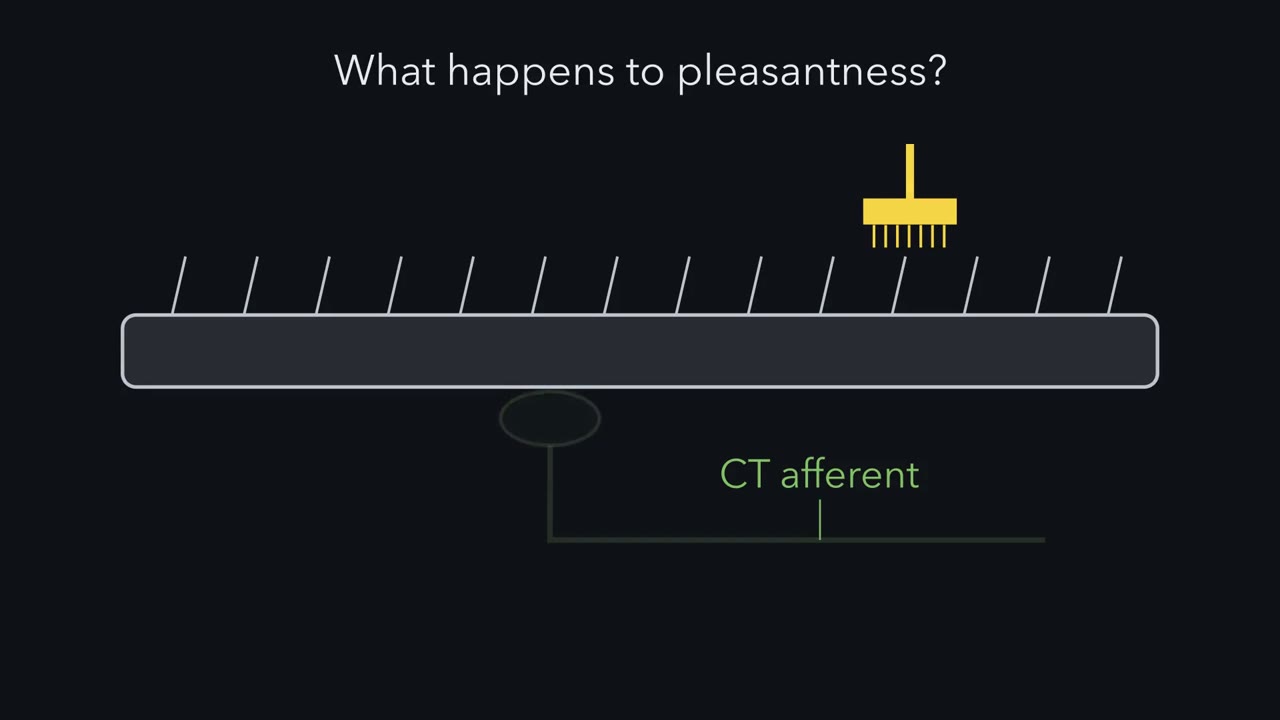
A permanent genetic label marks neurons that once expressed the gene, including some that no longer do in adults. And a dopamine-sensor signal in the nucleus accumbens was reduced during mounting. A chamber preference, a mating behaviour, a dopamine signal. Each is an outcome, not a feeling. Back to the one idea. In people, one fibre has a caress-shaped curve that pleasantness follows.
Which mouse cell, if any, matches that human fibre is still unsettled. Keep the human candidate and the mouse outcomes apart until a match is made.
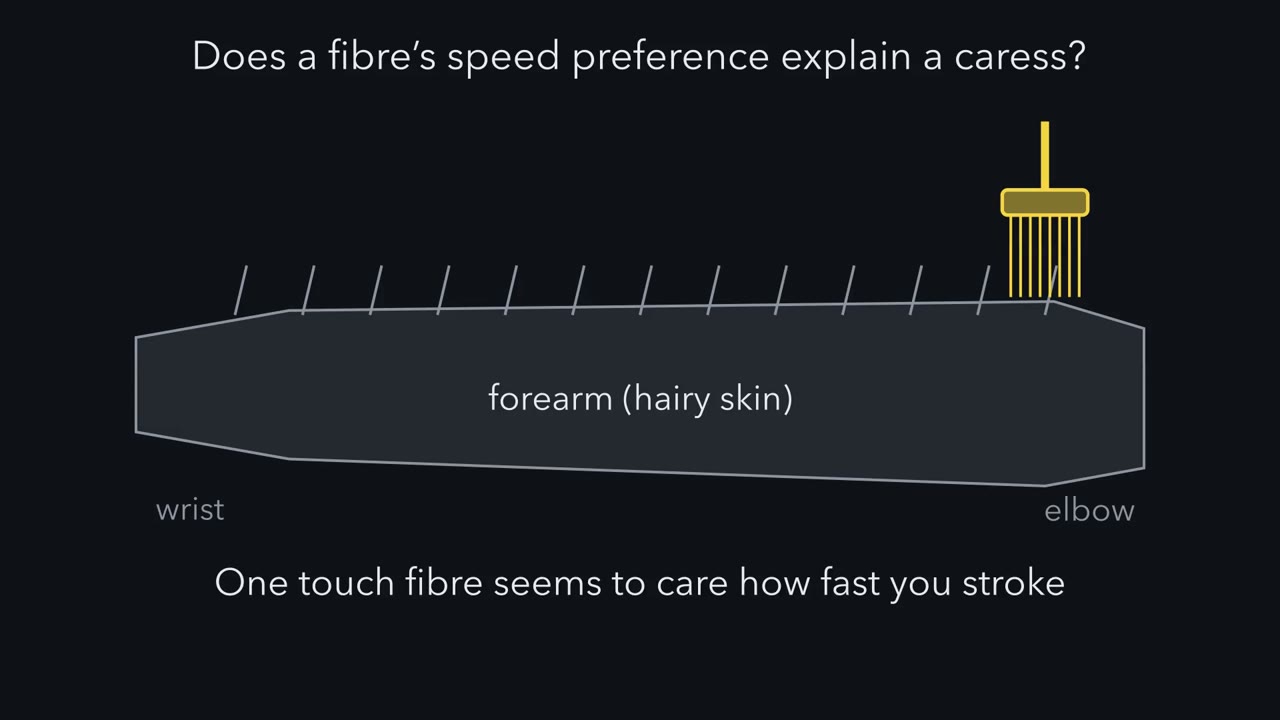
Brush a forearm at a few centimetres per second and one slow, unmyelinated fibre fires hardest. Is that why it feels nice?
Continue in the lesson: Hairy Skin, Stroking and Affective Touch →
2:28 · Free, with captions and a transcript. The lesson has the full text, the questions and the sources.
More films from this lesson
How this film was made. Narration: an AI narrator voice (Kokoro, af_heart) reading narration written from this lesson's text. Animation: AI-generated in code (Manim) by Claude, a schematic with no drawn molecular structures. Captions come from the narration script. See something wrong? Report it.