How the Timer Breaks
Read the transcript of “How the Timer Breaks”
Film transcript: How the Timer Breaks
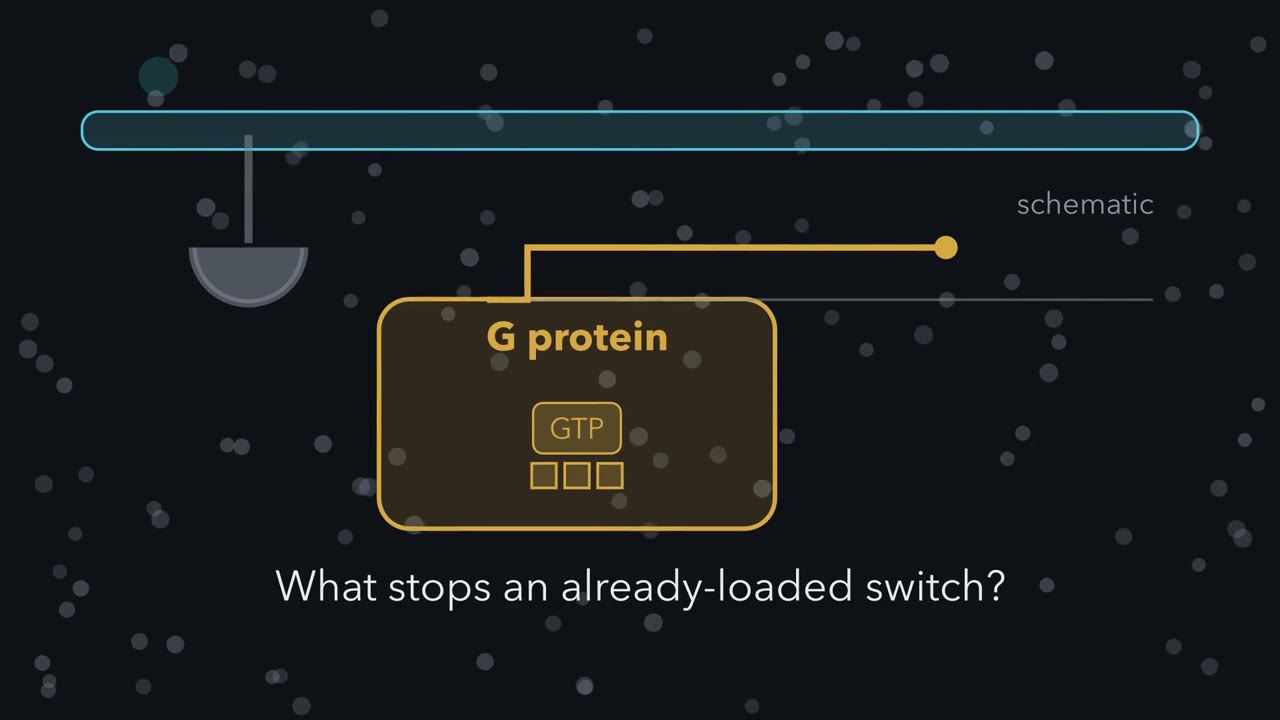
The first film followed a gold, GTP-loaded switch until cutting turned it slate. If cutting ends that interval, what happens when something blocks the cut or speeds it up? Use the same colors and the same switch. Begin with the ordinary cycle. A teal loading event starts a gold interval. Intrinsic cutting later removes the final phosphate, leaving GDP and ending the interval. This is our neutral reference for every perturbation. Replace GTP with an analogue the protein can bind but cannot cut. Loading still turns the switch on. Nothing changes at the loading arrow. The off event fails, so the gold interval persists after receptor input ends. Cholera toxin reaches the same logic through Gs.
Its modification obstructs Gs alpha's hydrolysis, so adenylyl cyclase remains active and cyclic AMP stays elevated. The timer stalls downstream of the receptor. Now add extra RGS protein to an already-loaded G alpha that this RGS can regulate. All other parts begin matched. Should its active interval grow longer, grow shorter, or stay unchanged?
Shorter. RGS accelerates cutting for the Gi and Gq families. The final phosphate leaves sooner, so the block returns to slate earlier. That family boundary matters. RGS does not have this effect on Gs. Ras G12V breaks GAP-assisted cutting differently.
GAP may bind, but the catalytic arrangement fails. This is catalytic failure, not missing GAP. Ras therefore remains GTP-bound far longer than normal. Ras Q61, shown beside it, also weakens cutting, even without GAP. Both mutants keep the gold interval abnormally long. They damage the off route, although their detailed defects differ. Dominant-negative Ras S17N is the mirror image. It binds GTP poorly and fails to activate targets. That failure sits on the loading side. It may also hold exchange factors away from normal Ras. Sort every case by its changed arrow. The analogue, toxin, and activating Ras mutants obstruct cutting.
Extra RGS accelerates cutting only for its substrates. Dominant-negative Ras impairs loading. One cycle can therefore organize every case. This classification predicts direction, not the exact shape of every cell response. Receptor shutoff, target kinetics, and messenger clearance still contribute. The map keeps that limit visible. First locate the changed step, then judge the trace. A lasting signal is therefore not mysterious once the cycle is mapped. Ask whether loading increased, cutting slowed, or clearance changed. The same map prevents blaming the receptor automatically.
The position of the defect determines the prediction.
After a receptor lets go, what decides how long an already-loaded G protein keeps signaling?
Continue in the lesson: GTPase Switches: The Timer →
3:45 · Free, with captions and a transcript. The lesson has the full text, the questions and the sources.
More films from this lesson
How this film was made. Narration: an AI narrator voice (Kokoro, af_heart) reading narration written from this lesson's text. Animation: AI-generated in code (Manim) by Claude, a schematic with no drawn molecular structures. Captions come from the narration script. See something wrong? Report it.