Above, At, or Below Basal
Read the transcript of “Above, At, or Below Basal”
Film transcript: Above, At, or Below Basal
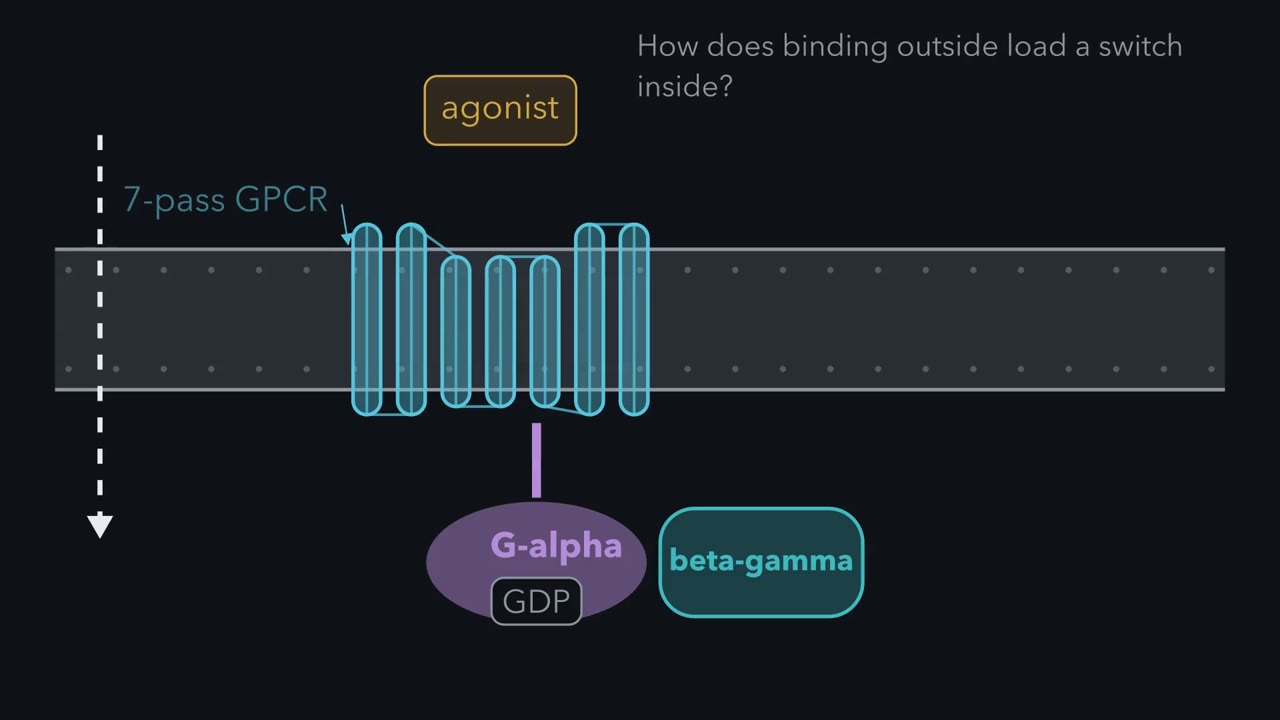
The first film followed a receptor as it loaded a G protein. If an empty receptor already signals, where can a ligand move the response? A receptor population can signal even when every binding pocket is empty. Individual receptors sample less-active and more-active shapes. If some active shapes engage G proteins, the population produces basal activity. That starting signal becomes the reference for classifying what a ligand does. An agonist raises signaling above that line. In the simple picture, it favors the more-active receptor population. Gold agonist blocks settle into open receptor pockets. More receptors remain signaling-competent, so the meter rises.
Agonist describes the measured effect, not merely the ability to bind. A neutral antagonist behaves differently. By itself, it leaves basal signaling approximately unchanged. Its job appears when another ligand arrives. Antagonist blocks occupy the pockets, so the incoming agonist finds few free receptors. At this agonist dose, the meter stays near basal instead of rising. Neutral describes the drug's effect on basal activity. An inverse agonist moves the response below basal. In the simple picture, it favors the less-active receptor population. Red-edged ligand blocks settle into those receptors. Fewer receptors engage G proteins, and the meter falls.
The prefix inverse refers to signaling direction, not to opposite binding. Now remove measurable basal activity from the assay. The meter starts at zero. A neutral antagonist cannot lower it. Neither can an inverse agonist reveal a further decrease. Added alone, they look the same. Distinguishing them requires a receptor system with a visible basal signal. Real ligands can produce intermediate changes, even at a saturating concentration.
Carazolol, bound in inactive β2-adrenergic receptor structures, is a partial inverse agonist. In an assay, it lowers basal signaling without producing the full reduction possible there. Efficacy means the response a bound ligand can produce. Partial describes its efficacy in that measured pathway, not incomplete binding in this assay. The active-versus-inactive picture is a useful first model, not a claim of only two rigid structures. Receptors sample ensembles of shapes. Efficacy is measured for one response in one cell. A ligand classed in one assay may class differently in another. Keep the meter and assay beside the receptor whenever you name efficacy.
Use one reference line and three questions. Does the ligand raise signaling above basal? Does it leave basal unchanged while blocking another ligand? Or does it lower signaling below basal? Those observations separate agonism, neutral antagonism, and inverse agonism without pretending the receptor is a simple switch.
Adrenaline strengthens the heartbeat but relaxes the airways. How can the same hormone give opposite orders?
Continue in the lesson: GPCRs and Trimeric G Proteins →
3:54 · Free, with captions and a transcript. The lesson has the full text, the questions and the sources.
More films from this lesson
How this film was made. Narration: an AI narrator voice (Kokoro, af_heart) reading narration written from this lesson's text. Animation: AI-generated in code (Manim) by Claude, a schematic with no drawn molecular structures. Captions come from the narration script. See something wrong? Report it.