The Climbing Line
Read the transcript of “The Climbing Line”
Film transcript: The Climbing Line
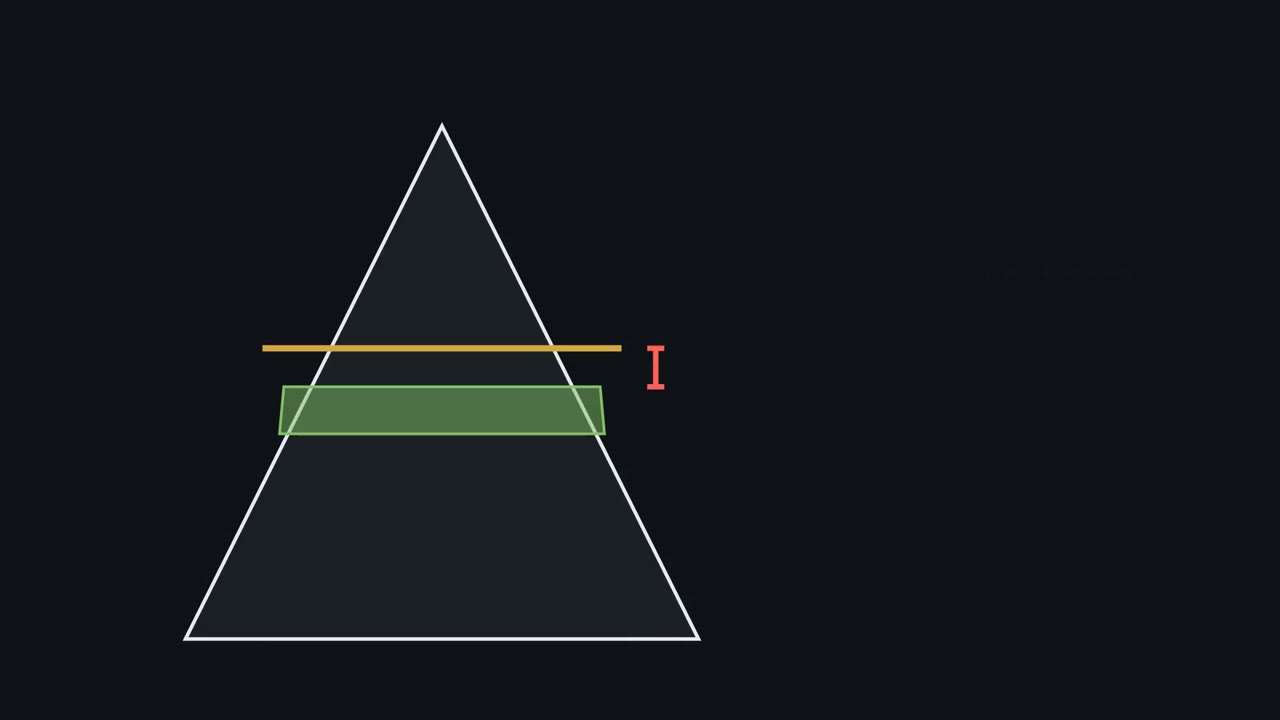
A mountain warms by 0.3 °C each decade. How far uphill must the beetles' range shift, to stay as cool as before? Picture the slope as stacked bands of temperature, warm at the bottom and cool at the top. The gold line is an isotherm, a line of equal temperature. This beetle lives only where it is cool enough. So the gold line marks the lower edge of its range, the warm edge. Now warm the whole mountain. Every band slides upward, and the gold line climbs with them. The beetle's climate is on the move. How fast does the line climb? That depends on how quickly air cools with height, a slope's lapse rate. Here it cools 0.6 °C every 100 metres. Divide the warming rate by the lapse rate.
The result is the climate velocity, the speed of the isotherm. On this slope, it is fifty metres uphill each decade. Now let the population move, as beetles settle higher and low ones die out. The green band climbs, but slower than the gold line. The red bracket between band and line is the gap. Each decade the line pulls further ahead. If the beetles started in step, the gap is the difference in speeds, times the time. So moving is not the same as keeping up. A range keeps up only by moving as fast as its isotherm. Now set a flat plain beside it. There, temperature changes toward the pole, and far more slowly with distance. So on the flat, how far toward the pole gives the same cooling as one metre uphill?
A metre, a hundred metres, or about a kilometre? In one European example, about a kilometre and a half. A short climb buys the cooling of a long journey. The exchange rate varies by place. So raw distances cannot say which shift kept up. Each shift is judged against its own isotherm, on its own slope or plain. A 2011 synthesis pooled many studies of land species. The median shifts were about 17 kilometres poleward and 11 metres uphill each decade. But the medians hide wide variation. Some species ran ahead of their isotherm, and many lagged behind it. One last warning. For a forest beetle, clearing the lower slope can lift the range's bottom edge, whatever the temperature does.
A shift shows change, not its cause. A range keeps up only by moving as fast as its isotherm.
A mountain warms 0.3 C in a decade. How far uphill must a beetle's range shift to stay as cool as before?
Continue in the lesson: Global Change: Species on the Move →
3:08 · Free, with captions and a transcript. The lesson has the full text, the questions and the sources.
More films from this lesson
How this film was made. Narration: written from this lesson's text and read by an AI narrator voice (Kokoro, af_heart). Animation: AI-generated in code (Manim) by Claude, a schematic with no drawn molecular structures. Captions come from the narration script. See something wrong? Report it.