Films · Genetics and Molecular Biology
How Codons Become a Chain
Read the transcript of “How Codons Become a Chain”
Film transcript: How Codons Become a Chain
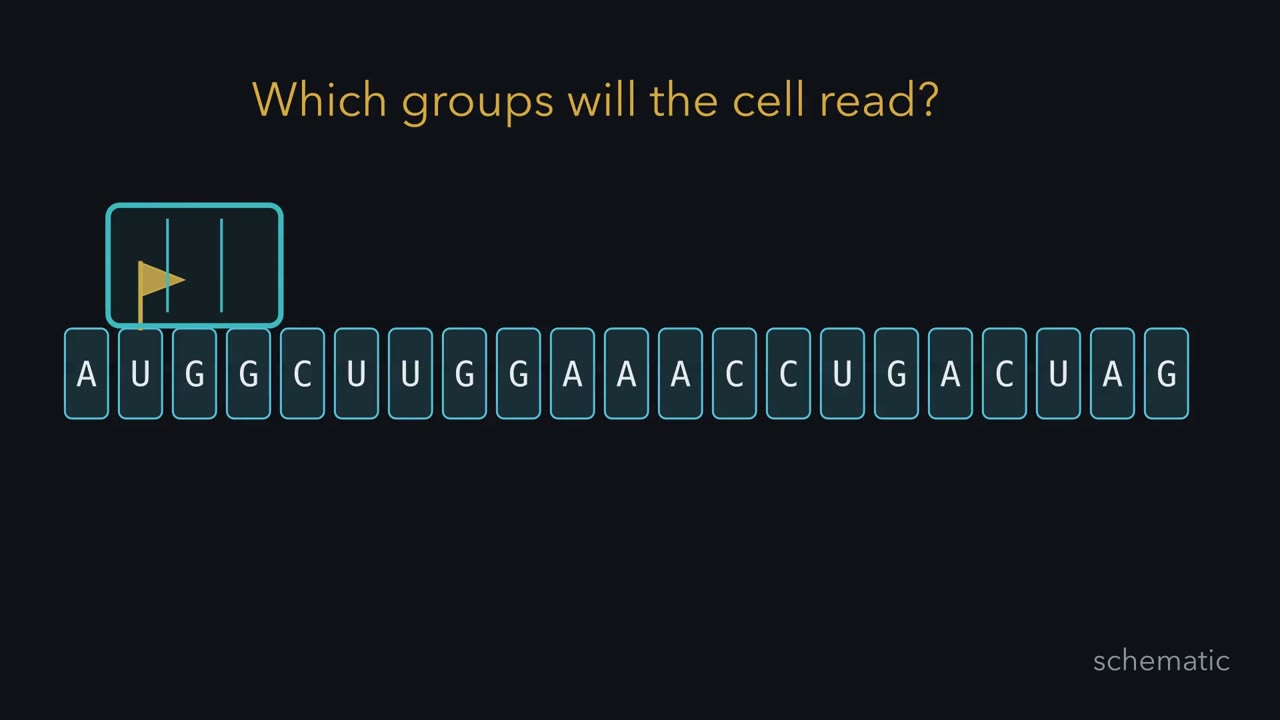
The first film fixed the codon boxes. How does each box choose an amino acid? Keep the same blue message, gold start, and teal reading window. Now add the adaptor that connects sequence to protein. A transfer RNA has two working ends. Its anticodon can pair with a codon. Its other end carries an amino acid. The adaptor keeps both identities physically linked as it moves. Before the adaptor reaches a ribosome, an aminoacyl transfer RNA synthetase usually loads it. The enzyme selects an amino acid and the transfer RNA meant to carry it. Some synthetases also remove mistakes. Translation therefore depends on separate checks. The synthetase chooses the cargo.
At the ribosome, the anticodon tests the codon. The growing chain receives whatever cargo arrived on the accepted adaptor. Charged transfer RNAs connect codons to the growing protein. Predict this case. A transfer RNA carries the wrong amino acid, but its anticodon matches the codon. Will the ribosome reject the adaptor, or accept it?
The pairing check passes. The ribosome does not inspect the amino acid itself. The wrong cargo can enter the chain. Accuracy therefore depends on charging before the ribosome and pairing at the ribosome. Now follow a cycle. The P site holds the transfer RNA carrying the growing chain. The A site receives a charged adaptor whose anticodon matches the next codon. The E site is the exit. The large subunit transfers the chain onto the amino acid in the A site. Then the ribosome advances by a codon. The chain-bearing adaptor moves into the P site, while the empty adaptor reaches the E site and leaves. The ribosome is not merely a track. Its large-subunit RNA positions the two transfer RNA ends and catalyzes peptide-bond formation. The reaction occurs in an RNA-lined pocket.
That is why the ribosome is called a ribozyme. The same blue ribbon moves through the teal window. Each accepted adaptor adds a green block, so the chain grows in codon order. The ribosome repeats the cycle without changing the frame. When a stop enters the A site, a release factor arrives instead of a transfer RNA. The completed chain leaves, and the ribosome can be recycled. The stop adds no amino acid. The codon never touches its amino acid directly. A charged adaptor makes the connection, while the ribosome preserves the order. The adaptor carries identity from the code to the chain.
How can one added base regroup every codon that follows, while one substituted base may change no amino acid at all?
Continue in the lesson: The Genetic Code and Translation →
3:27 · Free, with captions and a transcript. The lesson has the full text, the questions and the sources.
More films from this lesson
How this film was made. Narration: an AI narrator voice (Kokoro, af_heart) reading narration written from this lesson's text. Animation: AI-generated in code (Manim) by Claude, a schematic with no drawn molecular structures. Captions come from the narration script. See something wrong? Report it.