Films · Genetics and Molecular Biology
The Frame Sets the Message
Read the transcript of “The Frame Sets the Message”
Film transcript: The Frame Sets the Message
How can an added base regroup every downstream codon? The answer lies in how a cell divides a continuous message. Watch the same ribbon throughout this film. Its letters will stay fixed until we deliberately change them.
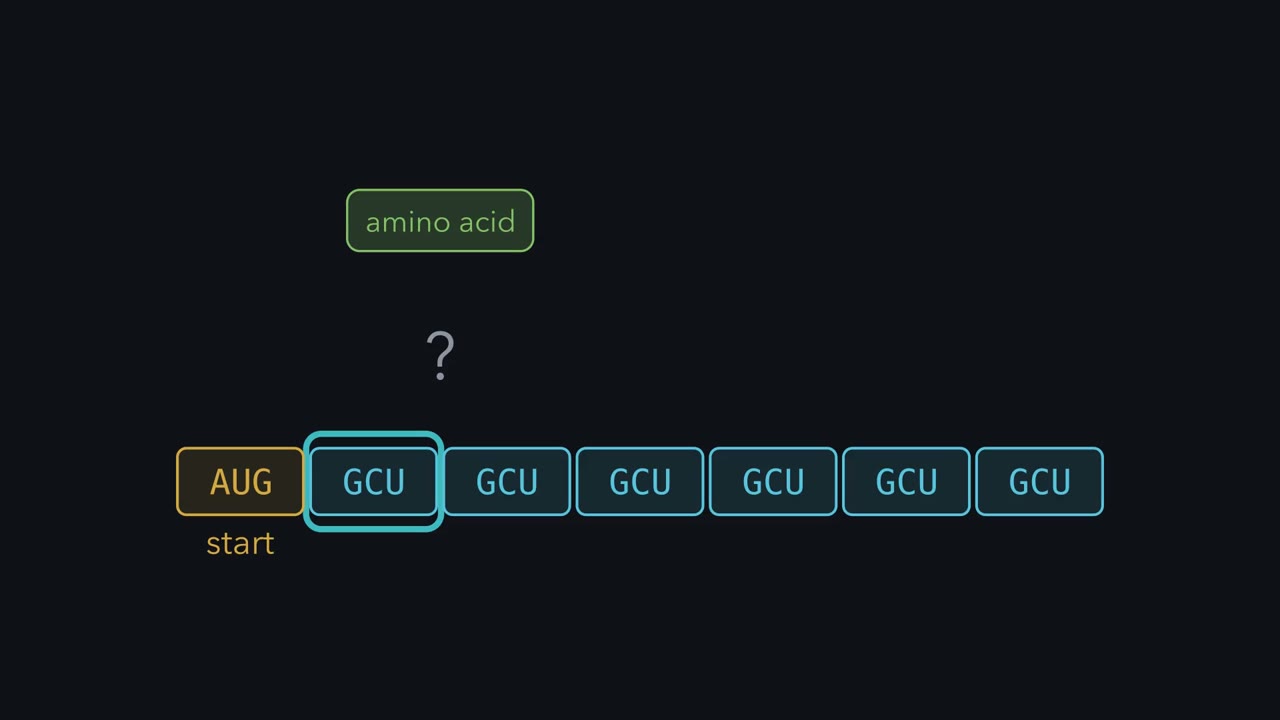
A ribosome needs a starting place. Once initiation selects that site, a teal reading window locks onto the message. The window covers a triplet, then advances to the next nonoverlapping triplet. Each window position is a codon. The frame is the alignment between that window and the ribbon. Start at a different base, and every box contains different letters. Start at the same base, and the boxes remain fixed as the window moves. A fixed start makes each next triplet a codon. One base or two bases make too few words for all the amino acids. Triplets make enough. So fixed-length words must be at least triplets. Only experiments could test the real reading unit.
Now replace a base inside a codon. The surrounding boundaries do not move. That codon may keep the same amino acid, specify another amino acid, or become a stop. Later codons keep their original grouping. Predict what happens if a base is inserted after the start. Will only the nearest codon be regrouped, or will every downstream codon be regrouped? Hold the reading window still and follow the ribbon.
The new base joins the ribbon. Every downstream letter slides relative to the fixed window. New triplets appear all the way along, until a stop ends translation. This is a frameshift: the grouping changed, not merely a letter. Researchers called the shift classes plus and minus. A nearby plus and minus often restored function after a disrupted stretch. Same-sign shifts did not restore the frame until a complete triplet's worth accumulated. The later message then returned to its earlier grouping. In phage experiments, those patterns often restored gene function. They supported a fixed reading point and a triplet, or a multiple. Genetics supported a fixed frame, but did not assign the dictionary.
Cell-free translation and ribosome-binding tests linked defined RNA messages to amino acids. Together, the evidence turned moving boxes into codons with assignments. A substitution can alter a codon without moving later boundaries. An insertion or deletion that is not a multiple of three moves the downstream frame. The lasting lesson is simple. Keep the starting register, and every later codon keeps its place.
How can one added base regroup every codon that follows, while one substituted base may change no amino acid at all?
Continue in the lesson: The Genetic Code and Translation →
3:21 · Free, with captions and a transcript. The lesson has the full text, the questions and the sources.
More films from this lesson
How this film was made. Narration: written from this lesson's text and read by an AI narrator voice (Kokoro, af_heart). Animation: AI-generated in code (Manim) by Claude, a schematic with no drawn molecular structures. Captions come from the narration script. See something wrong? Report it.