From Sprouts to Seed-Making Trees
Read the transcript of “From Sprouts to Seed-Making Trees”
Film transcript: From Sprouts to Seed-Making Trees
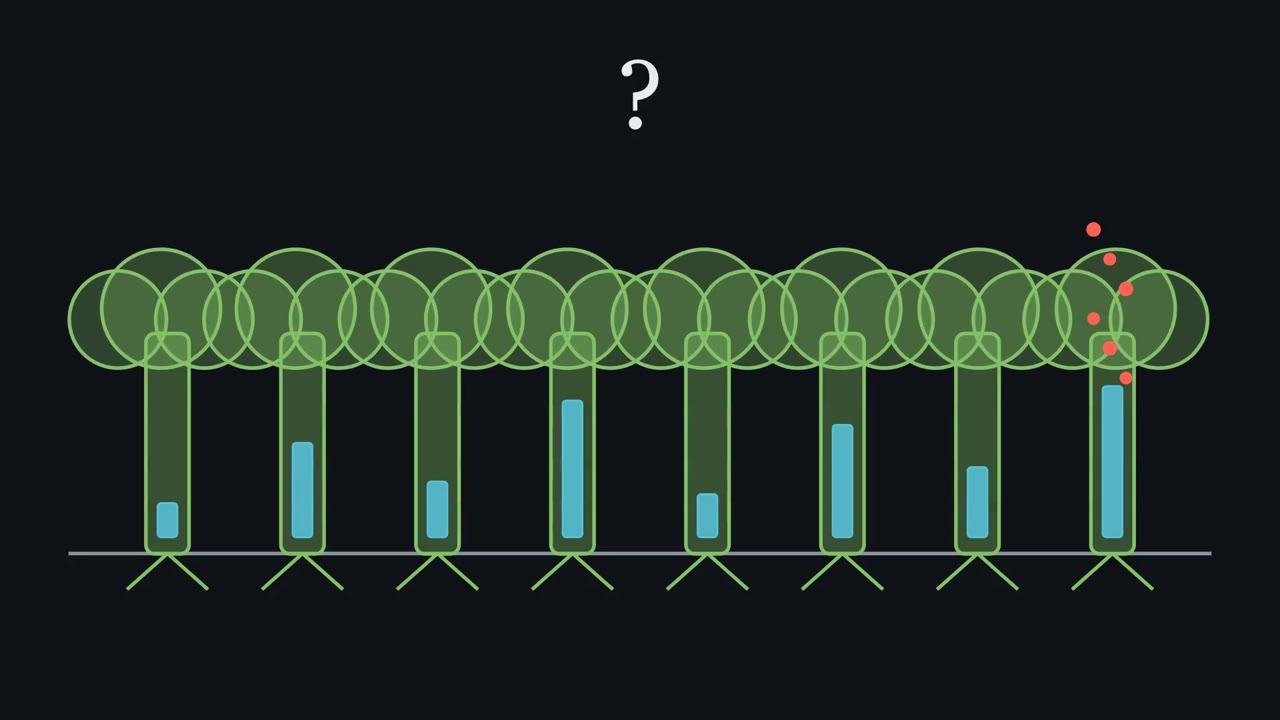
The first film showed that a population needs survivors that reproduce. American chestnut roots still send up living sprouts. Why has that population not recovered? Keep the same colors. Green marks living chestnut tissue, red marks blight, blue marks inherited resistance, and yellow marks seeds. A green root remains underground. It sends a leafy sprout upward. Red fungus grows into a crack in the bark. A canker widens around the young trunk. The trunk above it fades grey, while the protected root stays green. Soon that root sends up another sprout. The cycle repeats. The forest contains living chestnut stems, but the sprouts rarely become seed-making canopy trees. Living stems alone do not show that the population is recovering.
Freeze the cycle after a new sprout appears. No yellow seeds are present. If every sprout dies before making seeds, can these sprouts rebuild a lasting population? No. Each green sprout proves that living tissue remains, so the species is not extinct. But if sprouts die before making seeds, no new generation replaces the old roots. In the wild, few sprouts make seeds.
Survival requires survivors to reproduce, not merely remain alive. How might people change that path? Breeders begin with American chestnuts and Chinese chestnuts that resist blight better. They cross the trees. Then they expose the offspring to blight. Blue resistance bars differ among the offspring. People choose the most resistant young trees. Then they cross those back to American chestnuts and test again. That is artificial selection. People choose which trees reproduce, instead of letting the environment alone decide. The goal is not simply more differences. It is inherited resistance strong enough to help trees survive, make seeds, and grow a next generation.
Other traits still matter, but they cannot replace resistance to this fungus. Crossing does not promise recovery. Breeders need repeated tests across many families and sites. These tests ask how well young trees survive and resist blight. Some scientists have also tried adding one gene from wheat. In tests, it helped American chestnuts resist blight. That work is still being checked. Both paths ask one question. Will enough trees survive, reproduce, and keep reproducing? Return to the underground root. A sprout alone keeps the past alive. Seed-making trees can begin the future. For this forest, recovery means living through blight and producing the next generation.
That is why the chestnut can remain alive yet fail to recover. The rule for this film is narrower: survival requires survivors to reproduce, not merely remain alive.
American chestnut trees were once common in Virginia’s Blue Ridge. Why did a fungus nearly wipe them out, while their roots still send up sprouts today?
Continue in the lesson: Extinction and Survival →
3:41 · Free, with captions and a transcript. The lesson has the full text, the questions and the sources.
More films from this lesson
How this film was made. Narration: an AI narrator voice (Kokoro, af_heart) reading narration written from this lesson's text. Animation: AI-generated in code (Manim) by Claude, a schematic with no drawn molecular structures. Captions come from the narration script. See something wrong? Report it.